Utopia and the freeconomy

If money was our only motivation, only idiots would become teachers. Not that it would matter, since nobody would give birth to children in the first place. But what does this have to do with Utopia? Read and find out!

We are living in troubled times. There are wars and rumors of wars, and due to first high food prices and now the financial crisis, millions of people have sunk down into poverty over the last year or two. It is natural that many people living in this world today feel gloomy. And with unstable regimes gaining nuclear weapons – and some of them probably qualify as mentally unstable as well – the fears of massive destruction are returning a generation after the Cold War ended. It seems like a bad time to stand up and shout: “Turn your mind around, for Utopia is near! Listen to my words and let us together create a Golden Age!”

And yet, the objective truth is that we are living in an age of almost unbelievable affluence for much of mankind. Even as America and some nations that depended on her has had a bad year, economic growth in China remains far above what we in the west would call a boom. Many developing countries have continued to develop, as far as each of them was independent on western financing. And even in the valley of recession, most people in the West have a standard of living their grandparents could not have dreamed of. I know this because I was there, but there are plenty of books, old newspaper archives and movies from 50 years ago. It is a scientific fact that for all classes of western society, living standards have improved and life expectancy has increased. Yet we rarely celebrate this. A large part of the gloom is of our own making, then. We quickly adapt to what we have, but mourn our losses for far longer, and even feel the loss of what we never had. If we turned our mind around, we would already be living in a Golden Age. (I have cheated a little and already done this before I started writing, so I know this from experience.)

Today I want to write once more about a special part of the Golden Age, which I have mentioned before but not in this context. It is what we call the “freeconomy”. The word is obviously a combination of free (as in not costing anything to get) and “economy”. This is a poorly explored field, because it should not have existed according to most economic theories.

Economics is based on the notion that people will do anything for money and nothing without it. This is a fundamental misunderstanding of human nature. The ruling economic systems in the world today are based on a species that does not exist on our planet. This is rather famously said about communism, but it is to a large degree also true of capitalism. While more realistic than its eastern counterpart, capitalism is still breaking down past a certain point, namely the point where our physical needs are actually filled.

The fact is that when we have food, clothes, a roof and some such stuff, we start wanting to realize our inner nature. How much money this requires varies depending on each of our nature. Traveling is still fairly expensive, while there are other people whose inner nature manifests in making things from nothing and giving them away. Economic theory breaks down in face of such people. The solution society has found is to apply relentless pressure on the populace to create artificial needs through intense, manipulative advertising. If you have been away from television for months and get to see some of their ads, you will cringe at the crass and completely unrealistic message. But as long as almost everyone is bathed in this message from toddlerhood onward, it works, keeping people down in in an artificial state of need.

When I call modern emotional advertising satanic, I am not merely using the word mythologically, but quite literally. The Hebrew word “satan” supposedly means “adversary, one who plots against another”. These people pretend to be helpful to you, but their success depends on keeping you from discovering free and lasting sources of happiness, much less making other people happy. I ask you to stop for a few seconds to think: Will you believe those who use you like a milking cow, over someone who freely gives his time and his money to try to reach you with a message that will make you happy forever? Which of these two has the motivation to tell you the truth?

Here and there, scattered people are breaking free. The reason may vary. Almost the whole world of blogging, for instance, is a facet of the freeconomy. People contribute their knowledge, their insight, their experience for free, or even in some cases pay to reach a larger audience. Of course, much of this is very nearly worthless, but they still try. And in the world of entertainment, the freeconomy is now a big part. People write short stories and whole novels and publish them on the Net for free. A multitude of online comics are available for those who like that, more than you could possibly read each day and still keep a job. Most free games are still quite simple (though you can download free chess programs that are a match for any non-professional player), but even commercial computer games have a whole underbrush of free additions made by their fans. And of course there i Linux, the free operating system that is now on a similar level as Windows and in some ways better.

While the most obvious signs of the freeconomy are online, I will go further and claim that there is an element of it in ordinary employment. Here in Norway, for instance, you actually lose money by taking a long education. This comes from a combination of progressive taxation and a low spread in payment. People with a long education earn their money over fewer years, and so even if they earn a bit more each year even after tax, it is not enough to make up for the cost of their education, in many cases not by far. They still do it though, because they love their job. They are actually willing to lose money to do the job they want. This is a flagrant breach of the laws of economy. If economic theory was true, Norway would soon have one of the least educated work forces in the world, but the opposite is true. Depending on how you measure it, we are the top or one of the top 3. Because people can afford to lose that money, they do it, because they want to do what they love and love what they do.

When our physical needs are met, there are other needs that take priority. It is true that one of the most powerful is recognition, or praise. But the truth is also, as a much better man than I has said, that “it is more blessed to give than to receive”.

Even if it did not bring joy, we would have been obliged to give something back to the society that gave us food, clothes, education, entertainment, communications. With all due respect for our parents – and for me and many others, our parents have been awesome – the fact is still that they in turn relied on the greater society to make our lives possible. And even after we grew up, we rely from day to day on a huge number of ordinary people who go about their work so we can have the essentials of civilized life: Yogurt, computer games and Internet access. If we are physically able, it should be morally compelling to work even if we did not get paid more than we needed to stay afloat.

But moral compulsion aside, doing something for others is a source of joy in its own right. I am sure you have felt this. There are of course many ungrateful people, and human nature is to think about these for days or decades after you met them. But if we shift our perspective and think of the times when we felt that our help reached someone? Do you remember the feeling you had at that time? The warm glow, the joy welling up inside when you saw a smile light up the face of someone you helped? When we consciously seek to help others through our job, and pay attention to the opportunity to give, there can be many such occasions.

Imagine a realm of Heaven, where all your physical needs have fallen away. You will never feel hungry or thirsty or tired or in pain. Yet, these absences are not in the long run sufficient cause for happiness. You can only so long go on thinking “yay, my head does not hurt, my neck does not hurt, my back does not hurt” etc. But if we add other people, things suddenly change. Because we can make each other happy with good words, and this comes at no cost to ourselves. In fact, on the contrary, we will feel that warm glow and joy inside when we bring a smile to the face of another.

Now, you may not believe in Heaven, but you probably do believe in Norway, which is a reasonable approximation. Oh, we still can have pain here, but due to the widespread high standard of living, we don’t have to worry about food, clothes, roof and walls. In a society like this, work is not simply a way to stay alive. It can be either a way to earn more and more money and waste it trying to gain happiness by curling up around your own desires, or a way to help others and bring a smile to the face of a stranger. Which of these do you think makes people more happy? Yes, that was a leading question, but it is still trivially true. Even if you were emperor of Earth, you could never get everything you wanted, because your wants would simply grow to always exceed what you could give them. This is human nature. But even if you are just an entry-level worker, if you work with something that benefits others, you can imagine the smile on their face when they realize what you have done for them, and you feel that warm glow in your heart and mind.

Take away the satanic brainwashing of modern advertising, replace it with simple truth, and the advanced societies like Norway would immediately be able to enter a golden age where people were motivated to work by the joy they would bring to others, rather than by their raging desires. Utopia is that close. We just have to stand up to the lies, lift the radiant torch of simple truth, and grasp the better world that is just within reach. Best of all, we can do this one by one. There is nothing to say that we can’t help others AND get paid for it. I do this each workday, and perhaps you do too, but you may not have seen it in that light. Please do. Think about how you can help bring happiness to others with the work you would do anyway, at the workplace or in your home. When we start seeing things this way, we can see that the Golden Age is right here, right where we are.

Turn your mind around, for Utopia is at hand!

“Words of wisdom are, uhm, hard”

The bookshelves used to be flowing over with fantasy books, but lately I have cleared out the fantasy and begin to fill up with books of Truth and timeless wisdom. Now to do the same with my head…

Today’s title comes from an old friend of mine, and I can certainly understand her. After all, we kind of wake up on the outside first, that is to say, the material world. The world inside is more or less completely in shadow unless you are born an introvert, and even then it rarely pays your bills so you need to look outward much of the time.

What do I mean by inside and outside in this case? What happens to us is outside. What we do is also outside.  But what we decide is inside, and how we react to what happens. If we never witness ourselves, our inner space where thoughts and feelings happen, then we will be taken by surprise by what we do.  This is how it is with many people. When others do something to them, they do not make a conscious decision on how to react.  They just do what comes naturally to them.  Depending on their nature, this may not be too bad. But potentially it could result in tragedy, and for many people it does.  Even if they never murder anyone, they may still kill their marriage and their friendships without meaning to or even without knowing why. They may ruin their health and their finances, and then wonder why God let bad things happen to good people like them.  This is what we call an “unreflected life”.

When you reflect on your life, you can start by looking at it from outside, as if seen by a stranger who is neither your friend nor your enemy. If you saw a stranger acting like you do, how would you judge that?  This is the first step, self-reflection for dummies, and we need to keep that up later as well.  But eventually you should be able to observe your own thoughts and feelings arise in your inner space.  Daily meditation will help with this.  If you are not born an introvert, it will likely take some time – months, probably – before it really takes hold.  In that period you will simply need to keep repeating your mantra or count to ten or whatever your form of meditation is.  It will take hold eventually.

Esoteric knowledge requires you to have this space inside, a bubble of time between action and reaction, where you can glimpse yourself.  This is why parents tell their kids to count to ten before answering those who taunt them.  In that space, that tiny bubble of “now”, you can catch yourself.  This is the beginning of esoteric knowledge. Without this, it will never make sense, and you will be confined to the outside of your mind, helplessly watching yourself do things you don’t understand.

This tiny bubble of “now” is what expands over time to become a whole kingdom within, and in this kingdom there have been many travelers through the ages. They left behind notes from their travels, of the things they encountered (or they told others, who wrote it down).  By reading this, you can be prepared for what you have not yet come to.  Obviously the map is not the terrain – if all you do is read about others’ travels, you will never arrive where they did.  But it is still a good preparation.  When you go on a vacation in the outer world, you do read about the place you are going to, right?  How much more if you go to a remote place where few have ever been and that is shrouded in myths and legends.

Even so, some mystics are needlessly obscure. Perhaps they feel that their knowledge should only be given to those who are worthy.  Or perhaps they just don’t have much gift for clarity.  Or perhaps it often is what the Swedish writer Esaias Tegner says: “The obscurely spoken is the obscurely thought.” Or in simpler translation, murky speech means murky thoughts. Even I, even right now, I am writing more hazily than I wish I could, because I don’t have enough clarity of mind.

This is why I am so impressed when I find someone who can explain such things simply.  And yes, that includes Ryuho Okawa. I don’t care that he believes he used to be king of Atlantis, as long as he can put into words the timeless wisdom that I almost knew already but had not consciously been able to form into words.  If believing that you have lived for billions of years is what it takes to hold this kind of insight in your mind until it crystallizes, then so be it.

Rather than just leaving behind words of wisdom, Okawa also patiently explains how he got there in this life.  It is not like he has just been relaxing on the couch and the voices in his head told him everything.  He has been studying since his youth, voraciously devouring the words of the high spirits who have lived throughout history, spitting out that which has mistakenly been called “great” literature but did not fit into the grand puzzle.  His advice is to always be like an iceberg, exposing at most 20% of what you know at any time, preferably much less.

So when I find myself writing something unclear, I realize that I have not understood it to the degree it can be understood.  I may not have learned enough about it, or I may have learned but not yet lived it long enough for it to settle down inside me and crystallize.  When wisdom becomes clear as crystal, it shines brilliantly, and just watching it is joy in itself.  But as the Bible says, the book of prophecy tastes like honey but it hurts in the stomach.  Digesting words of wisdom means having to say “no” to rash impulses.  In a way, it is more of the same as growing up.  As a child we may think that grown-ups can do whatever they will, but when we arrive there we realize that freedom can only live when married to responsibility.

And that, I believe, is why words of wisdom are hard.  Some of them have to become flesh in us before the next level will even start to make sense.  If we stop living wisdom, we will eventually come to a point where we cannot learn more of it in theory either.  In fact, if we never start, we will never come very far. Uhm, that sounds kind  of obvious. But then wisdom is kind of obvious once you’ve been there.

To serve in Heaven, again

“Nothing makes me happier than being able to help others” says Sawako from the anime Kimi ni Todoke (Reaching You).  It is a very family-friendly and inspiring anime that will teach young people truth, virtue and inner beauty, even though it is not made by Happy Science.  Highly recommended.  Still ongoing on Japanese TV.

Today’s entry was inspired by RyuhoOkawa on Twitter:  Those who think the world exists for them will go to hell, whereas those who think that they exist to serve the world will go to heaven.

Long-time readers may remember my entry “To serve in Heaven“, from February 2001. Time sure flies, eh? In it, I tell the imaginary story of two planets, both of them copies of the original earth, but one inhabited by those who want to rule (Hell) and one by those who want to serve (Heaven). Logic dictates that this goes badly for the Hellions, because even though they have a strong desire to rule, there is not a soul around who consents to being ruled! Obviously then in our world the same kind of people are happiness parasites, or should I say happiness vampires, who can only attain some degree of happiness at all because there are less egoic people around.

It is no big surprise that Ryuho Okawa sees it similarly.  I also think this is a pretty good hint that he is after all not The Antichrist, despite his eagerness to take over Christ’s job as savior of mankind.  (Without the pesky dying on the cross, obviously.)

I think it is a safe bet that Okawa is not the Son of Satan, given that’s Satan’s gospel is “You deserve better!”  If you look at today’s advertising from a higher perspective, you will know why we think the world is largely under his thumb. But that is not going to last.  The sun will rise. Of course, to us Christians, the Son has already risen.  But whether or not you are a Christian, the laws of the mind rule just as absolutely as the laws of gravity or magnetism.  If you follow Satan’s gospel: “You deserve better”, you will become unhappy and live and die in a state of bitterness.  If you follow Jesus gospel: “It is more blessed to give”, then your happiness will necessarily increase whether you want it or not.

This is because, as I also said before, whenever you let a blessing or a curse run through you toward someone, it will leave a residue inside you.  This happens regardless of whether the blessing or curse actually has any effect on the other person at all.  It certainly has on you, and this too is simply natural law and cannot be altered anymore than the world’s streams will start running uphill tomorrow and the sun rise in the west.

You don’t actually have to be religious for this to work either.  Even if you are an atheist, you still have to obey the law of gravity, as the clock runs just fine without your belief in a clockmaker.  It is the same with the laws of the mind. Conversely, religions will not actually in the long run let you get away with breaking the law. Sure you can get forgiveness from God (although people may still treat you like scum, get used to it) but the thing is, forgiveness does not mean that actions don’t have consequences.  Even if you deeply regret and repent of your years of gluttony and accept the Lord as your personal savior, you’ll still wake up fat the next morning, this I confidently predict.  And if you keep overeating and asking for forgiveness, you will get fatter and fatter.  Likewise, if you are a greedy bastard, you will be dark and hungry inside even if you are a religious greedy bastard.  This is a direct observation that anyone can make for themselves if they live long enough.

I want to serve in Heaven, not because I want a job in Heaven, but because to serve is Heaven, rightly understood.  I don’t mean in a sense of reducing oneself to cattle that can be used by anyone for any purpose they may see fit.  I talk about sharing happiness:  Love, hope, joy, courage.  Radiate it like the brightness of a clear lamp, like the warmth of a roaring fire. To be near such a person is a state of good fortune, but to be such a person – that is Heaven. Such a person will eventually be able to say, like the French mystic Madame Guyon: “If I went to Hell, it would be a problem – for the Devil.” (Not an exact quote, but it captures the meaning.)

(Speaking of Mdm Guyon, there are indeed saints and bodhisattvas who experience a “dark night of the soul”, but this is something else again.  If this is relevant to you, you have nothing to learn from me, quite the other way around.)

Beyond the Yellow vMeme

To take the next step and become useful in the world of tomorrow, we need to re-integrate science and spirit.

I have written in the past that I seem to function mostly in the Yellow vMeme (as seen in Spiral Dynamics). I also said that I very much doubt I will ever go beyond that. This is as far as it goes, I thought. I am no longer so sure of that. Given enough lifetime, I think the upward pull may continue to take me onward to the next level. But it is an uncertain thing yet, and will be a close call at best.

In the more religious terminology of Kofuku no Kagaku (Happy Science), the turquoise vMeme is called the 7th dimension, the realm of angels (saints) and bodhisattvas. These are people who live for helping others and keeping the world on the right track. In more psychological terms we may say they have transcended the ego as the center of their life. They obviously still have an ego, without which personal identity would not function. But the ego is no longer the axis on which their lives turn.

During the Yellow vMeme we gain a systemic insight in how the world works, and realize that we are a (not very big) part of it. With this humility and understanding, we can look for the points where we can be useful and help the world (or rather our tiny corner of it, usually) get on the right track. But we still kind of do this at our convenience and for our own reasons. We are not compelled by a deep insight that makes us consider our earthly lives little more than a projection of a higher plan that was in action long before us and will continue to go on long after our passing.

Compare to the Bodhisattva vows, some of which I found listed here. I was particularly smitten with this poem:

May I be a guard for those who are protectorless,
A guide for those who journey on the road;
For those who wish to go across the water,
May I be a boat, a raft, a bridge.

May I be an isle for those who yearn for landfall,
And a lamp for those who long for light;
For those who need a resting place, a bed,
For all who need a servant, may I be a slave.

May I be the wishing jewel, the vase of plenty,
A word of power, and the supreme remedy.
May I be the trees of miracles,
And for every being, the abundant cow.

Like the great earth and the other elements,
Enduring as the sky itself endures,
For the boundless multitude of living beings,
May I be the ground and vessel of their life.

Thus, for every single thing that lives,
In number like the boundless reaches of the sky,
May I be their sustenance and nourishment
Until they pass beyond the bounds of suffering.

The last line is the key. As long as there are other beings who live in ignorance, confusion and suffering, those who have found the cause of these things must live to help them. For there is no true difference between us and them, we are merely instances of the same origin, branches of the same tree if you want.

I have had the good luck in my life to meet people who were to some degree such saints. I say “to some degree” because people don’t actually fit into boxes. The levels we talk about are more like milestones along a road. And even that is not right, because humans are not that stable. We are more like waves. The sudden, foaming waves tend to fade as we grow deeper, but there are other, longer waves that I read about in the autobiography of saints. Some of these waves last for years. And there are still “peak experiences”, where for a brief time you see something you cannot understand in your everyday state of mind.

To make things even more complex, humans have different lines of development in their lives, and some lines may be far ahead of others. For most people, the cognitive line – theoretical understanding – is far ahead of the rest. This is why a child can agree and expound on why homework is a good idea in theory, as long as he does not remember that this may mean he has to do his own homework too. This is not actually hypocrisy, because you are on your way to it. The hypocrisy is to consistently pretend that you have already reached the level you have seen ahead of you. Mocking your children in such a situation will cause them to lose courage. This is expressly forbidden in the New Testament. I cannot offhand think of a similar injunction in other religions, but it should come automatically when you understand how the human mind works, whether or not you are religious.

The purpose of religion is of course not to control you, but to bring an understanding of the human world – which is mostly a world of the mind – in a consistent framework. The more you understand how the human mind works, the more your understanding will become similar to a religion. Neither Confucius nor even Gautama the Buddha intended to start a religion; their teachings were philosophies of the mind. But all you need to change that into a religion is to start worshiping the philosopher and add some decorative props.

In any case, whether or not you feel religious, you need to develop a deep understanding of the human mind, because that is where we actually live. The experienced human world is not made of quarks and gluons.

Actually, let us make a short stop right there. According to current scientific knowledge, quarks make up the neutrons and protons in the nucleus of the atom. Two Up quarks and one Down quark make a proton, while one Up quark and tow Down quarks make a neutron. There are many other types of quarks with varying properties and interaction, but only those two are part of ordinary matter and always in those combinations. Now, say that someone is an expert on quarks. He knows them all by name and can list off all their properties and interactions, as well as when they were theorized and by whom and when they were discovered and where. In short, our friend is a veritable quark genius. But unfortunately he has forgotten, or never learned, the rather narrow connection between this “realm of quarks” and the atomic nucleus. While he is surely a genius, his knowledge is not actually connected to the world he lives in.

This is how it is with many people. They know a lot of things but they don’t know how these things connect to the actual life we live as humans. I used to be like that too. I would collect random facts but I did not connect them in an unbroken chain to the actual life I lived.

A characteristic of the Yellow vMeme is the ability to see things as systems, to see them as integrated, to see where they fit together, see one thing as part of another. But there is still often something that is lacking: Seeing oneself in all this. We may see our bodies as part of an unbroken physical structure, but the actual experience of being ourselves is separate from this. We may have learned some theory about the mind being a product of the brain, and since we know a lot about matter and very little about mind (not to say spirit), we kind of take the easy way out by labeling the mind as a kind of by-product of the brain. So the brain, we think, makes mind in much the same way that the kidneys make urine.

If we stop at this stage, a disconnect continues to exist between what we actually experience as true and what we theoretically claim to believe is true. If we explore the world of the mind, we realize that it is very large, very detailed, and governed by its own laws. These laws can not be derived from the physical laws that govern the material brain.

Let me take another example. Let us say you have a coworker who is supposed to analyze data on his computer, but then the boss walks in and finds him playing a computer game instead. The unlucky fellow makes the following excuse: “But it was on the computer!” That’s pretty lame, don’t you think? But the fact is that a lot of people run software on their own brain that everyone with good sense should realize will not get the job done. You cannot just explain that by saying “my brain did it!” This is the kind of disconnect we have a lot of in our age, and we have to get past this to get to the next level.

Our fascination with matter is not quite a bad thing. Thanks to it, we now live longer and healthier lives, we can enjoy pleasures fit for kings, and accomplish what would recently have looked like miracles. Like communicate with people all around the world in the blink of an eye. But at the same time, there are epidemics of problems that stem from the mind: Avoidable depressions, substance abuse, eating disorders, obesity, diabetes and numerous other lifestyle diseases. Statistics show clearly that deeply, actively religious people are less exposed to these.

There has to be a way to integrate these worlds. To gain our spirit back without going back to the middle ages. And those who find the way are obliged to share it.

Letting the Light in

Generally, light is considered a good thing. Here outside my little home, since invisible Light is a whole lot harder to photograph.

My (still unfinished!) Lightwielder stories are obviously fiction, but they do carry certain elements that I perceive as real.  More real, indeed, than our everyday rags and riches.  One of the central tenets is that the Light is not only unlimited, but more than unlimited.

Let me explain what I mean by that.  If the Light was limited, if it was scarce or in short supply, then Lightwielders would have to compete for it.  If there were two of them in the same area, one or both would find it harder to channel the Light.  If however the Light was unlimited, then you could pack together as many Lightwielders as the space allowed, and they would all be able to channel as easily as if they were all alone.

But the Light is not quite like that either.  Rather, as the fictional Book of Light says, “where two Sing, three are present”.  (Singing, or chanting as some of us might call it, is the common way of invoking the Light in my stories.  There are more general and more specific songs depending on what you want to achieve, and depending on your attunement.) When two Lightwielders are singing the same song, the Light is stronger than the sum of what they could channel alone.  Add more of them, and the effect grows stronger and stronger.  The Light flows stronger and more readily, like a fire when the burning logs are moved together. (And yeah, I’ve burned a lot of logs lately, thanks for asking.)

But apart from this very noticeable effect, there is said to be a weaker non-local effect.  There is a saying, I believe it to be a commentary and not a direct quote from the Book of Light:  “If everyone was a Servant, all the world would be bright” and also, “If everyone was a Servant, every Servant could raise the dead.”   The Lightwielders believe that every time someone channels the Light into the world, it becomes slightly easier for everyone else.  This is a bit similar to the belief in morphic resonance, although more specific.

It should be obvious to those who know me that I hold similar beliefs.  The difference is that the Lightwielder stories take place in an imaginary group of worlds in which spiritual effects take a clear physical form.  In the normal world, this is not the case.  Most people don’t actually see light shine from someone who lives an extremely honest life of blessing and giving.  Some people claim to see this light (author Ryuho Okawa among them) but it should be clear that this is a visualization that comes from inside the observer, not a physical light made of photons that can be caught on film.  But people who have a reasonably unhurt soul are easily able to grasp the mental picture and agree that this is a good way to describe such a person.  For this reason, saints – not only in Christianity but also their counterparts in other religions – have long been portrayed with a halo or aura of light radiating from them.  If you were to portray such people with for instance leaves or brown threads protruding from them, it would not at all be obvious and probably disgust the onlooker, but the image of light radiating from a person is immediately easy to understand.

OK, I really ought to go back to writing those stories, shouldn’t I?  But the point I’m making today is non-fiction, or at least I certainly believe so.  I believe that there is a “Light”, for lack of a better word, outside time and space, but present everywhere and at all times.  Humans, probably no one else, can let this light in.  The purpose of most religious practice would be to find those cracks in the cosmic eggshell where the light can be seen, even if only as weakly as a twinkling star, and then pry the crack open, letting in more and more light.  You could also say that we are together in a huge dark room, and whenever someone opens their little window to the sunshine, the whole room becomes a little brighter.

Thus I posit that if one’s religious practice causes the world to become a darker place (in the long run, I mean), it needs a critical review. I don’t really have any grand revelations about the Dark Night of the Soul, but I am pretty sure that if one causes a Dark Night for everyone around, it is time for a re-think. “This is the message we have heard from him and declare to you: God is light; in him there is no darkness at all.” (1. John 1:5).  Your religion or life philosophy may vary, but hopefully not in that regard.

Millionaire of the mind

Some people are easily fired up, but does that fire cause them to truly change, or just to glow for a while before they return to their previous state?  (Picture from the family-friendly anime “Kimi ni Todoke”.)

Earlier this week, I finished reading through Ryuho Okawa’s book, The Philosophy of Progress. After this, according to the back of the book, I will be a “millionaire in the world of the mind”.

That may not sound like much.  One image that comes to mind is the little old ladies who line up at the lottery counter in the supermarket.  Lotteries are surprisingly popular, considering how small the chances are of winning more than you lose. But I believe these people don’t take part in lotteries because they earnestly believe it is a way to get rich. Rather, it provides them with a sense of excitement. You risk something in the hope of gaining something of far greater value.  Well, I hardly have any need for that, when you realize that I am risking my very soul while I hope for spiritual immortality and enlightenment.

But the world of the mind, as Okawa sees it, is hardly a vague and hazy daydream.  It is the Real World, of which our 3-dimensional world is only a small part. Nor is it a private place.  Billions of spirits are active, far outnumbering the people on Earth, and some of them are watching over us at any time.  (Well, I suppose there may be times when modesty would cause them to look another way, but maybe not. If a spirit is sufficiently high, it is not disturbed by any event of earthly life. Or that’s what the presence in my head seems to tell me. I am not quoting Okawa on this, although the voices in his head and mine seem to agree on a lot of things.)

You will remember that shortly before I heard of Okawa or his organization “Happy Science”, I would eagerly tell you about how this physical world was just one of many world-layers, some of which were higher and some lower.  The lower worlds will be familiar to all who have daydreamed, to take an extreme example.  Such a world is private, easily malleable, and very temporary. In contrast, higher worlds are more permanent than everyday life, but also harder to change. You can vote to change a Democratic senate seat to a Republican, but you cannot vote to change the value of Ï€ or the speed of light. In the same way, you cannot change moral laws even with a filibuster-proof majority. Even though they are “all in the mind”.  Even if you cannot reach the higher worlds with an elevator or even a rocketship, they are in a sense more real than the physical world which they govern.  To learn the laws of nature and adapt to them (rather than trying to change them) is how science has made such great progress in the last few lifetimes.  Now it is time for the Science of Happiness to do the same.

I say this again, you may think that a world we can touch with our fingers must be more real than one we can visit only with our mind.  But this is not always so. It is certainly USUALLY so, because usually we visit worlds of daydream, either private or collective. But there are worlds that are prior to the physical world and rule over it, such as the laws of physics and mathematics.  These laws can not be invented, merely discovered.  In the same way, religion (properly understood) is a science of discovery.  This is why I can read a book centered in Buddhism and find useful commentary on important topics in my life as a Christian.  If religions were simply daydreams of their founders, any overlap between them would be random.  But as it is, the overlap increases the deeper you go into them.

That is not to say that there are not substantial differences of opinion between the Christ and the Buddha.  In one of his other books, Okawa narrows this down to a principal disagreement: The Buddha is far more optimistic about the strength in humans, while the Christ is focused on their weakness.  Okawa, who believes that he and the historical Buddha each come from the same spirit (of which each of them constitute about 20%), obviously sides with the more optimistic view.  He says essentially, I am not going to help you. I am going to tell you how to help yourself.

(Let me add that Jesus would likely agree about the disagreement. After his famous parable about the lost sheep, he says that there is more joy among the angels in Heaven over one sinner who repents than over 99 righteous who don’t need repentance.  That is a weird statement, because who are those 99 who don’t need to repent?  Have you ever met any of them?  I have my thoughts about this, but they are not yet mature enough to serve.  In any case, it is with St Paul we really get the doctrine that every human being is a totally, utterly, abominable stinking carcass of irreparable evil.  Paul gathers a selection of the harshest descriptions the Old Testament comes up with for God’s enemies, and declares this to be a full and fair description of every one of us.  I can understand Paul too, because compared to the beauty and majesty and purity of the divine, even glimpsed trough a glass darkly from a great distance, our natural condition certainly seems more like a badly wounded criminal on the run than a millionaire in the world of the mind.)

In any case, I did read the book. Now to read it again. And again, presumably.  It is rare indeed to see a publisher recommend that you read a book several times.  Normally they would want you to buy the next book; after all, that is where their money lies.  So they must have a lot of respect for Okawa to include his recommendation in their blurb.  But they do: “By repeatedly reading this book you will experience this extraordinary feeling that your soul is making great progress.”

Of course, feeling that you are making progress is subtly different from actually making progress, and I will try to bear this in mind.  After all, millions of Americans felt that they were making progress when they elected a progressive President a bit over a year ago. Many of them don’t feel that anymore.  Which of their feelings is the right one?

I believe that human minds are not easily transformed in substance. But they can more easily undergo a phase transition, like when a solid melts into a liquid and perhaps even boils and evaporates.  But when the energy from outside is removed, they condense and congeal again, to solidify in a form that may be somewhat different from before, but similar as it is of the same substance.

If I become a millionaire in knowledge but does not invest that fortune in a small grain of precious selfless love, then I am fooling myself. I am pretty good at that.

Why sex is love

If even a flower or tree were to think, “there is no meaning to this body, no purpose”, then they would be sorely mistaken. All higher life is built from selfless love.

OK, this is not quite the angle you would expect from the title, unless you know me. But I’m quite serious. Sex is love, even though most creatures don’t know it. Luckily we are here, so we can understand on behalf of all creation.

You hear a lot about “the selfish gene” these days, but that is an exaggeration, to put it mildly. More like a delusions. Let us zoom back a billion years or so.

Originally all life on Earth was haploid. That is to say, the living cells had only one copy of each gene. If that copy was bad, the cell was in trouble. If it was really good, the cell would use it for all it was worth to get ahead in life and divide and conquer the seas. (Life was mostly in the water at the time, of course.) Actually there are lots and lots of single-celled organisms today who are haploid and very successful in what they are doing. But some of them also hook up briefly and exchange some genes. Let us not dwell too long on that. These are all primitive organisms, after all.

At some point we got complex cells, however. All large plants and all animals are like this, and a number of big single-celled organisms as well. They have a distinct nucleus where they keep their genes. And they don’t randomly hook up with any passing bacterium. And they have two sets of genes, one from mom and one from dad.

Hey, not so quick! There are haploid eukaryotes out there, you know. Well, actually you should not need to know that if you are a normal person doing a normal job. But you may be familiar with yeast, fungus and perhaps even algae. Some of these critters can go around with just a single set of genes for the longest time. And then under certain circumstances they make spores that meet and greet and hook up and become diploid (having two sets of genes) for a while. Evidently this was considered a rousing success by someone (commonly referred to just as “Evolution”), because by the time we come to snails and weeds and upward, everyone is diploid. Well, not male bees, but they are kind of an exception, and they have only one purpose in life. (Amazingly, human males are diploid.)

Now if you were a selfish gene, there is no way you would share your place in the genome with a stranger. Sure, it might be good for the organism in the long run to have a reserve, or for some remote descendant. But for you as a gene, it would be a bad idea. It means half the offspring would not get a copy of you at all. If only one offspring survived, then there would be a 50% chance that you were not there, and would die with your current body. What kind of gene is willing to work hard even knowing that its neighbor may be the one to survive and not itself? Not a selfish gene, that is for sure. A loving gene, we should call it.

Let us take that again. The average frog / grass / human gene loves its neighbor like itself.

This tolerance for another, competing gene would be one thing if the organism reproduced by just making a small copy of itself. There are indeed some creatures who do this. Mostly plants, but some insects and a lizard or two. But for the most part, plants and animals both gladly accept a deal where the next generation has only half its genes from them, and half from someone else. You’d think they would at least pick a close relative (and I guess that happens too) but most go out of their way to find a stranger. You may even be one of those. But from the point of view of the gene, this is the ultimate sacrifice. Half of your genes give up their life so that the other half may live on.

“Greater love has no one than this, that he lay down his life for his friends.” -Jesus Christ.

So basically humans are almost completely packed with Christ genes (metaphorically speaking), as are our furry and feathered and leafy friends. Love abounds in nature; it is the driving force in the evolution of all higher lifeforms. We are made of this stuff nearly from the molecular level.

High Spirits and history

“The cherry blossoms have not changed at all in the last thousand years….” Some things change daily, some not in a thousand years. Telling these apart is in itself a very useful skill, and can make a fool wise.

If we are to believe Happy Science (the Japanese religion movement, not just any happy scientist) there is a limited number of super high spirits for this planet, like archangels and saviors, and they are being incarnated from time to time to put history right. So this coincides with the conservative view of history I mentioned, that history is largely the work of a relatively few people, while the rest more or less drift with the currents, unaware of their part in the larger picture.

To make it worse, each of the High Spirits will show up repeatedly, making the numbers even smaller. For instance Newton was formerly Archimedes, and Buddha was Hermes (at least to some degree). So even though most of the really important people through history was one of these, there are only about 500 in total. So far Happy Science.

According to the substantially less happy science we know from ordinary history books, things were pretty harsh in the past. Life was poor, solitary, nasty, brutish and short. (Not so sure about the solitary part, since people had to crowd together with aunts and cousins in tiny houses or even tents. But nasty for sure. And smelly, let’s not forget smelly. Life was poor, smelly, nasty, brutish and short. The reason Hobbes forgot to include smelly was probably that at his time, life was STILL smelly. It was also still considerably shorter than now, on average, not least on his continent.)

If we go back a few generations from Hobbes, we also have another problem: Eyeglasses were not invented yet. Therefore the few sages who actually existed (and who did not die to war or plague or infected hangnails) were rendered unable to read on their own around the age of 50. Since those who had lived that long were likely to hang on for another 20 years or so, the invention of glasses would effectively double their time as a sage. (You aren’t born a sage, you know. Well most of us aren’t.)

Now what I am trying to say is that having even a limited number of non-idiots in the past is a miracle of Biblical proportions. Even if you could read, how many books were you likely to see in a lifetime before the printing press? And how broad would the background be of those books? What were your chances of gathering the wisdom of two or three or more different cultures or religions? Add to this that some of the great minds of the past were not scribes at all, but warriors or shepherds or some such.

While some of the famous people from the past were more known for their deeds than their thoughts, it is certainly true that some had a very high level of consciousness. They had an overview of life that is rare today, even though we are so well informed. They did not have our encyclopedic knowledge, but from the knowledge they had, they came to insights that have stood the test of time.

In contrast, many people today have a fairly low level of consciousness, even though so much knowledge is readily available. They continue to blame others for problems they could easier fix by changing themselves. They believe in random conspiracy theories that are easily disproved, and their beliefs make them unhappy.

Let me take a random example, not sure if I have mentioned this before. In the western world, a very large number of women (and even some men) believe that women are systematically paid less for their work than men. This would certainly look so if you look simply at the pay checks. But let us take a few seconds to draw this to its logical conclusion. If women were generally paid less for the same work, then you could start a business and hire only women. Businesses who hired only women, or almost only, would constantly earn more money, and eventually squeeze the competition out. This would cause massive joblessness among men and lack of female workers in the private sector, causing the men who were employed at all to mainly work in government-funded jobs where profit didn’t matter. Reality check! Is this your world?

Obviously any individual woman may be underpaid. The way to find out is to look for an employer who is willing to pay more. This is the same for women, men, eunuchs and hermaphrodites. It is also the same as a potato farmer trying to sell his potatoes. He may strongly dislike that people are paying more for wheat, even though potatoes are superior in every way and deserve a much higher price. But reality takes precedence. There is no worldwide conspiracy of billions of potato-haters, and likewise there is actually no such conspiracy of misogynists. Life if tough for everyone. Projecting the cause of our unhappiness on others may seem to help for a short time, but it also keeps us from making the best out of what we actually can change, namely ourselves.

There are many, many such projections. People blame the Jews, the Muslims, the Whites, the Hispanics, the Gypsies, the Republicans, the Democrats, their parents, teachers, employers, neighbors. All of these people who are blamed have actual, real faults. Who hasn’t? But because people have a low level of consciousness, they trip over the various faults of others which they rarely can do anything about, and forget to correct their own faults which are right there for the taking. Seen from a higher perspective, these are much like an animal in a cage, which claws randomly on the walls because it is unable to figure out the fairly simple lock to the cage.

By listening to the words of high spirits, whether you believe they come down from Heaven or grow up from the Earth, you can learn from them and become more and more like them. After all, humans are born with a phenomenal ability to learn. Just to go about your daily life you need to know a large number of things. You need to know how to dress yourself, how to find your way in a town or city, basic economic knowledge like having to pay for food, and of course you probably keep track of a large number of human relationships. By applying this learning ability toward the words and deeds of the people whose lives shine across history like brilliant lights, you can rise up to become a brilliant light yourself.

It’s gonna take its sweet time though, judging by myself. Well, all the more reason to get cracking!

Heroes and history

If Thomas Edison had not invented the phonograph, would we still have MP3 players today?  Or would there have been no gramophones, no tape recorders, no cassette players, no CDs, a world where canned sound remained as unimaginable as it was to the Founding Fathers?

I think this may be a matter where the world looks very different depending on whether you are a conservative or a socialist. And since most of these have little or no ability to peek over the fence, I shall take it upon myself to give you something at least a bit closer to the truth.

In the conservative view, history is for the most part a result of a few well-known people who have changed its course in one way or another.  Mao, Stalin, Hitler.  Churchill, Lincoln, Washington.  Jesus, Buddha, Moses.  Einstein, Newton, Archimedes. Remove any of these or various other “main characters” and history flows in a completely different direction, leading to a world mind-numbingly different from today.

To the socialist, history is a more or less predictable flow of micro-events adding up, driven primarily by economic conditions. Never mind that Marx’ own predictions were about as accurate as weather forecasts by a five year old. After all, Marx himself was limited by the extreme scarcity of information at the time, thus proving that everyone is a child of their own time. In theory it should still be possible to make a fairly good model of how history unfolds under varying general conditions.

One socialist author wrote with sarcasm about Alexander the Great conquering the known world:  “Did he not even bring a cook?”  The point is, of course, that Alexander would not be able to conquer even a tiny village alone, much less the Persian empire, Egypt and much of India and Afghanistan. This is true enough.  But it is equally true that the thousands of men, whether soldiers and cooks, made no serious attempt at establishing a Hellenistic empire before Alexander showed up.  What he did was give them a focus, a vision, a direction for their abilities.  They did not simply flow like water – someone had to break the dam that held them.

You could say that the most typical political hero is a vessel for the aspirations of the people, acting to contain and concentrate them, directing them toward a goal they may not have been aware of but generally agree with.  This also holds true for the political villain, only with different aspirations.  The difference is not always easy to see if you are very close.  In any case, the aspirations alone are not enough to create the hero. There must also be a vessel of the required stature.  Even with tragic flaws, it is required that you be larger than life.

Cultural heroes seem to be even less predictable than military and political ones. Sometimes they seem to embody a particular age, sometimes to usher one in.  Why do a bunch of them suddenly appear at the same time and in the same cultural area, like in the Renaissance?  What kind of social engineering do you plan to do to create a larger number of people like Mozart or Michelangelo? How do you produce an Einstein? (Apart from having a number of Jews around.)

The thing is, you must be a fool to think history-changing heroes just conveniently appear when the economic “realities” dictate it, kind of like fools of the past believed that flies and rats were spontaneously created in rotting food.  (Pasteur, another hero, proved this wrong.) Then again, you are definitely not going to conquer the world without a cook. And even the greatest teacher of philosophy or faith is of little worth if there is no one to hear. It is the interplay between the guides and the guided that make history advance.  More about that later, perhaps.  It was actually that I wanted to write about, but you see what happened.

Infinite Prosperity

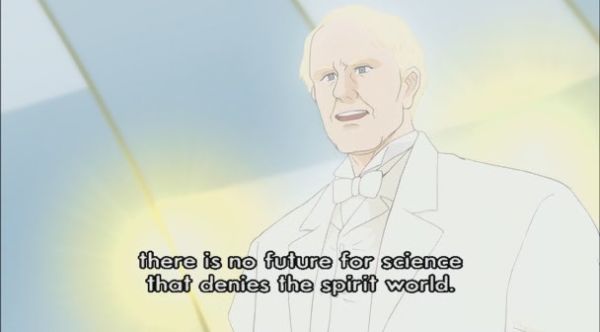
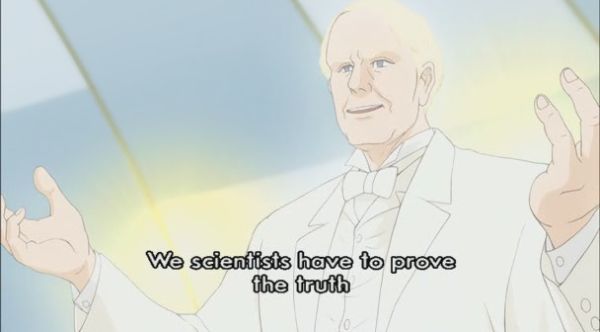
Screenshot from the anime “The Laws of Eternity”, also by Ryuho Okawa. The protagonists visits the angelic realm in heaven and is surprised to find a number of famous Japanese industrialists there. Because creating prosperity for others is the will of the Light / God / Buddha. Just in case this wasn’t obvious, he also wrote a book about it.

Infinite prosperity — wouldn’t that be nice around now? What with the move and the frozen water pipes and all. But I am talking about the book I ordered from Amazon.co.UK before Xmas and which I found in my mailbox when I came home late yesterday. Another book by Ryuho Okawa, its full title is The Philosophy of Progress – Higher Thinking for Developing Infinite Prosperity. Both Okawa himself and the publisher inform us that the book will need to be read several times, but what don’t you do for infinite prosperity. Or even for higher thinking, I suppose. Your enthusiasm about thinking may vary. Then again, so may your prosperity.

The book is, as usual, made from several sections that originated as speeches and were later adapted to written form. They vary in tone, more than usual, with one being very simple, as if aimed at children or people with well below the IQ of the average Japanese. Okawa strives to be easy to understand, but this was unusual even for him. Anyway, the different speeches help see things from slightly different angles, which should be helpful.

This is not a New Age book about “attracting” wealth, like the popular understanding of “The Secret” and “Think and grow rich”. The idea of attracting wealth is an abomination to Okawa, as it is to any right-thinking person. On the contrary, the purpose is to CREATE prosperity, so that it flows out from you, not toward you.

In contrast to the right-thinking person, who wants to create prosperity and let it flow out to others, I sometimes talk about “left-thinking” people, who want to draw in prosperity from other people and consume it. This is of course a kick in the shin to socialism, which by historical accident has become associated with the left hand. But it actually goes much further back, to the Old Testament, where Ecclesiastes says that “The heart of the wise inclines to the right, but the heart of the fool to the left.” (Ecclesiastes 10:2) The idea that we should all divide the cake and not bother about baking it is as foolish as they come. But this is not merely, or even mainly, a political problem.

For instance, you may feel that someone does not give you the respect you expected. A left-thinking person will say, out loud or in their mind: “You better respect me!” They may then go on to treat the other person with disrespect and even encourage others to do the same, to restore the balance. But a right-thinking person will first jump to another conclusion: “Perhaps that person sees some flaw in me that I have overlooked, or perhaps I have just not done enough to merit their respect. I have to do better.” It may of course be that the other person lacks respect and gratitude in general, but unless you are their parent, this is not something you can fix directly. And it could certainly also happen that you just haven’t done anything particularly impressive. (I know this is generally the case for me, but then I don’t expect much above bare civility either.)

Now in all fairness Okawa is mainly a spiritual teacher, and so the prosperity he talks about is mainly spiritual. But he certainly isn’t opposed to a little cash for the true believers. He does discuss Jesus’ warning about rich people, camels and needle eyes. Much like me, Okawa believes the problem was attachment to material things, rather than the things themselves. (Not unexpected, since Okawa claims to be the Buddha reborn and the Buddha was very much about getting rid of attachment.) Unlike me though, Okawa is fairly optimistic about people having lots of money without getting attached to it. That may be doable for someone who vividly remembers being king of Atlantis and stuff like that. But for us commoners, it is hard to not get carried away by riches. I would not be so sanguine about it. I’m more with Jesus on this one. Big surprise, eh?

Okawa does make the valid point that these days, if you go the route of poverty you will be tempted by communism. Jesus presumably did not have that dilemma. Also, according to Okawa, it would be a problem if only bad people got rich and not good people, because the bad people would have way more power compared to their numbers, and there is plenty enough of bad people in power as is. My problem with this is the good people who turn to bad people when they get rich, because they fall in love with the power and prestige and forget their original purpose in life. I tend to hold the attitude of Proverbs 30: Give me neither poverty nor riches, “Otherwise, I may have too much and disown you and say, ‘Who is the LORD ?’ Or I may become poor and steal, and so dishonor the name of my God.” Of course, “not poverty” today is a bit different from 3000 years ago…

Luckily Okawa goes on to focus in great detail on the purpose of progress in this world. It is not to hoard stuff for ourselves, but to expand our mission of causing as much happiness as possible in this world while we are here. And financial progress is only one contribution to that, not the goal. For instance, a company cannot be said to truly make progress if the employees don’t feel joy about working there. A company should be run in such a way that the happiness of the employees and business associates increases over time. The company should also contribute to society through taxes. Okawa foretells continued decline for America as long as the nation continues to see tax evasion as an admirable activity.

(As leader for the Happiness Realization Party, Okawa favors drastic tax cuts in Japan. What he refers to in his book is presumably not having as high taxes as possible, but being as honest as possible and paying the taxes intended by the society you live in.)

The book is quite multifaceted, as are his books in general. One of the unsuspected jewels appears while he discusses the hells relevant to greedy people, the Hell of Hungry Spirits and the Hell of Strife. While there anyway, he stops by the Hell of Lust for a paragraph or two. I think I will write about that in a separate entry, if ever.

Anyway, to not get completely lost in the details: Prosperity is not about having lots of money. That’s incidental, although people who know the Truth cannot possibly become destitute. True prosperity is about manifesting an ever increasing amount of happiness: First in your own life, and as soon as practically possible to begin spreading this happiness to people around you, in ever wider circles, until the whole world is brightly lit with hope and joy.

Okawa should know what he speaks of in this regard. From being a fairly ordinary young man he has brought forth an organization that is dedicated to creating utopia through love, wisdom, self-reflection and progress. Millions of people have bought at least some of his books, and if they enjoyed them as much as I do, that is a good amount of happiness right there.  And take my word for it, it is not easy to write in a way that fills people with hope and strength of will. I’m still working on it though!

As I said when I ordered the book: “When I have infinite prosperity, I’ll be sure to share it with my friends.” Work in progress!