Responsibility for our own health

"I aim to become a tropical girl, fruit juice running through my veins!"

“I’m aiming to be a tropical girl so fruity that fruit juice runs trough my veins!” That’s more like it. As long as there are toilets within running distance, at least.

There is a tendency in America, and increasingly in other countries as well, to expect medicine to fix our health, while we otherwise destroy it with our poor life choices. Not every person is like this, and there is a gradual awakening to the truth in this matter, but this is still mostly limited to the well off and the intellectual. Most of the population is still caught in a very dangerous situation: They take a short-term view of the long-term challenge of staying healthy.

It is natural that children don’t think far ahead. Even being 30 is old to them, so they hardly give it a thought. But for adults it should not be a great surprise that they may want to live, and live a good life, some decades into the future as well.

We know some of the greatest causes of poor health in adults are caused by lifestyle choices:  Smoking, inactivity, eating lots of fat or sugar, casual sex, abuse of alcohol and pleasure drugs, stress and conflict. Oh, and not washing your hands.

Yet when public health is discussed, it is mainly a discussion of money, of insurance and the quality of health care. Of course that matters too, but once you need health care, things are already pretty bad.  There are so many things that can be done to prevent illness, for most of us. Of course some are born with the disposition for certain illnesses, and there are accidents. But this is not the most common.

There is nothing flashy about preventive health maintenance. Taking the stairs instead of the elevator when feasible, keeping the snacks in the opposite end of the house from the TV or computer, taking a walk every day or two or having some physical activity as hobby, working through feelings instead of drowning them in booze or worse… none of these things are likely to bring you praise if you do them or consternation if you don’t. Nobody notices anything until you seem to be more lucky than other people.

Is it really worth it? You could be lucky. Perhaps you have the kind of genes that let you smoke all your life and never get cancer, gorge on fat and never get heart disease, may be you are even naturally resistant to HIV (some people are, especially those of Nordic ancestry, but still only a minority). You never know until you try, right?

But on behalf of society it would certainly be a good thing if people didn’t try their luck in this regard. And for those who don’t have unusual luck, it is likely they will regret their lifestyle choices. Of course, most of us have done things we regret. But every time we avoid it, we do a service to ourselves, our families (if any) and the society as a whole. It is not too late to start… probably.

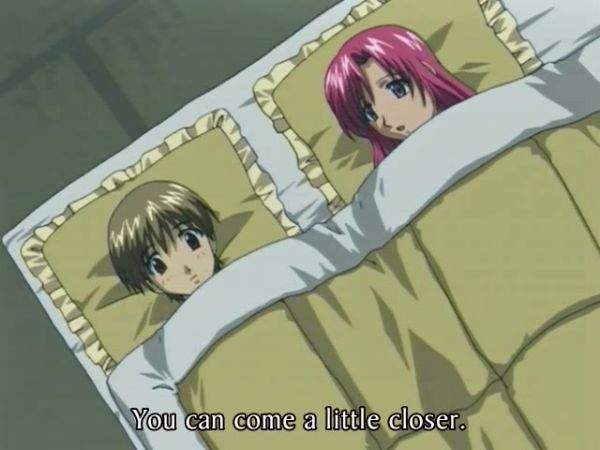
“Come a little closer”

“You can come a little closer.” Look at his face! I know that feeling. ^_^ 

On the commute bus in the morning, the radio was playing, distracting me from my hagiography reading off and on. Toward the end of the trip, it played a love song which sounded like it was performed by an underage girl. This tends to creep me out, knowing human nature as well as I do now. Luckily (thanks to the miracle of Google and catching some of the words) I now know that the girl was Frida Amundsen, and definitely not as underage as she sounded, even back then. Finding the song was a bit of a challenge, because there sure are a lot of songs asking someone to come closer, closer to me.

I guess this is one of the most common human emotions. I can kind of understand it, even if I don’t feel it myself. During my attempt to regain my humanity, in my late 30es and early 40es, I learned a lot about human emotions. I should use this more in my writing.

I have always been in love with you,
But, you are unable to see that
I have felt this way, every night and day
Wishing that you would just come
A little closer
Come a little closer
Closer to me.

Already when I heard it on the radio (and only caught a few words), it reminded me of a favorite Japanese song that I bought some years ago, after hearing it in the anime Midori no Hibi. The song Mou Sukoshi (“just a little more”) is also sung by a girl who sounds a bit childlike, and in fact expresses a wish to get a little closer to your heart. Just a little more, just a little more…

I have however never understood why people keep thinking and feeling this and never say it. In Heaven everyone may know what you think, but not on Earth. Men in particular Really Are That Dense. This is a scientific fact. We are not studiously ignoring you. Well, I might have been anyway, but it wasn’t necessary, back then.

Understanding humans is new and fascinating to me. I was not born like that. I thought humans were like me, and misunderstood you constantly. This upset me greatly. But as I grow, even as I become more aware of how different I am, I also come aware of how you really think and feel. And that lets me come a little closer. Just a little more.

Friends forever

Are there really friends that care about each other their whole life?

Are there really friends that can care about each other their whole life?

I wrote about this at length, but decided against uploading it. I’ve been writing entirely too much about spiritual things lately for someone of my pray grade. So I’ll try to make this more straightforward.

Yes, there really are friends who care about each other for as long as they live. Perhaps not their whole life unless they also happen to be twins, but from the onset of their friendship and forevermore.

St Teresa was one of those people who loved her friends very dearly and always had them close to her heart. You’d think someone who had God had enough, but to her there was not a clear distinction between God and his children. Those who loved “His Majesty”, as she liked to call Him, having them as friends was in a way like having God himself.

The key to robust friendship is that they are founded on love that gives without asking anything in return. Friendships founded on need are not robust. It could simply be the need to not be alone, so these will fade when there is someone more readily available to be together with. Or it could be the need to be entertained, or to feel important, or even in some cases an erotic “need” to be in the presence of an attractive person, which often excites people even if nothing comes of it.

But some friendships are based on a common love for something that does not fade. And these friendships can last for as long as we both shall live, and even beyond, so I believe. Be that as it may, my friendship is free and must be freely accepted. While I’m happy to help a friend, you should not be too optimistic about starting up your friendship by asking for favors, if you are just another greedy human seeking benefits for this brief life on Earth. But if you seek glory and immortality by endurance in good deeds, I’ll definitely consider being Friends Forever. ^_^ I could need more friends like that.


Preparing for “poverty”

Small house in Sims 3

With bedrooms and a second bathroom in the basement, this house in Sims 3 has room for a small family to live very comfortably. Having huge expanses of floor is not something most people will get used to in the near future, if things continue their current course. The bookshelves may also disappear, and the computer be replaced with tablets. Not sure about the mailbox.

For decades now, we who live in the rich world have assumed that we would become richer or richer. OK, perhaps not all of us, but nearly so. Americans have been more accepting of the fact that a society that creates winners must also create losers; here in Europe, we have largely pretended that this only applied to substance abusers. The ordinary Joe and Jane would be better and better off for each passing years, and their children even more so, world without end.

There was a vague sense of guilt because most of the world — the so-called “third world” — seemed lost forever in abject poverty. But that’s what happens when they try to rule themselves, and if it was our parents’ fault, it certainly wasn’t ours, and anyway they supplied us with cheap raw materials so it wasn’t all bad.

While we looked the other way, the developing world actually developed. OK, there are still some few nations mired in unspeakable poverty, usually in a state of war or civil war. But most of the human population isn’t living like that anymore. They still have a long way before they are as wealthy as us, but they are catching up rapidly.

Now the Chinese can do almost all that we can do, only cheaper. And people are understandably getting nervous, when their privileges start to come into question. It is not just theory, either: The income of a single working American is not much different from 20 years ago, and sliding downward. For a while the family wealth increased because both man and wife was working for pay; then it increased because you sold the same houses to each other for ever higher prices. Now that illusion too is broken; people hope that the government will be able to do something, perhaps by confiscating the wealth of the super-rich. But even if you took it all, you would only be able to hold the government debt steady for about a year. There just aren’t that many super-rich, and if you try to sell their stuff all at once you won’t get much for it.

The time may be drawing to a close when we could eat T-bone steak each day and the Chinese ate mostly rice. The steak and the rice are going to be more evenly distributed, so it seems. Not just with the Chinese, but India, Brazil, Indonesia and Nigeria are all huge nations who want their part of the world’s resources. At least the Indians don’t eat cattle… well, most of them don’t. But you get the point. Even though the rising tide raises most of the boats, some of the “super-rich” nations of the world will have to move downward toward the average.

It amuses me when Americans whine about the “1%” rich, and don’t realize that in the eyes of about 6 billion people, they are the 1%. OK, more like 5%, but still. The difference between having a private jet and a car may seem huge, but not when you’re saving up for a cheap bicycle.

***

This was just an introduction, really, but probably necessary because most people in the western world have still not understood with their emotion that their Golden Age has ended, and that lean years are ahead.

***

One trend in the near future of Europe and America should be small, cheap homes. Some of these will be in traditional apartments, but also suburban homes will probably be small, on small plots of land, in order to be affordable. I don’t mean we should tear down the large houses that are still around, I just mean that new homes should be smaller. Young people looking for a place to live will generally not be able to pay a lot, because even if they have a long-term job, it is not likely to be very well paid. There will be exceptions, of course, but their houses are already built, the big ones.

With gas prices set to skyrocket once another billion cars roll onto the roads, the suburbs of the near future should not be just rows of houses with roads to take people to the city. Rather, cities and towns and villages all should have a mixture of residential, shopping and work buildings. Since most work won’t involve smokestacks and the like, there is no reason to have the buildings far apart from the homes. You will not want to drive for an hour for a slightly better paid job, because it will cost you more in gas than you earn. But of course many jobs only exists where there are many people (a neurosurgeon needs a much larger population than a hairdresser). So large cities will continue to be large, but may become more dense and more varied as people seek to live within reasonable distance if they can afford it. Again, small affordable housing near the city or large towns will be highly sought after.

Electric cars will be widespread, but they will remain more expensive than gas or diesel cars, and electricity itself will grow more expensive. At the same time, wages and salaries will continue to shrink. Driving will no longer be something you do thoughtlessly or just because you are bored. And you will think twice about visiting a mall far away, or drive your kids to another town for some trivial activity.

Taking a plane to an overseas vacation will once again be for the rich. In so far as ordinary workers will have vacations, they will mostly spend them at home or at least in their own state, most years. Tourism will continue to grow for a while, because there will be many more tourists from the countries that used to be poor. But it will not grow at a breakneck speed, and not forever. Specifically, travel by plane will necessarily suffer from peak oil and the transportation boom. Planes are fast but not particularly energy-efficient. People will gradually need more and more of a real reason to take them.

With all things electronic continuing to give more value for money, I expect people to gradually switch from skin meetings to video meetings, and relaxing in virtual worlds instead of actual travel. Physical books will also probably become more of a luxury, although this is still a ways off.

The world population is now forecast to peak at somewhere around 9.5 billion, which is within the planet’s capacity to feed, at least for a while. What has changed the most is that most of these people won’t live in dirt poor third world countries, although I fear some will. But most will live in the new “second world”, not the communist world that use to bear that name but rather a compromise between todays first and third world. There are already a good number of such countries, and I expect the rich world to gradually sink to meet them, although not at the same speed as the emerging countries rise.

With a large “world middle class”, food will be expensive but most will be able to afford it. (Again, I expect hard times for the few countries who don’t get up in time.) Luxury food will become luxury again for the ordinary worker in America and Europe. In particular meat will be expensive, since it requires a lot of plant food that could otherwise have been sold to humans. Of course there are many areas that are better suited for grass than for grain, fruit and vegetables. In Scandinavia, for instance, the mountains are suited only for goats and sheep, not for grain or soybeans. I assume the same will hold true for the Rockies and other mountain chains. But overall, meat will become a bit of a luxury. Not something you only taste for Christmas, but perhaps once or twice a week unless you are well off and want to show it.

Again, we are not talking about abject poverty here. I put the word in quotes in the headline because in the eyes of most of the world, it is far from poverty. It is simply sensible living. But for many of us, that will be a rather new thing. We should think ahead and prepare, both individually, as families, and as society.

Stop dieting!

Running like the wind in Sims 3

Run like the wind! You’ll love it, at least more than dieting. Or if you are too sick to run, just walk. Or do yoga, if your neighborhood is too dangerous. Don’t just sit there and diet! Do something!

If you know what’s best for you, drop that diet and back away slowly. Then faster and faster. It has been known for years that diets are ineffective; now it seems more and more clear that they are outright harmful, quite likely every one of them.

Of course there are situations where you have to avoid certain foods, such as allergies or particular problems of the digestion. I am here talking about dieting to lose weight, a multi-billion dollar industry which it seems (like so many others) is based on the near-demonic eagerness to exploit the ignorant as if they were cattle.

As I said, we have known for a while that diets don’t work except in so few and rare cases that it would be like relying on lottery for a living. There are in fact numerous diets that leave the subject noticeably lighter after a few months. However, after five years the number who has stayed down in weight is less than those who have actually grown fatter than they were when they started. In all fairness, they might have gained weight anyway, and they did get a brief respite. But in any case, this means we cannot make a correct judgment from the “before” and “after” pictures, but also need a “much later” picture in which you have regained your plumpness and then some.

Still, while I have mentioned this in the past, it did not move me to an impassioned plea. That only happened because of new reports coming in from several sources, including Norway’s University of Science and Technology (NTNU Trondheim), showing evidence that weight has virtually no effect on health and survival in a modern society. What causes the wide range of “lifestyle diseases” is instead inactivity. An overweight person who is physically active is no more likely to get diabetes, hypertension and stroke than a slimmer person. Only when obesity reaches a level where exercise becomes impossible, does it spell impending doom.

The flip side of this is that if you are slim but inactive, you are risking your very life. And this, dear reader, is the problem. Not that diets are ineffective; that is the Light’s own grace, if I may say so. The danger is the time in which the diet is effective and you actually lose weight. This means you no longer have to exercise to keep your weight down; the urgency fades.

If you can both diet and exercise to your fullest extent, then I suppose it is harmless. But the moment you choose between activity and dieting, you need to be aware which one is purely cosmetic and which one is likely to save your life.

***

Even children are at risk now. When I was a boy, 40 years ago in Norway, the idea of children dieting was unnatural if not outright blasphemous. Instead, they would run around. There were two fat kids in our village, a brother and sister; they had some kind of hormone disease, we were told. It is probably true, because they were giants from before they started school. The rest of us, including their brother, were slim. Boys would spend whole afternoon playing soccer; I am not sure what the girls did, probably something useful? In school breaks they were playing tag or throwing small balls.

These days, kids are sitting in front of the TV or computer monitor all afternoon instead. Well, not all of them all of the time, but enough so that there are fat kids everywhere. I very much doubt they have all suddenly  were born with hormone disturbances! And contrary to what you kids may believe, there was plenty of food 40 years ago. OK, so out in the countryside there weren’t potato chips in bags, but we made our own, cutting potatoes in slices and frying them in animal fat, salt and pepper, and frequently adding a fried egg to the mix. And then we ate until we were full.

Some of us loved a good book as well, and would read for hours. So we did not run around all day. But we ran around everyday. Or walked around, in my case, since I have exercise asthma since I was tiny.

But now we have, for the first time in history, teenager whose arteries are partially clogged by fat before they are even grown up. Medical science proceeds at a brisk pace, so hopefully they will live to old age anyway, somehow. But it won’t be cheap. And not particularly pleasant, I dare say. Wouldn’t it have been easier to run around at least an hour each day?

But mainly I write to adults here. You have the opportunity to make your own life decisions, at a cost. So you thought you would not spend the time on walking around (or you live in a neighborhood where you cannot walk around without being mugged / raped / killed, if you live in certain parts of South Africa or America). Instead, you will just eat less fat or sugar or bread, or whatever the fad is when you read this. And it works. You may feel hungry for a while, but you lose weight, and everyone is happy. Until your body starts degenerating from lack of use anyway, and you get the same illnesses as the obese people, only a little later.

Humans are made to move about on their feet, and if you don’t do it, there will be trouble. Even if you diet. So drop that diet and start moving! You’ll soon find you need your energy and can eat with a good conscience.

Concupiscence and OKCupidsense

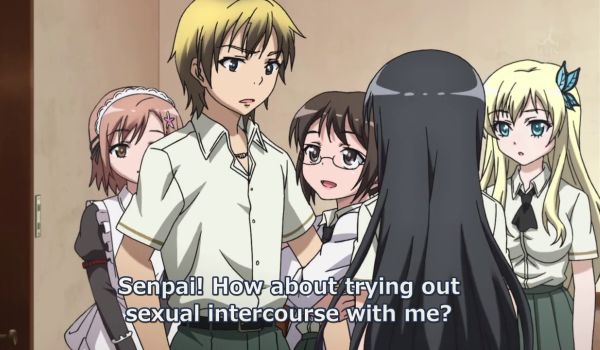
"How about trying out sex..."

In our inner life, concupiscence is the part that is always eager to try out some expected pleasure, common sense be damned. If our will agrees, sin is conceived, meaning “mistake”, “error”, “missing the goal”. When the sin is mature, it causes death – the removal of our link to eternity, so that our physical death becomes an end to the meaning of our life. Apart from the actual vocabulary, I think any serious religion or spiritual philosophy will recognize this. Not all have a word for it though.

I learned a new word! That’s not often. Actually, I had a kind of vague idea of what it meant and would not have fundamentally misunderstood the text; I have a talent for that, absorbing words from context. But in this case it was pretty specialized: “Concupiscence.” I am mildly surprised that my spell checker recognizes it, even.

The only places I have seen this word, that I can remember, is in Catholic theology (or psychology, I guess, since it is about the human soul; God has none of it). Concupiscence is our natural tendency to want the wrong things. The word is indeed related to “cupid” and sexual lust is one of the typical ways this manifests, but it is not so limited. The tendency to seek pleasure in this world in any form outside of God’s will falls under concupiscence.  So it is pretty nearly a description of my whole life up until now. 0_O

In the Christian Church at Brunstad, we called this “the sin in the flesh”. Unlike Protestants, we believed that it is not a sin that condemns, until we give in to it. Rather it is a tendency to sin, and because of this it is really hard to live a pure life. But some people become free from it, bit by bit, eventually. Not many, it seems, but some.

Strangely, it seems the Catholic view is more similar to ours (for I still hold this belief, though without the specific vocabulary, which is too saturated for modern man. Mention “sin” and an elaborate defense mechanism is triggered, ending any rational discourse; so I rarely use the word when explaining how we humans keep hurting ourselves. Like it or hate it, language changes over time. In Norway today, “sin” means “sex”, more or less, and I hear this is getting common in America as well.)

Speaking of which, a quote from the Catholic Encyclopedia: “Hence desires contrary to the real good and order of reason may, and often do, rise in it, previous to the attention of the mind, and once risen, dispose the bodily organs to the pursuit and solicit the will to consent, while they more or less hinder reason from considering their lawfulness or unlawfulness. This is concupiscence in its strict and specific sense.” Bodily organs to the pursuit! Oh, the stories one could tell.

***

The word became a lot easier to remember once I realized the “cupid” part. It reminded me of the American matching site OKCupid, of which I have been a member since before City of Heroes came out. I know this, because the reason I joined them was a City of Heroes quiz an online friend linked to, and it was based on the Alpha build of CoH. It was already changed when I took part in the closed beta, so it must have been around 8 years ago.

Anyway, that was how I came to OKCupid, and I am not sure it even was called that at the time. It started – as far as I knew, at least – as a collection of quizzes of all kinds. The idea was that people who had similar results on the quizzes would be interested in getting to know each other, I think. It has developed into a full-fledge dating site, including a mobile app that finds users near you (if they consent to being found). But it is still full of quizzes and questionnaires, so you can hang out there without outing yourself as a desperate loser. “I am just here for the quizzes.”  Actually, that’s more or less what I write in my bio. I certainly don’t need a puny human or its shallow interests. ^_^

But even so, I have plenty of concupiscence of various kinds. It is just that it doesn’t really lend itself well to dating sites. Computer games, on the other hand… I am still occasionally looking for that Fluffy Tails mod for Skyrim. They had one for the previous game, after all. No matter what your concupiscence, the Internet will deliver!


Christmas Evolution

"There should not be a barrier between Buddhists and Christians"

“There should not be a barrier between Buddhists and Christians” says the Buddhist monk in a Santa Claus costume. Christmas has become a widely celebrated holiday in Japan, among other places,  far from its snowy home in Bethlehem… wait…

Here in Norway, Christmas Eve is the high point of the Yule holiday. Around 5 o’clock, more precisely, though it may perhaps be later now that both adults and children stay up longer in the evenings. But it used to be 5 PM, if my memory serves. Church bells would ring, Christmas songs would be played on the radio, and families would gather around the Christmas Tree. A long evening of heavy food, gifts (usually already placed under the tree) and sugary treats would follow.

(A large number of Norwegians also celebrate Christmas as if it was not about the miracle in Bethlehem but rather the miracle in Cana, where Jesus turned water to wine. My family never took part in any alcoholic celebration, and I personally am not influenced by alcohol on a personality level, only in a purely physical sense.)

Living alone, I don’t celebrate Christmas in any outward way, although I enjoy classic Christmas songs all through the month and more frequently turn my thought to the mystery of the Incarnation.

I have a running joke about Christmas Eve, going like this: “Why is everyone talking about Christmas Eve? What about Christmas Adam?” Of course, arguably Jesus Christ is the “Christmas Adam”, as the Bible says elsewhere, “The first Adam became a living soul; the second Adam became a lifegiving spirit.”

This year, however, the voices in my head had a little fun. I hope it is not too blasphemous.

“Why is everyone talking about Christmas Eve?”
“It is short for Evolution. Like in Adam and Evolution. That sounds too long, you have already forgotten Adam when you come to the end. So people use the nickname, Eve.”

(At the time of writing, I was unaware that generations ago, the story of Adam and Eve was in fact performed as a prelude to Christmas, and presumably is one of the roots, as it were, of the Christmas tree. Whoa.)

Christmas certainly has evolved! The first centuries of Christian history has no sign of celebration of Jesus’ birthday. Although the relevant parts of the gospel were in place already in the earliest known manuscripts, nobody made an attempt to celebrate it or even set a date until the Age of Martyrs came to an end. When Christianity was accepted by the Roman emperors, Jesus’ birthday was quietly aligned with the celebration of Sol Invictus. Christianity has after that gradually absorbed various pagan Solstice rituals, and this evolution has continued into my own lifetime.

The Christmas tree appears as late as the 15th century, and did not become widespread until a century later. Christmas trees in homes appear a couple hundred years ago.

Santa Claus is named for the bishop Nicholas of Myra, who was famous for his timely gifts. However, the modern character is merged with Nordic mythical creatures who protected the farms, often thought to be the spirits of the farm’s founder, or underground gnomes. Santa Claus has only gained his current form very recently, in my lifetime, and is taking over Christmas from Jesus to some extent, being less controversial. (Not that this says much.)

But while Christmas itself has evolved, it has also played an important role in the evolution of our society. For the celebration of a helpless child as God has year by year, generation by generation, increased our respect for children. It still has a long way to go for many people, but you will hardly believe the callous disregard for children that was common by the onset of the Christian Era. Both the Greeks and the Vikings allowed a man to kill his infants at his own whim, with no repercussions of any kind. (One theory of the Viking expansion is that it stemmed from a search for wives, as too many girl babies were killed by their fathers as useless in war.)

The bonding of babies and parents that is universally accepted as a good thing was often deliberately avoided in the past, something that may have made sense on a practical level with the high infant mortality. But the importance of this early bonding for healthy emotional and intellectual development is a major part of modern psychology. In a manner of speaking, the relative humanism of modern western civilization can trace its evolution back to the little child in the crib.


“continually with thee”

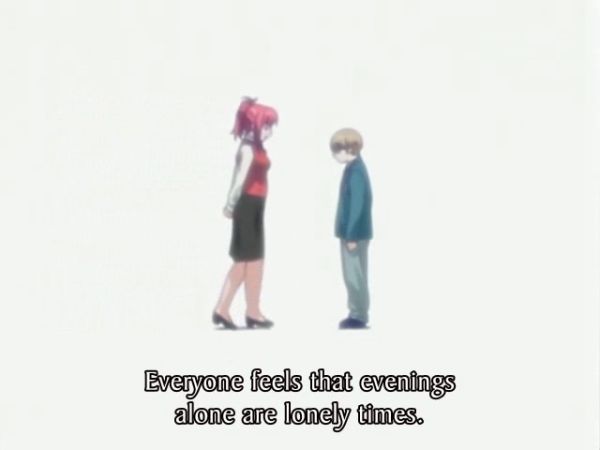
"Everyone feels that evenings alone are lonely times"

“Everyone feels that evenings alone are lonely times” says the teacher. But wait, there is one who does not feel like that, and that is I. For I am continually with thee…

So foolish was I, and ignorant: I was as a beast before thee. Nevertheless I am continually with thee: thou hast holden me by my right hand.” -Psalm 73, verses 22-23.

This paradox is the heart of my life. I am not all heart, I have many other sides as well. But when we come right down to it, this is the mystery that sets me apart from the average person and changes everything. The “thee” in this text is presumably God. At least it is someone in Heaven. And that’s so for me too. If this Presence is not God personally, it certainly seems to represent Heaven.

The strange thing is that even though I have been as foolish and ignorant as a beast, if not more so, nevertheless I am continually with this Presence. It is beyond obvious that it is not something I have deserved or achieved.

And this more than anything else is what creeps me out about the teachings of St John of the Cross and various other highly respected saints. I can live with not eating tasty snacks or playing computer games; most of the world probably still has other priorities than that. I can live without a lot of things, if it is necessary. But I am not sure I can live, even literally, for long without the Presence.

The few times the Presence has been hid from me, typically for a quarter of an hour or so, I felt an anguish unto death. It felt like the core of my being was ripped out, and I felt physically weak, icy cold from the inside out, stunned by unspeakable fear, and the world had lost a dimension much like if you woke up and could only see in black and white. Everything seemed to be reduced to mere matter, as if the life and beauty and presence that fills everything had retreated to Heaven and closed the door behind it.

Now you may reasonably say that this is how people see the world, but I doubt it. I don’t think even hardcore atheists see the world dead and bare like that. They just are not able to realize that the life and beauty and presence all around them is not an automatic part of matter. Or they think it is just added by their own mind. And I guess that is correct, in a manner of speaking. But it is not automatic. It is not something the mind just can choose to add, or simply add by habit. It is something that can be taken away. But that intrinsic quality of the material world is not all of it, although it is striking. There is also a presence as if someone always watches over me with warm eyes, as if I were a small child playing in the presence of its parents.

“Continually with thee” is the best description I have ever seen of this. And even if I knew that something amazing was on the other side, I would not have the courage to let go of that hand.

I believe this Presence may have been there all my life. When I was four, my mother took me to a hospital in the city where I would spend several days being checked for various things about my asthma. She could not stay there with me, and could not afford to stay in the city even. She had to return to the farm, a night’s travel away, and it probably broke her heart. I did notice, but not much more. I had a most excellent time, except the nurses forced me to eat meat and fish. I put up a ferocious battle, and that was how my mother located me when she came some days later to pick me up. I was screaming – not for my mother, but rather, I was screaming: “I want just dessert! I want just dessert!” – because the main course was all full of dead bodies.

As a child, I was a talkative fellow, but I also spent hours on end alone by the river or in the forest or the mountain. All the while I was speaking out loud (it took quite some effort to stop it when I grew up), as if I took for granted that there was always someone there with me. I did not really think about it until much later, who or what my invisible friend was who was listening to me. When I learned to pray and later, in my teens, learned to stop praying and just listen, I could sense the Presence there, its aura as real as I myself if not more so.

And, except for those brief glimpses of Hell – or that was how it felt to me – I have been continually with my invisible friend. But it is not merely a silent presence. It has definite opinions on many things. It approves and disapproves, warns, comforts, gives me advice. It cannot be forced to “say” anything at all, and not to keep to any particular topic. It will supply information that it deems useful, for the most part, and often practical in nature, while my own thoughts often wander to obscure scientific topics it refuses to discuss.

So that is how it is. Sin is said to separate us from God, and it certainly makes things awkward, but even though I have been as a beast, I have been continually with Thee. It never caused a complete separation, a closing of the door. Well, actually I am not sure that one or two of those glimpses of Hell did not start with me sinning, but I know not all did. It seemed more like a biological thing, as if my God-sense was blinded. In a sense, it may have been more like my spirit had left together with God and the me that was left was “meat”. Although I am not entirely sure. I am in no hurry to test it again. Never is soon enough.

Thou shalt guide me with thy counsel, and afterward receive me to glory.” -verse 24.

The Presence has guided me with its counsel, exactly, probably before I even read this verse (although that is hard to say, I may have read it in the old Danish Bible I found on the top shelf when I was 10 or so). I am a lot more worried about the reception into glory though, because I did not always (or was that “not very often”?) follow that counsel if it seemed less fun or more bothersome than my own alternative. Only when things went wrong did I have to take the next counsel.

Whom have I in heaven but thee? and there is none upon earth that I desire beside thee.” -verse 25

This was the verse I was actually looking for when I returned to this psalm today. In Norwegian it says “I have lust for nothing on Earth”, which unfortunately is not an accurate description of me AT ALL. But “none” is an entirely different matter. I mean, I am glad there are humans, I would not be able to live long without them, I even like some of them, they are decorative and sometimes interesting. But there is no ONE of them that I “desire beside thee”, no particular person that fills a hole in my life. I have never been in love, even though I tried when I was young. But there is no keyhole to which anyone on Earth is the key. There is no human-shaped hole in my life (or dog-shaped or whatever). There is only one hole in my life, in my heart, and it is continually filled, except during the glimpses of Hell (luckily long in the past right now, long may that last).

I know from experience that if I pray earnestly for something to be taken away from me, it can happen. I made that mistake once! I was young and too eager for my own good, and had noticed that when I did something good for someone, I felt a kind of reward inside, a warm glow of happiness like that of a dog being praised. Having read some hagiography, I prayed to God to take away this feeling, as it was pleasing to the ego. And from then on, it disappeared. I feel bad when I do the opposite, but I feel no pleasure in doing good. Which worked nice for the saint I had been reading about (Madame Guyon, I think), but not for me. I haven’t really done much good since then, because I am a big bag of ego and when I don’t get praised by the Presence, I don’t really care. I mean, sure, I can help, but I don’t look for opportunities or go out of my way.

So I am not going to ask for the “Thee” to leave me. No ifs and buts about it. No way. As far as I am concerned, I would be happy to stay like this forever. And ever, amen.
How not to eat the rich

Boy sucking girl's finger, from the anime Amagami SS

Eating the rich, one finger at a time!

There is something absurd about the Left’s fantasies about taxing the “super rich” to fix the broken economy. It is not specifically that it is evil – that is a matter of different opinions – but that it is impossible.

As I have mentioned before, the real super rich are not like Disney’s Scrooge McDuck, who has his money in a silo full of coins and bank notes he can bathe in. Rather, their wealth takes two basic forms: Stocks and bonds. Stocks are part-ownership, mostly in running businesses. Bonds are money lent to other. There are also various derivatives of these, such as the option to buy a stock or a bond at a certain price at some future time. But it really boils down to these two types.

Now say you decide your economy is so messed up that you need to grab 10% of the wealth of the super rich. It is not really sad for them, they still have more than they need for a thousand years of comfortable living, which the Light is unlikely to grant them in any case. But let’s look at what happens when they try to pay their taxes.

Alternative one: They try sell enough stock to finance their extraordinary tax. This is done on the stock exchange, as the name implies. Suddenly there is a glut of sellers and a lack of buyers. This is what we usually call a “stock market crash”. We had one in 1929, heralding the Great Depression. We had another heralding the current troubles, which are the troubles that motivate the Left to want to eat the rich in the first place. So the solution is another stock market crash?

Well, this may seem harmless enough if you are 25 and unemployed. Seeing Wall Street crash and burn, figuratively at least, will probably be satisfying. Not so for your parents: All pension funds are heavily invested on the stock exchange, and everyone’s future pensions will start to unravel before their eyes. This is not a good idea to sign into law for a President who plans on a cushy retreat position as, say, anything other than a panhandler.

Well, how about the bonds? Some of these will mature – the loans fall due – over the course of the year, so these at least should be easy. Just take the money and don’t lend it out again, pay your taxes instead. Fine. But credit has become a bit of a cornerstone in society. Factories or shops that don’t get their credit extended  have to close their doors, even if they otherwise run a profit. In fact, the infamous “financial crisis” that threw the rich world into recession recently was caused by a lack of credit, rather than anything else.

Let us quickly mention the fact that states also depend on credit these days, and a credit panic would cause them to be unable to pay civil servants, state pensions, food stamps etc. Of course, they could just compensate by taxing the rich more…

It is not that it is impossible to tax the rich without the world going down the drain. Many countries tax their rich more than the USA (and a few tax them less). That is not the problem. The problem is the time scale. You can’t confiscate 10% of their wealth one year, or the economy will start spiraling toward death and destruction. You could grab 0.5% each year for 20 years and get the same money with no measurable disruption. But the problem with this is that it won’t solve your problem right here, right now. Even shooting every one of America’s super rich and taking all their money – provided you magically could do this without causing a panic – would only be enough to keep the US debt at its current level for a year, rather than the usual skyrocketing increase. Stealing a measly percent or less simply has no noticeable effect, but it will insult the corporate overlords that wines and dines the politician class. Not worth it, in other words.

How do you eat an elephant? One bite at a time. It’s the same with eating the rich. You have to start doing it a generation before you are going to spectacularly mess up your economy. With the current scarcity of time machines, I don’t see a great past for this in America. (Of course, we did it in Norway. We do everything right in Norway. We are simply the best. We were created in God’s image, and then we evolved. Just ask any of my fellow Norwegians.)

More LED bulbs

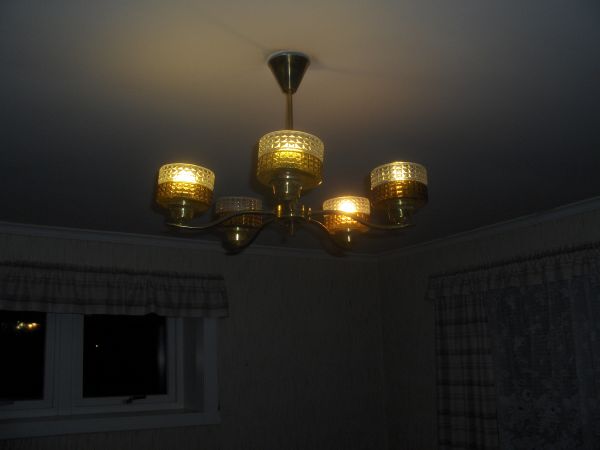
Lamp with 5 light bulbs, one of them dark

Two of these are different.

Now for the reason why I was in the electronics supermarket in the first place. You see, the last few weeks the light bulbs in this house have started dying off at an alarming rate. See the picture above? In it, there is only one of the original light bulbs left, the one to the right of the dead one, the one with the yellower light. You know what? Between me taking that picture earlier this week and now, it went out too. On the other hand, I have replaced the one that is lacking in the picture.

What is even more disturbing than them going out merely days apart, is that they did so one after another with the clock, always the one to the side  of the newest bulb, always the same side. It is like a conspiracy.  Is it a mysterious message from beyond the universe? If so, I don’t understand it, so I’ll just ignore it. Write clearer messages if it is important, Beyond The Universe!

Lamps like these are actually ideal for the new LED age. You see, one big difference between LED and incandescent bulbs is how they handle high output. This is more or less the default for the old type of bulbs, although technology has made available small, weak bulbs for flashlights etc eventually. The first ones, however, were big. With LED (light emitting diodes) it is the other way around. The first were the tiny on/off lights on electronic equipment, barely visible in daylight. New technology has increased the output, as well as the energy consumption.

The largest direct replacement LED bulbs I could find were 7W, which corresponds roughly to 40W incandescent. There will probably be stronger ones eventually, but it won’t be easy. Basically you make stronger bulbs by cramming in more diodes and using blue light, which is converted to white by the coating.  But weaker lights are cheaper to make and more energy efficient. You can retain the higher efficiency, but at the cost of changing the shape of the bulb to get more diodes, for instance in a long rod in the middle of the bulb. But if you want to keep the same shape and size, there are limits currently to how strong they can be.

That’s where lamps with multiple weak bulbs come in handy. They put out plenty of light, but they don’t do so all at one point. 3W LED bulbs easily replace a 25W bulb of similar size and shape, shave almost nine tenths of the electricity cost, and last for 30 years. Or that’s what they say – the technology has not actually been around for that long. Actually there is no reason why they should not last for a century, but unfortunately I am unlikely to find out.

You may have heard about how incandescent bulbs were made with planned obsolescence through a conspiracy among bulb makers. There is a long and seemingly reasonable video freely available on the Net revealing the conspiracy, which stretches decades back. Reality is slightly different. Not that there wasn’t a conspiracy, but it was a conspiracy of standardization rather than simply exploitation.

You see, with incandescent bulbs, longevity comes at a cost. Two costs, actually. For bulbs to last longer, you need a slightly thicker filament (the glowing wire part). The thinner it is, the more fragile. But the thicker it is, the less efficient. You get less light per watt with a thicker, sturdier filament. This isn’t rocket science: The copper wire that leads to your lamp does not shine in the dark and does not melt off the plastic insulation. Because it is much thicker and offers less resistance, it does not even grow hot. The thinner and the more resistance, the hotter and brighter. So you can have incandescent bulbs with longer life, but a higher utility bill or less brightness. The companies standardized on a certain proportion, the 1000 hours bulb. It may not have been incidental that it also got them more sales, but why would they have less sales when the utility companies reaped the difference?

In any case, with LED bulbs having a lifespan of 15, 20 or even 30 years, there is no economic incentive to planned obsolescence at all. By then, the current leadership of the company is likely to be gone, the shareholders will also have changed, even many of the employees. There is simply no point in adding the electronics to keep track of the age of the bulb and make it go poof after 20 years. So it is more likely it will still shine brightly when you and I, dear reader, have both gone to our eternal home and moss covers our headstone, if any.

But if, as I sincerely hope, my eternal home waits until well after I have left this particular house, I’ll probably bring my LED bulbs along, or at least as many as there are lamps in the next domicile. Not that I have any in the sight right now. It’s up to the landlord now – the rent is up for revision at the turn of the year, and if he is too greedy, I’m out. With my LED bulbs, Light willing.