Toddlers and dreams

“It is scary and dark out, and there are aliens…” In your dreams, young lady!

On the bus yesterday, there was a particularly loud toddler. I was a little irritated by the loud screams for a short while, but reflected on myself and noticed something. The way the toddler goes through intense emotions seemingly at random, or sparked by small impulses that cause extreme reactions. It is a lot like dreams, is it not?

I know some people, especially with old age, begin to dream so prosaic dreams that they cannot in the end tell them from real life. Such as the old man who naps after dinner and snores loudly for quite a while, then assures everyone that he did not sleep, he was just thinking with his eyes closed. To not be able to tell your dreams from your thinking, I am not sure whether that says most about your dreams or about your thinking… but at least when we are much younger, this is not the typical dream.

Even at my age, at over 50, I often experience stark fear during my first dream of the night. Whenever I can remember one of those, it is usually about some immediate threat, like a car accident about to happen, or a thief, or big spiders, that kind of thing. In waking life, extreme and immediate danger is very rare. While an armed burglar may eventually take my life, it is very much less likely than dying from fat like so many Norwegians do, unless I keep up my exercise schedule.

At the end of the night, dreams of great pleasure are more common: Flying, sexual activities, or wielding magic. Again, not spectacularly realistic. Especially not the sex…

Anyway, what strikes me is that dreams express extreme feelings and may change suddenly,  just like the waking life of a toddler. Could it be that toddlers are actually living in a dream? That until they learn to impose narrative on their life, there is no “real world” as we know it? There is the self, and the (m)other, but they are both rather nebulous, and the world even more so. A cat is not extremely much more realistic than a monster. The laws of nature could suddenly change. And some small thing – or even just the passage of time – could turn triumph into tragedy, then disappear just as suddenly.

I wonder: How much does our toddlerhood continue in our subconscious? Or, opposite, how far does our narrative reach beyond the realm of speech? If we had to face the world without being able to tell ourselves what is real and not, what would the difference be between our daily life and our nightly dreams?

Working on happiness

“My only wish is for her to be happy!” That is usually a good starting point – if it is serious, and not an excuse for doing dumb things. Some practice and self-reflection may be needed to get it right.

From time to time I wish there was some way to transfer happiness. It is not that I particularly want to be less happy, but there are people I consider friends (or nearly so) who occasionally seem quite unhappy. I don’t mean the kind of happiness you can transfer with a smile or a few cheerful words. That would not be enough in these cases. People who are chronically bored, or angry for reasons they either don’t quite know or think they can do nothing about, or who just find life meaningless and humans disappointing.

There are many conditions that fall under the umbrella of “unhappiness”. And there are many of them I can do little about. In the past, I would buy small things to my student friends:  Books, CDs, DVDs, perhaps clothes or stuff for the house. I hoped this would cheer them up, and I guess for a while it did. But now they earn more than I do, many of them, but they are still not happy. What can I do about it now?

The fact is, happiness is one of those things you can’t just transfer, it is like strength or health. If you are strong and someone else is weak, you can give them a helping hand, but you cannot give them your actual strength. At best you can teach them exercises that will make them strong, but chances are they already knew that but for various reasons never did them, or did not benefit as much from them as you.  (And of course, a lot of people give up if they don’t become as strong as you within a month or two.)

The same goes for health:  If you want to make others healthy, you have to encourage them to do their own healthy living. And even then it is not a sure thing. A few people may be born with weak health, and for some of the rest it may already be too late. But it is still the best we can do, set an example with our own healthy living. If any.

(On that note, I am back to quick walking an hour or more most days again, including this weekend. If a legendary lazy person like me can do it – and I call on my three brothers as witness to my extraordinary laziness – then it is hard to imagine who can not, unless they already have one foot in the grave and the other is amputated. Anyway, walking is not only good for your body but also for your psyche. It reduces stress and gives you time to defragment your brain.)

But basically, happiness is one of those things that work like that. You have to build up your own, because you cannot just take it from another. And that is a fact: You cannot take happiness from another. Obviously you cannot steal it, any happiness you gain from putting others down is sure to fly away faster than a bird on the window sill. But you cannot even receive it. Rumor has it that many people in America think their spouse will make them happy. I am sure there are joys to be had in marriage, but the deep happiness is not something that comes from another. Even if you think so, you are not looking closely enough. Other people may be part of a greater framework that supports your happiness, but the happiness itself must come from within. That is the nature of happiness. It is not something that is done to you.

So in the end, we both have to work on our happiness. There is no way around that.

But would you that, if you could? There are those who feel they should not be happy. Perhaps they have been told so in the past. Or perhaps they have been happy, but then something horrible happened, and they associate the sudden fall into tragedy with the happiness they had before. “If you are never happy, you can never lose your happiness.” And that is true enough, but it is hopeless truth. If you are always sick, you cannot lose your health, but it is better to be healthy even half the time than none of the time, right? It is like that with happiness too.

Unless you are very extraordinary, you will not be able to experience unbroken happiness for the rest of your life. There will be events that lend a tinge of sadness to your life for a while. You will not be ecstatically upbeat, at least, even if you generally wake up grateful each day. But even for an ordinary person, happiness can be built up, and start to take hold, take over more and more of your life. This is definitely the truth. A level of happiness that seemed extraordinary when you were young, may become the norm when you are 50. That is worth a bit of self-reflection and taking responsibility, don’t you think?


More fun with sleeping!

Duvet rolled into caterpillar shape makes for good sleeping! Definitely more so than mobile phones. Believe me: Unlike Kana-chan here, I have tried both.

Rather than meditate for hours, how about using the amazing power of the smartphone to improve sleep quality with less quantity? That is the idea behind applications like the successful SleepCycle app for iPhone. You put it somewhere in the same bed as yourself, and it maps your movements through the night and uploads them to the Internet… no, wait, it uses them to calculate your sleep cycles.

All humans have sleep cycles, evidently. They are not bikes, but structures of our sleep. They last from 90 minutes up to 110 minutes, most commonly the first from what literature tells me. In each such cycle we descend toward deep, slow-wave sleep, and gradually back up toward REM sleep, which is similar to being awake but with intense emotions. At the end of this dreaming, we may wake up for just a moment (but will generally not remember it later) and then sink toward the next deep sleep. If we don’t fall asleep at that point, for instance because we have already slept for 9 hours, we will generally feel pretty good and ready to take on the day. The SleepCycle app tries to wake you up at just such a point, but a cycle or two earlier than you would have woken up naturally. It should still be better than trying to claw your way up from deep sleep.

This is most important to young people, who continue to sink down into delta sleep, the deep silence of the brain, almost every sleep cycle of the night. As we grow older, we tend to only have that deep sleep in the first half of the night.  Now that I am past 50, that seems to be the case with me. (Although if you skip sleep a couple days, you will try to regain that particular type of sleep.) The elderly may have only minutes of deep sleep, some nights none at all. But enough about that.

I don’t have an iPhone, but I do have an Android smartphone. So I downloaded a very similar app, “Sleep as an Droid”. I even tested the sensor, that it was able to register the movements when I tossed or turned on my bed. But even though I tried to use it tonight, the alarm only went off at the last moment, and there were no statistics. I must have somehow gotten the setup wrong, I guess. It is a bit more complex than a common alarm. So I may try again.

On the bright side, it did not catch fire. It is generally a bad idea to cover your smartphone with highly insulating textiles for many hours on end. I tried to place it so that it was not covered, and did succeed, but still I guess it made me a little nervous: I woke up twice during the first few hours of the night. This may have turned to my advantage: I used the opportunity to restart the 2Hz delta brainwave entrainment track on my computer, getting extra doses of deep slow-wave sleep. I certainly was less sleepy than usual at work today, but it was hardly intentional on the part of the sleep app, so to speak.

Also, the phone was not warm at all in the morning, so perhaps I should give it another chance. I’m not putting it under my pillow though!


Sleep or meditation

“As a result, the treated subject appeared to lose its sanity and disappeared.” Unfortunately, this also seems to happen to blogs where the owner takes up a practice of meditating for hours a day. It seems to work fine in moderation though. Well, at least for the not disappearing part, so far. For the rest, judge for yourself.

We humans, and most animals, seem to have been made to sleep. Nocturnal animals sleep during the day, diurnal animals sleep during the night. Humans seem to naturally sleep some 9 hours a night, although most of us can get by just fine on 8, 7.5 or even 7. Much less than that and the majority will start to experience negative side effects.  Some have trouble even on less than 8.

Since our furry friends also need sleep (and feathered and scaled ones too), it seems pretty obvious that this need is biological rather than psychological. I mean, you could tell someone that hunger is just a feeling, and he may believe you strongly enough to go on without eating for quite some while, but he would invariably fall ill after a while. It is the same with sleep, if not more so. Pretty much any healthy person can go a week without food (as long as they have water, at least!) but a week without sleep is virtually impossible to arrange, no matter how much you engage the person to keep them awake. And even should you succeed, most will turn clinically insane before the week is over.

So why then is it a scientific fact that some meditation gurus can get by on half as much sleep, or in extreme cases even less?  And that even while they sleep, they still remain self-aware at the very least? Is it a miracle, a divine intervention overruling the usual laws of nature?

Actually there is a more this-worldly explanation, not that this world is not a miracle if you look at it in a certain way. But anyway! When you meditate, your brain waves gradually become synchronized across most of your brain. This also happens during sleep (except for the intense dream sleep, also called REM sleep). We spend some time early in the night in such REM sleep, especially as children and then gradually less over the years. Likewise we also spend some time, especially at the start of the night, in deep slow-wave (“delta”) sleep.  But most of the night is taken up by theta and very low alpha sleep. And this is brainwaves we can also have while meditating.

Usually people spend their meditation time generating alpha waves. This corresponds to a state of quiet and relaxed awareness. The same frequencies appear naturally when we lie down and begin to relax toward sleep, if we don’t have insomnia. Actually, people who start meditating will have a tendency to fall asleep if they get too comfortable.  But for an experienced meditator it becomes easier to stay awake and aware during meditation, and eventually more aware throughout the day… and finally throughout the night, for a few. Those who are able to reliably meditate even during the deeper theta waves, will basically get much of their “sleep” while meditating. The body and the brain both relax, but they remain aware instead of their mind drifting through fragmentary dreams.

So you may say the distracting functions of the brain are asleep, but the awareness is not. This, I believe, is how it works. But anyway, it works, but you are unlikely to see much of it if you start meditating during your midlife crisis. It tends to take a couple decades to get that far even if you start while you are young.

***

What else appeared to me in this context was acceptance. I had this idea that a lot of our sleeping brain activity is about problems, things we struggle with, things we fear or hope for, things we can’t let go of. I know that my own dreams at the beginning of the night tends toward the nightmarish – criminals, accidents, huge spiders –  while late in morning the dreams are often erotic or social, or occasionally religious. So it is a subconscious – or at least unconscious – form of thinking that is more involved than thinking in words. A form of processing. Working through our fears and worries toward what we really wish for.

What if we become more accepting of reality? What if we pare down our worldly desires and our attachment, and thereby eventually our fears? Then the brain would simply not have the need to do a lot of processing of that kind, right? So that may also be another mechanism by which meditation and similar spiritual practices reduced the need for sleep. It may be a two-pronged attack, both psychological and biological.

***

Unfortunately for the topic, I cannot explore this in my personal life. I am not a guru or anything. I began meditating when I was fairly young – in my late teens if memory serves – and did so actively for a while. But I had some experiences that seemed supernatural, and decided to cut down on meditation to avoid this. So after that I meditated only when I felt an intense need for it, for the most part, until now in my middle age where I have experimented more systematically with meditation and brainwave entrainment. (They are not the same thing.)

It does seem from my experience that using deep brainwave entrainment (delta frequencies) does reduce the need for sleep a bit and generally makes me less sleepy during the daytime. But I have not tested using theta brainwave entrainment for several hours a day, to emulate the hours spent in theta each night. I am not sure I am motivated for it even now, even for the sake of science.  Perhaps you or I will come across the writings of some actual guru who can tell us from firsthand experience. I am perfectly happy to take this second- or even third-hand. At least for now. You never know who I will be in the future, if any.


Happy Science on health


People suffer in times of illness. But don’t worry, Happy Science is here to rescue you from 70% of it! And they actually have a point.

One thing I am not too fond of about the Japanese religious movement Happy Science, is that only a tiny fraction of their books are translated from Japanese, and of these many are only available at their temples, which presumably means only to members. Being secretive is how you get a reputation for being a dangerous cult, after all.

On the other hand, I can understand them sometimes. One of the restricted books is about health and healing, for instance. Now, even in their official literature, Ryoho Okawa (their authority on absolutely everything) claims that 70% of physical illness originates in the mind. As such, he recommends self-reflection to cure most illnesses, including cancer, since this (properly done) will remove the psychological factors that lead to illness.

You can imagine what would happen if someone in America actually skipped cancer treatment and decided to heal herself purely with self-reflection… and died anyway.  Unbelieving relatives would sue for tens, if not hundreds, of millions of dollars. That’s just the way American society works: Americans are the world champions of litigation, after all. So I can understand their caution.

Nevertheless, I think even contemporary science will agree with Mr Okawa in general. He specifically includes such factors as smoking and alcohol, but also overworking, lack of sleep and other stress-related triggers. If we add all those up, not just the actual placebo / nocebo effect, 70% seems a pretty conservative number. Of course, even the most mentally healthy person will die eventually, and there are various genetic diseases that need no trigger but will manifest automatically. So unlike some religious sects in the west, Happy Science does not promise physical immortality to the faithful. Nor do they condemn the sick as evil – in fact, Mr Okawa says right out that good people are more disposed for certain illnesses.

Also unlike many western sects, faith as such has only a limited role here. What counts is to look objectively at our life (this is what self-reflection is about, it is not about blaming ourselves as I thought when I was younger). And then correct the mind, straighten out the mistakes and begin to think in a better way. Of course, this is not something that is done in five minutes. It is a lifelong project in one sense. But it will never start at all if we spend our life blaming others or fate or God or the Devil.

If you have faith in God or Buddha or Jesus Christ, then you should do what they tell you, right? To say “I have so much faith” and not really care what Jesus actually tried to tell people, that is not faith. Jesus said that he did not know where these people came from, who didn’t actually do as he said. So faith in our faith is of limited value, it would seem.

(As for relevant teachings from Jesus Christ on the topic of stress, how about “worry not about the day tomorrow”, or “[forgive your brother] not seven times, but seventy times seven”? I am sure these could cut down a lot on people’s stress levels. Jesus even seems to have taught meditation, since he specifically tells his disciples to “not let your thoughts wander here and there” (or “back and forth”). Well, enough about that for now. Jesus’ immediate followers tended to die by persecution anyway, so it was unlikely they would hand down an extensive lore on healthy living!)

Back to Happy Science. In their monthly magazine issue 207, there is a story about a woman who decided to forgo chemotherapy for her breast cancer, and instead heal herself. This was successful, which is probably why it appeared in the magazine. Somehow I suspect they would have been far less inclined to publish a story in which the protagonist died. Anyway, her cancer gradually disappeared, to the amazement of the doctors. Good on her!

But if you are a member of Happy Science and you read that story and what you take away is “Master does not want us to go to hospitals for treatment”, then you have not understood – in fact, you will in a sense have less understanding than you started with! If you want to follow a religion in a way that actually impacts your life, then you must study it in more detail, and if you do not understand it, you must ask those who have a greater understanding of the Truth, people who for some reason are more spiritually advanced than yourself. Don’t just think whatever idea pops into your head is the right one.

It could be worse. If you read a story like this and think “I also want to become famous”, or “I want everyone to see how good a believer I am”, then you are actually hurting yourself. This is not hard to understand. When you try to put yourself up above other people, this is the kind of thinking that demons have. The story of Satan tells how he could not bear being less than number one, and this was his downfall. Whether you take that literally or not, it is certainly a word of caution. Don’t use your religion to play cool. Or your health, for that matter. Let us treat it as a gift and a way to be useful to others.

Now, the woman in that story did not just reflect on herself. She changed her life. She began to eat healthy food and exercise vigorously. I am not sure how this affects breast cancer, but I know that in men, vigorous exercise for more than three hours a week can stop or slow down about half of prostate cancers, apart from any other intervention.  So we are not talking about some kind of “Harry Potter magic” here, but about living life in the way we humans were created to live.

And that’s the thing, is it not? You don’t need to be God to have an idea about how humans should live, although I suppose it wouldn’t hurt… Anyway, I’m not telling you to fall down and worship Ryuho Okawa. I personally don’t. But I think Happy Science’s public teachings on health could have a natural place in school textbooks and popular science and lifestyle magazines. The world would almost certainly be better for it.


Human husbandry

Let us talk about snacks. You know you want some. Well, you know some part of you want some. But we need to practice human husbandry here.

No, I am not talking about being a husband, despite the picture. I don’t have the experience to teach you that! I am making a twist on the phrase “animal husbandry”, the care and feeding of animals.

I am talking about the human animal that is our body and at least some of our mind. Now, I am aware that this is wrong and misleading. The idea that we are this pure spirit riding the animal body, an unrelated creature with a different and perhaps opposing agenda. This is a dangerous thought to hold onto as a worldview. The body and the mind are more than intertwined, they are more like the metal of a coin and its imprint. This is true. We are not separate beings, the mind and body.

And yet, let us take this metaphor further. It is a metaphor, kind of like a very simple parable, something used to describe something else. Not the thing itself. But let us take it a little further. In days of yore, say in the Viking age, it was the metal value of the coin that determined its value. You might cut a coin in two if you got something for half price, and it would work just as well. These days, of course, it is the imprint that makes a coin valuable. The metal itself is cheap and generally not very useful for anything else, or it would not have been wasted on coins. It is all about the pattern. Or in our metaphor, the mind.

In ages long gone by, it was also the “metal value” of the human that carried it through. Food was scarce, and especially food that was rich in energy, like sugar and fat. So if you came across something like that, it made sense to let the body eat as much as it could get away with, and come back for more if there was. After all, there would soon be less food again. Being well fed would give you the upper hand in survival and reproduction. Survival of the fattest, baby!

And reproduction… what a topic. In the wild, humans did not have all that many opportunities to find a valid mating partner. Also, life was short, and death came suddenly. You had to have a bunch of babies just to be reasonably sure some of them lived to give you grandchildren. Luckily one of the few threats that did not exist yet was sexually transmitted diseases, with the possible exception of herpes. So, you see what way this goes. It made purrfect sense to hit on what few targets you came across during your fertile years, unless something was horribly wrong with them.

Apart from that activity, however, running around too much would waste precious energy. If there was food nearby, a good idea was to eat it, and relax so your body had a chance to store up fat for the dry season. (Children would be the exception to this, as they urgently needed to explore the territory and their own limits and develop the survival skills to do this thing called life all over again.)

Today, things have changed a bit. Pretty girls are everywhere, and so are chocolate cakes, hamburgers, and couches. TV satisfies our curiosity without us needing to lift our plush backside until we drag ourselves to bed. The human animal is in hog heaven, as I think you call it in English. Unfortunately, as you may have noticed, there are some problems with this.

***

This is why, for instance, if you put the snacks in the same room as the magic mirrors, the enemy has already won.  If it is the TV, the human animal will quietly feed while you are concentrating on the story unfolding on the screen. If it is the computer, you will get distracted while working on your spreadsheet or letter, and snacking will make you able to concentrate again, mysteriously, although it needs to be repeated from time to time.

Unlike your friendly barnyard animal, your human animal has as much brain as you have. In fact, it has your brain, exactly. Sometimes you will fool it, sometimes it will fool you. Which is not a big surprise, since it is you.

This is why we need to keep the food in the kitchen, and if possible have the home office at least one room away from the kitchen, preferably two or three.  (Due to the rational layout in my current apartment, I only have to go through the two doors instead of three, but it still helps.) Buying an inexpensive mirror or two or three to place in the kitchen may also help. Then you will know that you will be watching you. Remember, you usually do stuff when you think you do not watch!

Now for that other thing – TV is a window, as far as the human animal is concerned. There is plenty of evidence that people who don’t have TV, and specifically people who don’t watch soap opera, are more satisfied with their current spouse, if any. This is because even though you, the rational you, know that the pretty women and rich and powerful men on TV are not your actual neighbors, your subconscious is still absolutely convinced that they are and you have drawn the short straw in the spouse lottery. (You have also drawn the short straw in the self lottery, but evidently we are a bit more forgiving about that.)

You don’t really need me to go on to tell you about porn, glamour magazines etc, do you? We know how this works by now. None of this stuff was around in the stone age. Seeing is believing. Seeing constantly is believing that it is available, achievable. Oh, that goes for the chocolate cakes and stuff in women’s magazines too. The more you look at them to desire them, the more ready you will be to engage in fateful behavior in real life. Just saying.

Really, you know this just as well as I do, once you start thinking about it. Go on, think, if you will.  I am not the master of you. The question is, who is? Are you?

Games made me do it!

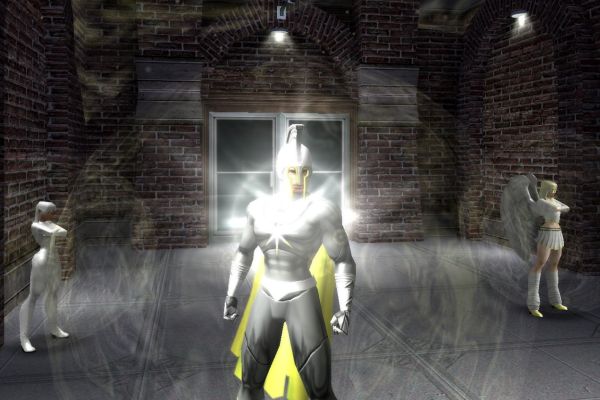
Screenshot from City of Heroes, starring my character In Hoc Signo Vince (a modern paladin type with a Roman-inspired helm and Valkyrie cape), leader of the supergroup Masshiro (“Pure white” in English) on the main European server. In the background two other supergroup members. Evidence to use against me if someone here in Mandal blows up something.

According to an article in Norwegian news site DN.no, the star profiler of criminals, Pat Brown, has found a connection between Norwegian terrorist Breivik and computer games. (Breivik famously mentions playing computer games in his 1500 page book. Of course, I mention playing computer games over and over in my far larger autobiography right here in front of you, and I have yet to kill any socialists in real life. So I think that may not be the crucial point.)

“Violent psychopaths often have a superhero complex” the expert is quoted as saying. (Well, it is translated into Norwegian, so some nuances may be lost.) “They are obsessed by the thought of playing the role as Superman, Spiderman or ninja and fight in a superhero way.”

Evidently it must be divine intervention that I have not already murdered several times over as many people as Mr Breivik. Well, I won’t deny that. Divine intervention is a good thing. (Somewhat depending on the deity, says a voice in my head.) But if so, I think we should not rule out demonic intervention in his case. Or “mind parasites” as we say in the Transdimensional Church of the Cosmic Raccoon.

Evidently computers must be a lot more widespread in Afghanistan than their $1 a day average income made me believe. Also, those games must be older than I thought to have influenced not only Hitler but also Genghis Khan (probably Civilization II in the case of Genghis, the Mongol Horde strategy was a pretty sure winner back then). Not to mention the Vandals, the Aztecs, and the Assyrians with their habit of stacking up skulls. Incredible how the amount of computer games has dropped over the last few decades to give us the fairly peaceful and harmonic world we have today, compared with every single age of recorded history (and the bone record of prehistory, implying that something like a quarter of the stone age dead were killed in some way).

Oh well. I should probably go set some pixel people on (spiritual) fire again. After all, I am not like you ordinary people who don’t do such dubious things as playing games!

Incidentally, the word “masshiro” is Japanese, as is the costume of one of the girls. It refers to all of us using light-based powers, as a symbol of spiritual purity, and has nothing to do with race.  Yeah, right, tell that to the judge!

Familiarigravity

I have never seen this bush before, because I had never walked that far from my new home. This probably happens every time I move, but usually I forget to write about it.

I was taking a one-hour walk today, finally, now that my foot is fully recovered. Well, it was meant to be a one-hour walk, but due to familiarigravity, it ended up more like 50-55 minutes.

What is familiarigravity? I can hear you ask. Actually, that is what I would like to know as well! I discovered it for the first time more than 30 years ago, toward the end of my high school years. (Yes, amazingly I have lived a long time already, longer may it last.) What I discovered was that when I leave the places I usually go, and walk into the unfamiliar, even if it is just along a road, I slow down and yet I tire more easily.  Conversely, once I turn around and start walking back home, walking becomes easier and I walk faster without getting more tired. It is as if there is a center of gravity somewhere in the familiar.

No, the road is not actually sloping upward. This is when I walk in flat terrain. If there is actual uphill or downhill, these add or subtract as usual. It is as if there is a second force in addition to gravity, similar to it but weaker and with a different center. This is what I today decided to call “familiarigravity”.

Obviously the law of familiarigravity is a law of the mind, not of matter. But the two are certainly intertwined in us humans. And I sincerely hope they will continue to be so for quite a while yet!


…or your time back!

In Japanese thought, it is not uncommon that the flow of time can stop. Perhaps there is more to that than we have known, in a manner of speaking.

I wish I could guarantee my readers full satisfaction or their time back, but that may be a bit over the top even for me. There are others who can actually give you time back, though. Jesus, Morpheus and your local training studio come to mind. What?

Well, it all began when the Norwegian National Broadcasting told about a Danish study. It looked at elderly people who habitually either went to church or listened to the church service on broadcasting. The women who did this lived on average 2.6 years longer than the control group who did not. For men the profit was slimmer, only 1.6 years.

It is worth noting that Denmark, like my native Norway, is a post-Christian country. For the last couple generations at least (which I remember) the norm has been to not be Christian, except for certain ritual like church weddings and funerals. So this is not a case of the poor unbelievers being harassed and stressed to death. On the contrary, at least in youth it is pretty common for Christians to be harassed. I bet it is no better for other religious minorities, but evidently this study was of Christians.

What struck me as I reflected on this, was that these 2 years of extra life may have been similar to the time they had spent over the decades listening to sermons and singing hymns etc each Sunday. How about that?

It is not like it would be completely unique. Many years ago I read a theme issue of Scientific American about aging. One point was exercise. The article said that if you start exercising at 40, the extra hours you add to your life are about the same as the hours you spend exercising. So for those of you who think exercise is hell on earth, you may as well cut it out unless you expect a worse hell after life.

But even this is not unique. Another study a few years ago showed that sleeping an extra hour adds an extra hour to your life. This only works up to about 9 hours a night (it varies a bit from person to person). After that, sleeping more correlates with shorter life. That may be because only a sick person could sleep that long, perhaps. But what is certain is that most of us sleep less than what would be good for our health. This has various side effects, like inactivity, overweight, diabetes and hypertension, and eventually an earlier grave.

On the other hand, we pay bills for every month, so if we could be awake the same number of hours in a shorter time, we might come out ahead financially. That is certainly possible, but I think I am curious enough about the future that I want to live a bit longer if I can. Even if it means sleeping a little longer, taking a long walk each day and perhaps even spend some time (or timelessness) in spiritual practice now and then.

Fury of the Northmen

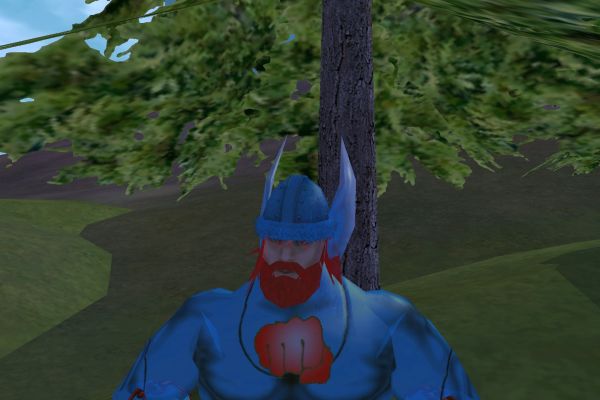
I must admit that I have a couple characters in City of Heroes inspired by Norse mythology. It lends itself quite well to warlike heroes… in a fantasy world.

As I expressed on Google+, there was something off about the bomb in Oslo. It did not follow the pattern of al-Qaeda or their Islamic copycats. The timing in particular was a bit off. Once I heard that someone was shooting at Utøya, the traditional summer camp site of the Social Democrats, I knew it had to be a nationalist. At that time, I still did not know he was also behind the bomb, just that something was subtly “off” about it.

You see, this guy was not the only one thinking of the (more or less) ruling Social Democrat party as quislings. I would guess somewhere around 1/4 of the adult population would agree with that, possibly more. And I mean quisling in a very literal sense. Nationalists consider the Muslim immigration more of a threat to Norway than the German invasion ever was. As it happens, I agree with that, in a manner of speaking. But it really does not matter now. History is coming to an end, and Norway and Islam both will become like dust on the wind. Not in my natural lifespan, perhaps, but in less than a century is my guess.

But most people don’t look forward. They don’t even look backward properly. They don’t realize that the world has changed more in the past 50 years than in the previous 500, or quite possibly 5000. They don’t notice that the acceleration of accelerating change is accelerating – that the pace at which chance increases is itself increasing. An exponential function of knowledge and change. All that you knew is slipping between your fingers. Your grandchildren will either be as gods, or not alive at all. The squabble between cousins that we call a clash of civilizations is … insignificant. Unless it somehow manages to inspire us to blow up the planet, I guess. And you have to wonder, after days like these.

As I said, nationalists consider the current stock of politicians to be guilty of high treason, so it would make sense to assassinate them. I can certainly understand their feelings, having been human myself. For much of my life, there was this constant undercurrent in my life of thinking “evil people must die, evil people must die”. It took me many years of self-reflection to realize that I was basically one of the evil people, and I am still not completely dead, although I am certainly much reduced. For someone stuck at the mental level I was at in my 20es, blowing up a government building or executing Evil People (TM) would certainly be a holy duty and a great joy. Having a good enemy to project your evil on makes life a lot more bearable.

You may have heard that Norwegians are eager to help all kinds of people and try to negotiate peace all over the world. That is certainly true. What you don’t know is that we do all this because we know, but dare not think of, that deep inside we want to throttle people with our bare hands, or at least cleave their skull with a good axe, and laugh as we watch the light die in their eyes. Do you really think our genes have changed that much in 1000 years? They have not, we just go out of our way to not trigger them.

“From the fury of the Northmen deliver us, o Lord!” So prayed the English monks during the viking age, and rightly so. Scandinavians may be slower to anger than people in warmer climes, but once the bloodlust rises in them, there is no holding them back. I am not really surprised that we have a throwback to that time: In school we used to learn a slightly glorified version of the old Norse history, with the strong and proud warriors as an ideal. “Noregsveldet” was it called in my grade school, meaning roughly “the lands ruled by Norway”, encompassing such vassal states as Ireland and Great Britain and parts of France, not to mention Iceland, Greenland and snippets of North America. I am sure Swedes are thinking back to the time when they ruled much of Germany as well, but let us stick with Norway for now.

It should not surprise anyone that people who take the Vikings as ideal, can get a bit … bloodyminded, so to speak. And one habit of old (which is unfortunately not restricted to this corner of the world) was, when you had an enemy you really hated, to kill his children in front of him before blinding him.

I see international media represent Utøya as a political youth camp, and that it is too. But especially for the younger (and more vulnerable) teens, it is mainly a summer vacation resorts for children of the Social Democrat political elite, the leaders locally and nationally and their friends in the party. I think you see what is coming here.

“They were friends” said Norway’s Prime Minister, Jens Stoltenberg, after the massacre, and he was right. Those kids were his friends and children of his friends.  “This place was my summer paradise, and it has been made into a hell.” The Oslo-bomber did not kill the traitors, as he (and many others) thought of them. Instead, he killed their children. I have on good authority that this is far worse.

And it makes sense. You destroy our future, we destroy yours. An eye for an eye. This man was perfectly sane – within his worldview. If the world he lived in were the real world, he would have been a hero. I am sure that is how he regards himself even now.

I am pretty sure there aren’t many others who think of him as a hero, though. Not even among his fellow nationalists. Most of us have the good sense to notice when the berserker rage begins to creep up on us, and go to extremes to avoid it. Because once it takes us, the old gods of thunder and spears are very much alive and well in the land.

From the fury of the Northmen, deliver us o Lord!  Amen.