Are we happy now?

“My emotions were almost unbearable.”  I have been in such a place, and I don’t want others to stay there longer than necessary.

When I warn against emotional advertising, or casual sex, or socialist envy, it is not because I crave that you agree with me or acclaim my opinions as being right. My purpose is simply to increase the happiness of those who read me.

I mean, I have other interests too. I am not a Buddha or some such, living only for the benefit of the world. Mostly I am minding my own small things. But if I bother to write about more general things, this is why. I try to pick something that is not so far out that ordinary people cannot “get” it. On the other hand, it should be non-obvious enough that not everyone has “got” it already.

People generally crave attention, acceptance and acclaim. Their map of reality needs to be verified by others. “Since others agree with me, I must be right!” For the same reason, people tend to only read books and newspapers that agree with them, listen to radio programs that agree with them, and so on. The need to belong to a group of like-minded people is so strong it might well be an instinct. And the best part of it is when you can get others to accept your way of seeing it, rather than the other way around.

But that is not what drives me. I am not part of a group. And I rarely hear from those who read me, well except for my old friend, who anyway seems to do quite well on her own. In terms of getting attention, it would be far more efficient to spend time on a dating site: Even if I never even got to second base, I would get a lot more excitement than here.

The other day, I read this in a newsletter: “A baby is born with a need to be loved – and never outgrows it.” This was evidently considered words of wisdom or truth, and I agree that it is probably a fact for most people. But as I have told in the past, we are not supposed to be children all our life. At some point we have to give more love to others than we receive from others, otherwise the amount of love on Earth will dwindle and go dry.  Sometimes it seems this has already happened. In the striking mental image by Ryuho Okawa, a society without love is like a hospital filled with patients crying in pain. Where are the doctors and nurses, who can give care and prescribe treatment that actually leads to healing?

But it is not just old age or a sense of obligation that drives me, I would say. I am still receiving love, and lots of it, but from the Light, from God or Heaven. This is my experience. I am receiving constant love and attention and advice from Above. You may be convinced that all such things are fantasies and only exist in my head. Then ask yourself: If you were hungry and you decided to fix this by fantasizing about food, how long would you survive? A number of weeks, perhaps months if you were a fat American tourist. But I dare say that your imagination would wear pretty thin after a couple of days already.  But I have lived this way for many years. So either the Heavenly Light exists, or the need for love and attention does not. In either case, you probably have to adjust your worldview dramatically, if you are an ordinary person.

Please do. And you don’t need to report back to me when you find a wellspring of happiness that never seems to go dry. You don’t need to remember my name or tell others about me. Just pay it forward. I have plenty.


Just say no to advertising

There is nothing quite like a light from Heaven saying “Think on your own!” But at least don’t let cruel enemies dictate your thoughts and feelings. The Servants of the Light have come to set you free; the rulers in the dark are seeking to enslave you.

This is a quick reminder that emotional advertising is evil, even demonic in a literal sense. Such advertising, most notably TV and movie ads but also the simpler form seen in many colored magazines, is callously designed to create insecurity, inflame desires for things you don’t need, and to make you identify with external status symbols.  It seeks to pull you apart from yourself and fuse you with highly temporary objects.

Modern advertisers know more about the human psyche than most of their victims, so it is no wonder they are successful. And make no mistake: To them you are valuable in the same way that cattle is valuable to the rancher. Your wellbeing is of no concern to them at all, as long as you can be used to create more profit.

There is no point in being angry at these people, though. They are captives of a deeper darkness than most of their victims, a hollowing that is the antechamber of Hell. The human subconscious operates in symmetry: What you do to others is done unto you. By making others into lifeless objects, your own life is gradually lost. Theirs is a fate worse than death. In any case, they are not your concern. You are.

There are two main defenses against manipulation. The most obvious is to run for your life.  Don’t watch TV or movies unless you have a good reason to. This is generally a good idea, but particularly so if there is advertising involved. The adverts are designed to manipulate you, and unless you are highly aware, they will.

There, I mentioned the other defense: Awareness. This again falls into two parts. One is to be aware of the purpose and form of the advertising. Typically it will depict a situation in which people receive acclaim, praise, respect or understanding from others, or experience emotional closeness. These are things people often feel they lack, and this feeling is aggravated by seeing others in these artificial situations over and over. In order to obtain these immaterial values, you are told (subtly, of course) that you need to purchase something you otherwise would not need.

The other part of understanding is your understanding of yourself. If you don’t know what makes you tick, if you don’t spend time watching yourself and looking over your actions and reactions, it will be hard for you to see when people are turning your knobs and pressing your buttons to make you work for them. Another benefit of such self-insight is that you are not easily manipulated by people in the flesh either.  Relatives, coworkers, bosses, many such people have techniques for manipulating you. If you know yourself and what is really important to you, they cannot pull your strings and make you dance to your tune.

If you are not yourself, who is going to be?

Be free!

Political Donaldism

We worry about people who take Scripture too literally, but what about those who take Disney comics too literally? (Picture from Wikipedia.)

Looking at political debate these days, I wonder how much of it is based on the Disney universe and its character Scrooge McDuck, whose most famous attribute is the giant Money Bin, in which coins and banknotes are stored like grain in a silo.

The things we pick up when we are children tend to stay with us through life, if we don’t actively reflect on ourselves and change our perceptions. Even then they continue to influence us subconsciously for a while.

In the real world, the “super rich” don’t actually store their money that way. The money is, except for that used in personal consumption, invested in various ways. The super rich may own entire businesses, which they have either founded or bought out later. They may own property which they rent out either to businesses or housing. They may have money in various financial institutions. But mostly their capital is invested in the stock market and in bonds.

The difference between the money bin and the stock market is pretty clear when we come to the effect of taxation. If the government were to somehow manage to siphon some money off from Scrooge’s money bin, chances are that they would put it to better use than being used for a rick man to dive in.  But if the government withdraw the same amount of money from the stock market or bond market, they better have a VERY good reason, as they are undercutting the future production of society.

This aside from the question of “whose money is it anyway”, which is a separate problem.

Not saying it can’t be done, but let’s just realize what is going on. You are not taking “passive” capital and injecting it in the economy. You are drawing money out of the productive economy because you have some purpose you think is more important. This has always been the case, of course. Even a very conservative nation would have a military, police and probably public roads. There are certainly various purposes that tax money can be used for.  But it is not true that this money is just lying around now. It is currently being invested in various of the things we like, and these will become scarcer – and therefore more expensive – as we withdraw resources from production.

So just keep that in mind, and try to consciously correct for the subconscious influence of Scrooge McDuck.

Ironically, Carl Barks who invented this character and his money bin, was himself pro-capitalist. “I feel that everybody should be able to rise as high as they can or want to, provided they don’t kill anybody or actually oppress other people on the way up.”

Ah, the marvels of unintended consequences.

An anti-dromedary??

An antidromedary? (Negative of picture from Wikipedia.)

Not quite. Enantiodromia is the tendency of the psyche to counteract change. Rather than passive resistance, enantiodromia implies an actual movement in the opposite direction of the recent changes.

A common phrase describing this is “two steps forward, one step back” (and sometimes, by the more exasperated, “one step forward, two steps back”.) Whenever a constant effort of change is put upon the psyche, there is a resistance. When one presses forward, it is a bit as if walking in a bubble of some invisible elastic material, which pulls one back as soon as one stops moving forward, or even if not. To make progress, one must drag this whole two-ton bubble forward with oneself.  This is because the conscious self is only a small part of the psyche, most of which is subconscious.

The lecher who gives his life over to sexual pleasures will after a while find that he no longer takes pleasure from them, even in quantities that he formerly found enjoyable. But at the same time, the monk who tries to devote himself to celibacy finds himself burning with unrequited lust.  (I am not talking here about the normal feeling of satisfaction or hunger in the short run, but over a longer span of time. As a tide compared to a wave, perhaps.)  Likewise the fervent believer will inevitably experience doubt, and a doubt that shakes his convictions to the core; but the ardent skeptic will suddenly be given to irrational superstition.

The greater the force by which one tries to move the psyche, the greater the force by which it strikes back. In many cases this has caused a whole new personality to emerge, one that is opposite to the personality one displayed before.  A revolution of the mind, as it were.

But reading about it, it seems to be another case of what Boris Mouravieff calls the “General Law”. Or in everyday speech: “Don’t rock the boat.” Don’t move too fast, don’t move too far, or the automatic mechanisms to stop insanity will kick in and drag you back. Or you could overcome, I suppose, with sufficient force.

Besides reducing the incidence of madness, the General Law also helps avoid cultural flutter. You would not like to go on a vacation to Malaysia and come back a Muslim.  So we have a defense against changing far and fast.  Although it seems to me that people who fall in love can punch through this barrier. Then again they are, in my eyes at least, already insane. ^_^

It is extremely rare that a voice in my head says a word I don’t know, for the obvious reason that the voice is not actually a voice but more like a current of thought in my greater flood of thought (or perhaps it is the other way around). In fact, I would still not have known how to spell it if not for Google’s helpful “Did you mean to search for…” feature.

Your soulmate may vary

Not a soul you’d want to mate with, to say the least.

I am not known for my unreflected obedience, so it should surprise no one that I disobeyed Bill Harris, director of Centerpointe Research Institute. When he sent me an email titled “Attract your true spiritual soulmate (single women only)”, I knew I was not supposed to peek. I mean, that is kind of like peeking in a woman’s purse, or something. But on the other hand, I thought to myself, I don’t want risking to be  attracted by a true spiritual soulmate without the knowledge to defend myself. So read it I did.

Since it turned out not to be particularly useful for me, I may as well pass on the moderately good news: Evidently there is a website named “Calling in the One“, teaching spiritual women how to become magnetic to their soul mate. I don’t particularly mind, as long as said soul mate is not me. The compass needle of my heart is already wobbly enough without spiritual women co-creating trouble along with the Universe. I would rather it point straight toward Heaven, into the Light, rather than spinning around a woman. No offense.

I have a few words to add, though, with a little help from an ever helpful voice in my heart.

Your soul mate is similar to you. Not a mirror image, but on a similar spiritual level. That means, dear single person, that if you suck, so does your soul mate. You better look extremely objectively at yourself, because we can assume that so does the universe.  (Unless your universe exists only in your head, in which case you are pretty much on the losing end of romance anyway.)

***

The American concept of “soul mate” seems to be derived largely from Judaism, where it is believed that singles are only half humans, needing another half to complete them, and that this half has already been decided in Heaven. I am not sure how Judaism usually arranges marriages these days, I assume the fathers don’t make a contract about it when the kids are small as was the rule pretty much everywhere in the past. But whoever makes the decision, it is a frightful responsibility.

In contrast, the Japanese new religion Happy Science (and possibly other sects of Buddhism, I am not sure) use the phrase “soul mate” in a quite different way, more similar to “class mate”.  There are supposedly 20-30 soul mates of you incarnate during your lifetime. They make up most of your family (usually, but it is possible to have other parents for some special purpose). They are your best friends, and your rival that seems to block your path at every turn.  When you meet a stranger and they feel as close as family, it is one of your soul mates, with whom you have spent many past lives and many centuries in Heaven, agreeing to meet again when you both did duty in the flesh again.

In this worldview it is not a huge disaster if you marry the wrong soul mate. Perhaps your spouse and you agreed beforehand to get together for the purpose of bringing into the world a child or two who needed just these two parents.  Or perhaps your spouse had certain qualities that were important to you at that time of your life, but over time you forgot those qualities and why you thought it was a good idea to marry just that person.

To be honest, I think Happy Science is more in tune with contemporary Americans than Judaism or traditional Christianity.  Happy Science basically says “People make mistakes, learn from them and make progress.”  Traditional religion says something like “People make mistakes, you’ll be free from them when you go to Heaven.” People today aren’t usually that patient.

In any case, the sad truth is that there are very few Ones. But if you are a Half and your soul mate is also a Half, then you may just end up being One together. You should not hope for much more than that.

***

Me, I am not a half, so I don’t fit into that equation. But I may be one of the other type of soul mate, your soul’s class mate during this lifelong education. (And quite possibly beyond.) Perhaps we can help each other with the difficult lessons.

And you said to me: “Who will open up my eyes,
To the wonder and the glory, and the stars in the sky?”
And you said to me: “For this road I’m travelling on
I need someone beside me forever. Who?”
And I said, “It’s me, and I’m ready to go,
ready to show
That I’ll never let you down.
And I want you to know, that this power will grow,
Every day, every beat of my heart,
Forever, forever…”

Yes, I quoted that song back in 2002 when I first bought it. And again in 2004, although that was more playfully. I still remember how I felt back in 2002. And you know what I feel now? That this power has grown, far beyond what I could imagine back then.

Whether I am still here when you read this or not, it matters not.  Even if no one praises me or notices me, I will strive to grow in brightness.  I don’t need to be loved (except by the Light), I don’t even need to be needed anymore. I only need for this Brightness to keep flowing into me, until my soul burns like a portal to a world of light. And then we can go into that light, home.

I wonder if that will really happen. I wonder if I will reach my aspiration. Probably not, given how limited I actually am. I would probably need to live till I am 120 or something, and I don’t even know whether I’ll be here next year. But I am glad I even got to see into this Promised Land.

Your soul mate may vary. As may you.

Music, books and countries

If you have a PC (or Mac, or Android phone) you can use the Internet to store your music. Actually you can do that anyway – Ubuntu Linux has had this for at least a year – but it is new to Amazon. com. And unlike Ubuntu One, it is for Americans only.

Amazon.com has launched a “cloud drive” service for their MP3 shop. People can save the MP3 files directly to these servers (not actual clouds, luckily) and play them from anywhere. Anywhere in the USA, that is.  Amazon.com does not sell MP3 files overseas, although ironically they sell CDs, which you can then rip and upload to competing “cloud” providers. It’s a good thing sending all those physical objects across the globe does not cause some kind of climate change or anything, since the end result is exactly the same, with the addition of a CD on a landfill.

I think it is safe to assume that the restrictions on export of MP3 files are due to negotiations with the RIAA, the Recording Industry Asses of America or something very similar to that. It bears mention that I have bought several books in electronic form from Amazon, quickly and without hassle, across the Atlantic. This fits with my impression that book publishers may be greedy like the rest of us, but fundamentally sane. The RIAA, on the other hand, systematically comes across as a collective psychiatric basketcase, more exactly organized paranoia. These are the guys, if you remember, who wanted many millions from a single mother for a couple dozen pretty boring music tracks.

Not to sow doubt about their clinical insanity and need for strong medication and straitjackets, but there is a fundamental difference between books and music that may explain their behavior to some small degree. Whereas music has been with us since time immemorial, canned music is a far more recent invention than the written word.  Books, in some form, is a mainstay of civilization. It could even be argued that civilization as we know it would be hard to maintain without them. Certainly a high-level civilization is unlikely to evolve without a lengthy phase of written records.  So basically, we know books, their causes and effects.

And it so happens that people who read books tend to be regarded as civilized. Whether this is cause or effect, or perhaps both, I am not sure.  As a friend likes to quote from The Penultimate Peril: “Wicked people never have time for reading. It’s one of the reasons for their wickedness.” Music, on the other hand, is often seen as loosening the bands of civilization (although this varies with the type of music, I would say.)

It may not always have been exactly like this. During my recent reading of Dante’s Inferno, there was a mention of an adulterous couple who had supposedly fallen in sin by reading a romance novel together, and consequently went to hell as they never repented.  My immediate reaction was “Who the hell would read a romance novel together with someone of the opposite sex if they were not already planning to do that thing?”  But it goes to show that books may once have been viewed with a certain suspicion which is now reserved for more modern technologies.

Meditation, observation & bzzness

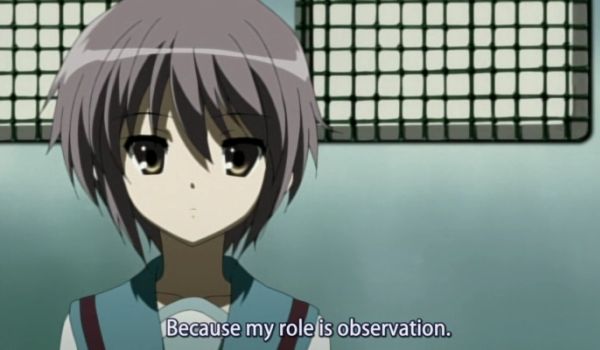
“Because my role is observation.” (Yuki Nagato, from an anime about Haruhi Suzumiya.)

I am still in the middle of reading Butterflies are free to fly (parental, grandparental, angelic and divine guidance recommended, as this book may well cause insanity, suicide or lifelong unhappiness in the fragile or not exceptionally sturdy and well-prepared reader.)

The book quotes Jed McKenna, a probably fictional teacher of extreme truth-seeking. This is actually kind of true: “Ultimately, the only spiritual practice is observation; seeing things the way they really are.” Whether it is the only, I don’t know, but I have found it to be essential. That is why I used to call myself a “conscientious observer” for a long time. (It is a pun on “conscientious objector”, obviously, but I did not pick it only for its fun value.)

In light of this, it is puzzling that Mr Butterfly … Stephen Davis, I mean, is pretty much rejecting meditation as a kind of distraction that seeks to induce an altered state of consciousness. I am not sure what kind of meditation he has done, but he presumably has done some, being the new-age person he was. But something must have gone wrong. You see, meditation should make you MORE aware, not less. If you’re tuning out, if you’re entering the land of fuzzy, you’re doing it wrong. Sure, meditation should cause you to relax. Your body, that is. Your awareness however should increase.

There are actually two aspects of this. One is the very slow increase in your capacity to be aware or conscious, a process that takes years. A more immediate effect is the surge of available awareness when you sit down and detach from the self-generated busyness of daily life.

Usually we spend our time either doing something that requires attention, or thinking of something that has happened or will happen or ought to happen or should have happened or may happen if, but perhaps not if, and it was their fault and not mine. This is the standard human condition. When we sit down and shut up, the awareness is withdrawn from these habits, and there is a surge of free awareness. When we are new and lack technique and discipline, it is common for this free awareness to latch onto random things nearby: Either sights or sounds, feelings in our body, emotions in our mind, memories or internal images. More likely than not, the surge of awareness will magnify these so they become awe-inspiring, or deliriously pleasant, or terrifying, or otherwise larger than life. Thus we have an Experience.

The Meditation Experience is pretty much unavoidable, and sellers of related materials (such as brainwave entrainment programs) do their best to create positive expectations, which will (if all goes reasonably well) assure that you get a Good Trip instead of a Bad Trip during your first sessions.

In reality, the Experience is a side effect, and actually a distraction. What we want to become able to do is observe ourselves. We want to be able to watch our thoughts as we think them, our feelings as we feel them, without having to stop what we are doing and ponder. Usually we are almost completely absorbed in whatever we are doing, and are seeing completely through our eyes. We are not at the same time seeing ourselves from outside.

The purpose of the observation is not to evaluate, to judge. I mean, sure we can do that, but it is highly likely that this will distract us and we end up with a courtroom case with ourselves trying to defend ourselves against ourselves, and I cannot imagine how much awareness one must have to keep track of that AND the actual life we are performing the living of, at the same time.

Sure, we should judge ourselves. But before we do that, we must observe ourselves. The purpose of meditation is not to feel good, although stressed people usually feel good when their bodies relax. (Then fall asleep, which is pretty much the opposite of meditation. But if you lack sleep, and almost all modern people do, it will soon become a habit to fall asleep when you try to meditate. This is the reason for the unnatural and even painful positions of many meditation schools. A better alternative, I think, is to actually set aside more time for sleep.)

People who have been meditating deeply, frequently and regularly for a couple decades or more, may begin to become aware at all times, including during dream and finally dreamless sleep. They achieve a state of constant witnessing.

I am not saying you cannot achieve that by writing down truth, as the more or less fictional Jed McKenna proposes. Perhaps meditation is a relic from before paper became commonly available. But it works, if you do it right, or even reasonably right. You become more and more aware of yourself, without losing the ability to actually live your life while you observe it. At first you have to take time out from your life to observe yourself, but eventually you can be said to “meditate” all the time, to some degree.

I don’t actually do that, not all the time. Occasionally I am swallowed up by something I do. And I am still unconscious while sleeping, after all these years, with a few seemingly random exceptions.

But the idea of meditation is not to increase fuzziness, but to reduce the bzzness of thoughts and plans and daydreams that repeat endlessly in the head, absorbing all available awareness. Bzz! Bzz! Busy bee thoughts fly round and round in the head. Withdraw from these. Because your role is to observe, first and foremost. Well, unless you’re an ordinary human or something, I guess.

Better and better day by day!

This world is amazing! Except perhaps for America.

My llama-focused reader in Thailand has digged out some quite interesting links lately, and the latest (as of this writing) was an online book called “Butterflies are free to fly“. Not for the weak of mind, admittedly. I was positively amazed and kept reading until Chapter 3, where suddenly the author throws himself at the steering wheel and makes a sharp turn toward the nearest off-ramp from reality.  I quote:

~ when you look at the world today, do you really think the human race as a whole is more peaceful, more loving, more tolerant, more fulfilled, happier, safer, better fed and better housed than it was ten years ago? Or fifty or a hundred years ago? When you watch the evening news, doesn’t the opposite appear to be true? Doesn’t it seem like the world – as portrayed in the 3D movies surrounding you – is heading in the “wrong” direction, away from constant and abiding joy, abundance, power, and love and into greater depths of pain and suffering despite all the efforts of all the different groups that have grown exponentially over the same period of time?

Where to begin? And if I begin, how will I end?

These last ten years have been by far the most wonderful in human history, beyond any imaginable comparison.  Earth is certainly no paradise, but it is less hellish than it has ever been since the dawn of recorded history. There are less wars and conflicts than usual. The sheer number of people who have been lifted out of abject poverty during the past decade is comparable to the entire world population at the time of Jesus or Buddha or Socrates. One of the years in this decade was the first time there were more obese than starving people on the planet. With all due disrespect for obesity, I think that is an accomplishment of biblical proportions.  During last year’s economic crisis, Africa as a whole saw an economic growth of around 4.5%. All but a few hate-filled fringes of the developing world have been growing at breakneck speed this decade.

Are people happier? Yes they are, with one glaring exception. Americans, more exactly those in the nation of the United States of America, are NOT happier.  But America is not a very large part of the world in terms of population. It still has a sizable economy and military, but I don’t think we are talking about those here.

Now, if we go back fifty years – and I happen to have lived those years myself – the improvements are nothing short of miraculous. No, that is too weak. My lifetime has seen a miracle of such a magnitude that if God’s prophets had included a reasonably concise foretelling of this age in the Bible, people would have thrown the Bible in the trash bin as utter insanity.  It is one thing for Jesus to walk on water, Jesus being Jesus after all.  But for numerous people to walk on the moon? Nonsense. But it gets worse.  Ordinary workers flying through the skies from one side of the world to the other? Thousands, no, millions of them? Children talking with friends hundreds of miles away? The music of great orchestra carried in your pockets and playing for your ears only? The knowledge of a million books in a box in your living room? No, wait, now in your shirt pocket! The eradication of smallpox, and the banishment of most plagues from entire continents? Come on, it is insane. Even if angels came down from on high and said this would happen, people might have chased them away with sticks and stones. And that is only a sample of what I have seen.

But are people happier? Yes, I think even the Americans are happier than they were in 1960. The rest of the world definitely. More peaceful? Definitely, despite some stop and go. More tolerant? Ask your gay friends whether they would want to take a time machine back 50 years.  In fact, ask anyone.

People may gripe, but only a few delusional people, mostly Americans, would seriously want to turn the clock back 50 years. The ones who would want to turn it back 100 years are so few, I think I may possibly know 1. That’s the guy who is praying for natural disasters to strike his (and my) native Norway so its people can return to the Lord. Turning the clock back 100 years would probably qualify. He would be disappointed, however, to find that people 100 years ago were not the pious souls he imagines. In my childhood I listened for many long hours to my grandfather rambling on about his youth, which is now 100 years ago, and let me tell you: The drunkenness, whoring and fighting that was the norm back then was just shocking and disgusting.

Do the various spiritual splinter cells have any hand in the great improvement we have seen, or is it all due to secular science?  That is another matter. I think we cannot separate the two. Rather they are two prongs of a much greater wave of change that is coming, one so immense that it must be seen from a very great height to become visible at all. For the rising tide lifts all boats.

Now, the book will get back on track, at least for a while. I am still making my way down it, not sure where I will stop reading. But because this is a common mythunderstanding, I wanted to clear it up. If you are American, you have my pity. I am not quite sure what went wrong, but please consider getting out of there while you still can. For most of us though, celebration is in order. Perhaps we should adopt the American tradition of yearly Thanksgiving – much good it seems to have done them…

Got food? Thank Norway.

Picture of the river that runs right past my home. What has this to do with your food?  Read on!

The real world is a complex place. It seems unlikely that the chilly mountain country Norway would contribute much to the world’s food supply, although we do export plenty of fish and the excellent Jarlsberg cheese, known for its mild and pure taste. However, looking up the word “Yara” may give you a surprise.

In 1905 the Norwegian researchers Dag Birkeland and Sam Eyde invented a way to create artificial fertilizer from thin air, by extracting nitrogen through electricity. Norway had, and still has, plenty of hydropower. So Birkeland & Eyde set about supplying the world with cheap fertilizer. Hydro, now Yara, is still the world’s leading supplier.

With all due respect to manure, which is a sustainable and local resource, it remains a fact that the high yield farming of the modern world relies heavily on mineral fertilizer. If not for the curiosity of the two Norwegian scientists and the nearby source of cheap energy, extracting nitrogen from the air might not have taken place in time to feed the flood of humans whose lives were spared by antibiotics and improved hygiene during the 20th century.

Of course, this is only one of many megatrends that have converged during the last few generations.  I would probably not have known of this one if I was not Norwegian – we learned about it in school (repeatedly, I think) and the company that was founded on the invention is still in the news occasionally.

These many seemingly unrelated events seem to push us ever closer to something. It is as if some kind of rising tide is sweeping humanity with it (not in the tsunami sense, at least not literally.) But what that something is, I won’t speculate on today. It is a pretty spring day and the ice is breaking. Also, I have food!

Mistaking Hell for Heaven

Does this look like Heaven to you? Actually it looks like the game Oblivion (which is the Elder Scrolls word for Hell), and is replete with demons, undead, monsters and criminals. Despite this, I bought a brand new computer in 2006 just to play it, and still occasionally enjoy it. This does not speak well for my soul, I suspect. Well, it may still improve. The soul, I mean.

“The path to Heaven passes through Hell. The sinner thinks this is Heaven, and stops.” That’s what the free thought in my head said this morning. I suspect it is only true in a poetic sense, but then again this is probably the case with nearly all references to Hell.

Depictions of Hell, from the time of Dante onward (and even earlier in the Far East) have had an amazing appeal to human curiosity, perhaps because so many of us have at some point suspected that we might end up there eventually.  In any case, I think these depictions are symbolic at best, even when made by the religious. And religious people are not the only ones who go into detail about this: A couple of my favorite fantasy writers in years past dedicated many chapters to the location. It is also a staple of cartoon drawings.

In fantasy, Hell is a terrible place and it seems highly unlikely that anyone would sign up for it voluntarily. But in real life, many people love hellish things.

To take an example that does not embarrass me personally, think of the people who comment on political blogs and online newspaper.  There can be little doubt that they really immerse themselves in anger, grudges, hate, suspicion and paranoia. And sometimes you can see the same people returning over and over to bathe in the lake of fire and lie down with the poisonous worms.  They can’t help themselves abstain from this suffering any more than a drunkard can abstain from strong drink.

These are examples of people who suffer voluntarily, perhaps foolishly thinking that they suffer for some greater good, although they end up simply tormenting each other and inflaming their own sense of victimhood.

These noble excuses rarely applies to those who are drawn into the Hell of Lust. To the saintly observer (not me, unfortunately) they appear similar to earthworms wriggling in mud. Their relentless fornication is simply gross. (And indeed there are many fetishes in this part of life that are just plain disgusting even to the average person. Just not to those who share them.)

A different case is excess and its consequence. Most of us learned during childhood that eating too much sweets caused a tummy ache, and during our youth we learned that staying up too late caused a very unpleasant tiredness the next day. Many adults have found that drinking to excess causes a headache, and that’s before you face the consequences of the things you actually did while drunk, which can vary from embarrassment to prison and diseases.  Despite knowing this in our brain, the temptation remains. Most debt problems also fall in this category. As such it may be said that entire nations go to Hell, financially. Widespread suffering follows.

To move on to the least obvious, there is the relationship of the perpetrator and the victim. In this world, the rapist may feel that he is in heaven while his victim is in hell. The thief may be similarly elated to abscond with your valuables, not thinking about your loss and the feeling of your home being violated, your security compromised. There are many such “pairs” where one feels a surge of satisfaction while another experiences a much deeper pain.

But in the spirit world, there is no such distinction.  Just as the pleasure and pain of carnal excess was separated by time, so the pleasure and pain of crime were separated by space: I am in my body and you in yours. But time and space collapse in the spirit world, and the murderer stabs himself. This is not actually something that only happens after death (in fact, I have no memory of ever being dead) but happens subconsciously in this life already.  Empathy is hardwired in humans (search for “mirror neurons” for more information on this). To resist it you need to amputate yourself psychologically, and your subconscious will not be fooled. It will give you hell already in this life. Crime is not a well documented source of happiness, to put it mildly.

In Buddhism it is taught that there are three Poisons of the Mind that lead people to Hell: Anger, Greed and Folly.  Here is my personal interpretation of this: Anger represents the animal mind that is overcome with passion. Greed represents the human longing for the eternal and infinite, gone terribly wrong by being redirected to material things. Folly is the insane notion that we are separate from others and that only I am real, the others are “non-player characters”, props that are placed on the scene where I alone act out my life. The three Poisons, then, permeate body and soul and intellect, causing them to malfunction. While this condition lasts, the more we strive for pleasure, the deeper we sink into suffering.  What we think to be Heaven turns out to be Hell.

But in this life at least, it is possible to wake up and realize that my suffering is trying to tell me something, that I have gone astray. Whether this awakening is possibly in the afterlife, is still hotly debated. Why wait? (Well,  except because I want to play just 5 minutes more…)