
Work angels and Gaming Jesus

Various occupations indeed. I actually thought of this picture, as it pretty much shows how I felt. I am not the kind of person who actually does SEE luminous beings though. I would probably have run screaming!

I am not alone in my head. Neither is anyone else, or at least not any normal person, but most are not aware of it, or only very dimly.  I sometimes jokingly write about “the voices in my head”, but they are not actually voices, more like independent thoughts. Today, they helped me at work.

After noon, I ran into two different cases which I could not solve. In one case, others had already tried to solve it too but given up. But while I was talking with the client, I received what I can only call a revelation. In fact, I said so out loud the first time, it was so out of the blue.  I cannot give any details about it, of course, my work being mostly non-disclosure. But it was computer software related.

I trust I have mentioned that for a while I developed software on my spare time for a friend, creating a big database system that let a number of workers register and access information regarding debt collection, and the system would follow up and print various documents and so on. It was really far too complex for a single person to keep in his head, but what happened was that I frequently received sudden insights, as if someone from outside projected into my mind how to do a task, complete and ready to just key it into the computer, or very nearly so.

Today was somewhat similar, only less extreme. I did not follow any logical train of thought. It was more like intuition, or even more than intuition. Jumping to conclusions, but in a good way. And it worked. Of course, perhaps. I mean, either of course because these things do that every time, or of course because I would not have written about it otherwise, given my good relationship with the “silent voices”.

***

The other part of today’s subject header is a bit different. I have mentioned a couple times in the past where I have bought a computer game acting on impulse, and how I had been warned in advanced by the “voice in my head” to not buy it. Each time it turned out to be wasted money. I may have referred to this warning as coming from “Gaming Jesus”, an expression I picked up from the now long gone web comic “Shawn Island”. In this comic there was a vaguely Jesus-like amnesiac who spent much of his time playing computer games and believed he was Jesus, thus he got the nickname “Gaming Jesus”. The phrase must have stuck with me, because I thought of this after I had been warned (in vain) a couple times about bad games.  I defended this idea by saying that perhaps people were saying “Good Lord what a terrible game” or “Jesus, this game sucks!” so obviously the Lord would have heard a lot of these comments already before I came to the shop. ^_^

No actual blasphemy is intended. There could be any number of reason why an independent thought process in my subconscious would know that a game was bad even though it had not heard it or read it until later.  Reasons like, uhm, reasons, I guess. Wait! Like, if it had been that good, I would have heard of it elsewhere?

Anyway, I heard about Civilization V yesterday, though not in a positive way. An online friend said he was not going to buy it.  But the non-voice in my head did not warn me against it. I checked it out a bit online and realized that it would probably be fun.  I don’t really have time to play much, but I used to love the Civilization series from the very start and have spent many happy hours on it. I certainly wish Sid Meier to become (or stay) rich and famous. So I bought it today in my late lunch break.

There was no protest by independent thought processes this time.

I actually forgot about it until a ways into the evening, at which point I installed it and played until it suddenly was close to midnight. It is like the original, and at least most of the sequels: Just a little more!  I remember when I had just got the original game – it may have been the first evening actually – I suddenly noticed that there was a strange light on the curtains. Cautiously I checked out what it was… it was the dawn. I had thought it was still evening. Not quite as bad this time, but I should probably be careful. Life is short enough. While I have gained a kind of perspective and time dilation from playing various games, I have other things to do now that are competing for the time.

Since I did not get any warning against the game, I assume it is not the reason why I got a sunburn.  What? It is October, in Norway, and it has been overcast for about a week, almost year record in this part of the country. But I really have a red triangle in the area where my topmost shirt button has been open. It looks like a redneck sunburn alright. Huh.

I also began freezing and shivering even though it was not particularly cold. It reminded me of a fat poisoning, though I don’t remember eating enough fat for that. It seems to be fading now, after spending time in outdoors winter clothes in a warm room, and before that some physical activity in front of a space heater.  It’s too late to go to bed early in any case, and I will wait a bit longer to see what happens next.

I have no idea whether there is a connection between the shivering and the fake sunburn, much less a connection to Civ5.  But I assume that if it was something bad that was happening to me, the silent voice in my head would have warned me.  OK, so I more or less stole that one from Socrates, but why not. If the independent actors in (or through) my subconscious can help me solve problems at work and be a better judge of computer games than I am, who knows what else they might do.

But if they tell me to kill random people, I’m opting out.

(Seriously, why do some people have voices that tell them to kill their neighbors, while I have the ones who tell me to stop playing games and take the pasta off the stove before it gets burned? It certainly does not go by merit, I can tell you that much.)


Ignorant geniuses

Footsteps that disclose a higher world, from the family-friendly anime Kimi ni Todoke (Reaching You). Unfortunately, I am not good at reaching you in the way I describe today, but I hope you will still be able to dig out something worthwhile!

Synchronicity is fun! Regular readers may remember my recent entry on diversity of ignorance, inspired almost completely by a short essay by Bjørn Stærk. This was on Tuesday 21. The same day, seemingly out of the blue, a regular reader of the One Cosmos blog recommends the book The Intellectual Life by Sertillanges. Two days later, and probably as a result of the comment, Robert Godwin pulls out a quote from Sertillanges’ book:

“Contact with writers of genius procures us the immediate advantage of lifting us to a higher plane,” which confers “benefit on us even before teaching us anything. They set the tone for us; they accustom us to the air of the mountaintops. We were moving in a lower region; they bring us at one stroke into their own atmosphere”.

This was eerily familiar to me, because Ryuho Okawa (the would-be savior from Venus) recommends exactly the same in at least one of his books. Probably The Laws of Happiness, but possibly one or more of the others where he brings up the connection between wisdom and reading. Okawa uses the expression “high spirit” where Sertillanges uses “genius”, but perhaps we should bear in mind that the Japanese word for genius starts with the kanji for Heaven. Also in ancient Europe, genius was assumed to be a helper spirit that followed certain families, rather than just a measure of high IQ as it is used today.

(I think this needs another paragraph, because I got it wrong when I was young. I thought genius was simply a high IQ, nothing else. I assumed that quantity gradually shifted into quality. I suppose in a way it does at the other end of the scale, at least. However, I have later found that it is possible to have a high IQ and a tediously mundane spirit. The current theory, according to Science Illustrated, is that geniuses lack a kind of “filter” so they observe more of what goes on around them. This is not purely a good thing, it can cause problems as well. I don’t know that it is even so simple. Today’s science puts its pride in never having to resort to spirits to explain anything, but for humans (or at least some of us) our spirit is a pretty big part of life. During the night, you can explain many things without mentioning the sun. In daylight, somewhat fewer.)

Back on track! The important part is that genius can be transferred, at least to some extent. As Sertillanges and Okawa both insist, exposure to this kind of thinking has a chance to change our own way of thinking. Not the content, mind you, but the very form of our thinking.

You can say that we have a capacity for understanding the knowledge that is given to us by life, books, teachers, or whatever. We have a memory to store it, but we also interact with it and process it, consciously or not. Like a liquid takes the form of the container it is in, so also knowledge is formed by the vessel. Now, what happens when we come into contact with true genius / high spirits? Not only a pouring of more knowledge into our vessel, say I, but a change of the container itself. We are expanded; new directions of knowledge or understanding open up. We realize something is possible that we did not know before. This changes us.

Another metaphor that several people (including me) have experienced in a dream, is finding doors in their home that lead to new rooms or whole wings or levels of the house that they had never known about. So, you don’t just bring more stuff into the same living quarters: The place itself is expanded. (Though in those dreams, there are usually already things there.)

Do you see what I mean? There is an ordinary transfer of information, and there is the transfer of capacity for information. Any parrot can do the first, but who is capable of the second? Who can touch your mind and expand it in new directions? These rare and precious moments change our lives.

The reason why I enjoy reading Bjørn Stærk, Robert “Gagdad” Godwin, and Ryuho Okawa is precisely this, they repeatedly unlock new rooms of the mind. The factual content may be more disputable.

This gets even more pronounced when you get to the geniuses of the past. The knowledge in society at that time was not just fairly small, but much of it was Just Plain Wrong. The gender of your children does not depend on which testicle the semen comes from, even though Aristotle is undoubtedly a genius in numerous ways. And Plato may have been more than a bit off with his idea of women as communal property. The cosmology of Moses was extremely simplified, to say the least. Even relatively modern writers are children of their time to an almost shocking degree when it comes to the facts they assume and the acceptance of some values in their society.

This is where we have to keep the baby and the bathwater apart. We have to be able to throw out the false facts and the misunderstandings that are often embedded deep in the thought, and still retain the vibrant spirit of the genius, the heartbeat that can quicken our own and throw open the doors of perception.

Back to a better future

Modern, unhealthy food is making inroads in Japan as well. Not a good thing, but at least it beats the Middle Ages.

There are those who say that we live unnatural lives today, and suffer for it. Our genes are those who survived thousands of years of physical labor and a low-fat diet, so when we now have the opposite, our bodies don’t know how to react. The result is an epidemic of obesity, diabetes, hypertension, and atherosclerosis.

Hogwash, say others. The lives of our ancestors were nasty, brutish, and short. Human life expectancy is at an all-time high and still increasing, even in the mature west, with about 5 hours a day. In the developing world, progress is much faster, as people are fleeing in droves from the “healthy” life of backbreaking labor and periodic famine.

There is certainly a tendency to make the past more romantic. The people who do so tend to be on the political left, but not all liberals hold this opinion. Some liberals have actually studied history, and it is hard to think of any period of the past that was not worse than our own time in numerous ways.

That does not mean we can learn nothing from it, however. You’d think it would be the conservatives who tried to conserve the few good points of a sad time, but even these tend to yearn for a glorious past that never was: Only their imaginary good times were more recent, some time in the previous century usually. But the decades without condoms but with coat hangers were not a paradise either.

That said, there certainly are new challenges today. Childhood obesity is rampant, and unless some solution is found, it will be very hard for them to reach the age of their parents and grandparents who put on weight later in life. Every process in the body goes much faster in childhood, and this includes the harmful effects of fat in the body. We recently learned that fat has another effect apart from clogging up arteries: It acts as a pro-inflammation agent. This seems to be why autoimmune diseases are rampant in today’s high-fat population.

(Notice that fat induces inflammation when it circulates in the bloodstream. As long as it is stowed away in the fat cells, it is more or less harmless, so a person with lots of fat cells can be obese and have very little fat in the blood, and a person with few fat cells can look normal but suffer from chronic fat poisoning.)

We should certainly do our best to avoid a return to the past, with its backbreaking child labor and tooth-breaking chaff-laden diet. This does not change the fact that some physical movement each day is extremely good for your health. The question is, can we as a society do anything about this, without installing video surveillance in the homes?

Yes, we can, and we already do. In Japan, physical exercise in schools is quite a bit more frequent and more strenuous than in the US, and while children there are fatter than their parents were, they are still lagging greatly behind on the obesity wave. Here in Norway, it has become normal for schools to provide fruit for children to snack on as an alternative to bringing in chips and chocolate. As long as the child does not already have a chronic disease, the school is ideally positioned to boost public health. It is already a prison to most of the kids, after all, so a little extra torture in the form of running a few laps won’t cause an armed uprising.

For the most part, however, our lives are our own. In other words, it is up to you and me to learn from the past and the present, then use this knowledge to build a better future. This future should follow a middle way, I believe. Moderation in all things. Then again, there is a saying that “moderation is for monks”. Strangely enough, monks tend to live long and healthy lives, but the option still remains less than wildly popular.

Can happiness be shared?

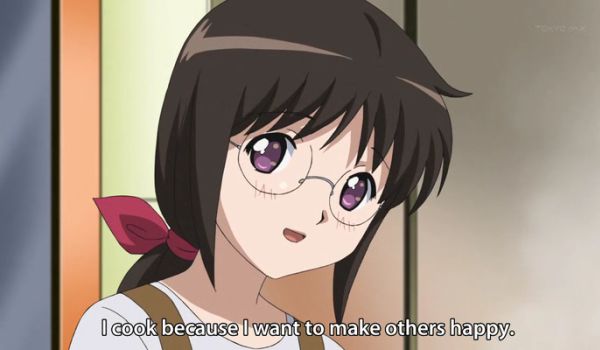
“I cook because I want to make others happy” says this ideal girl from a Japanese cartoon. I suppose this is more or less why I write as well, it certainly does not pay my bills. But do people actually become happy when you do something for them, or is it the one who does something for others who becomes happy? Both? Depends?

“Can happiness be shared?” sounds like a crazy question, but I do not mean to ask whether two (or more) people can be happy together. Rather, my question is more like “can a happy person give away some of his happiness to others?”

This is not a completely theoretical question for me. I am actually quite happy most of the time, pretty much except when I am sick and getting sicker, or when I have just made a mistake. On the other hand there are many unhappy people in the world, and a few of them are my friends. There are probably many more who are not exactly unhappy, certainly not to the point of complaining about it, but who feel empty and dissatisfied or frequently experience boredom in their everyday life. Could I transfer some happiness to those who need it more?

This seems easy enough if you believe that happiness is a matter of money. Simply give them money, and they will be happier than before they got it. Certainly this seems to be the assumption of most of the world’s governments, and it is not entirely pulled out of Marx’ behind. At a low level of income, where you cannot afford life’s necessities, money makes a huge difference. So if some people have plenty of money and others are starving, it makes a certain sense to steal from the rich and give to the poor, at least if you can somehow convince the rich to continue collecting riches that you can steal. This is a pretty big part of the “art of politics” in our time, but the time for this is probably about to end, because people are gradually realizing that happiness is not quite that simple.

There is a whole new “economics of happiness” being crafted now, based on studies of large numbers of people. For instance, happiness for men is strongly tied to marriage, and somewhat less to employment. For a man, in terms of happiness, a wife is worth years of hard work. This should not really come as a surprise to anyone, I guess. Now as we are moving toward economics of happiness, imagine the chaos if the state were to try to ensure maximum happiness in this regard. Especially since there is no such strong link for women. (Actually, it is totally possible that women marry happy men and avoid the unhappy ones – the statistics would look the same without a control group forced to marry at the behest of the scientists. Let us hope we’ll never know, then.)

Others look at what kind of people are happy. They find that those who do something for others, without getting paid for it, tend to be radically more happy than those who don’t. Again, this is rather old news: “It is more blessed to give than to receive”, as was said almost 2000 year ago. But there is also the possibility that happy people are more likely to volunteer than their depressed brethren, and again the only way to find out for sure is to try it for yourself and see if you feel happier.

So, it would seem that happiness is a bit like stamina: There may be a genetic component, but if you are even vaguely healthy, you can improve it by doing certain things that may seem unpleasant at first. Happiness exercises, in this case. But if that is so, we cannot send other people our happiness, or at least not to a great extent. They will have to grow their own happiness by walking the path that leads to it.

The truth is probably that you can do both: Give a man a fish, and he has food for the day. Teach a man to fish, and he has food for a lifetime.

***

EDIT to add: Since some may not be familiar with the research, I will point you to this little BBC article on happiness which drops some names that are useful for your further Googling. In particular, I am thinking of Professor Oswald on the economy of happiness (he assigns price tags to various things not buyable, to compare them) and Martin Seligman on how to live a happy life individually.

The few who know

I did not even know there was chestnut cream on top of Mont Blanc! What is my head filled with?

I am not even talking about esoteric knowledge here, just plain ordinary things that people supposedly learn in high school:  Does radar use sound waves, do antibiotics cure a common cold? Obviously if you ask 1000 coins about this, you will get about 500 yes and 500 no. If you ask a large number of Americans the same, you will get about 55%, usually but not necessarily of the right answer.

55% may sound a decent number.  If 55% of adult Americans know that radar uses radio waves (electromagnetic waves), then high school teachers may still be able to pat themselves on the back. But unfortunately, it is not so well. Remember how we got almost the same result from flipping a coin? Well, not exactly the same result.  We need to find a number that, together with half of the rest, produces 55%.  Or, for the people who don’t think like normal people, X+(100-X)/2=55.  In any case, we find that if 10% of the population actually know the answer, and half of the other 90% are right by pure luck, this gives the result shown in real life.

This also holds true for more complex equations. For instance, there recently was a study showing that 18% of polled Americans thought President Obama was a Muslim, while half did not know. That leaves about a third knowing that he is officially a Christian.  (There was, as you may remember, quite some controversy about the pastor of the church he used to attend, one Reverend Jeremiah Wright.) So, it is obvious that the “Don’t know” fraction should be larger, but should it be larger by 18%?  No, according to our coin toss theory, it should be larger by about 36%.  If the 18% who got it wrong had bad luck, then there would also be 18% with good luck, as it were, leaving only about 15% actually knowing the professed religion of their president.

(Arguably this may be a good thing, since the US officially has a separation between church and state. But as an expression of the overwhelming ignorance of publicly known facts, as a part of a great pattern of “Don’t know, don’t care as long as I can’t eat it or have sex with it”, it is somewhat more sinister.)

How did it end up like that? Well, as I recently wrote, people are stupid and crazy as part of a long-standing tradition going back as far as we can follow. There has been some pressure on some people to be smart and sane, but not many. For most, it was good enough to till the soil and don’t stand out from the crowd.

Contrary to appearances, modern journalism is not actually trying to fix the problem, but make money off it. If you look objectively at the “news”, you will find that much of it is actually more like pornography, except with Wrath instead of Lust.  Or sometimes both.  But the point is, it aims to excite rather than inform, much less elevate to a higher perspective.

Let me take an example that has made the rounds in social media lately. Evidently a large American retail chain has given a generous donation to a political group that supports a candidate who opposes gay marriage. Outrage abounds.

Now, it so happens that in the US (but not everywhere else) the politicians who oppose gay marriage are generally those who promote business-friendly legislation as well. The history of this goes well beyond the bounds of this essay. The businessmen probably did not even consider that anyone would think they had an opinion on gay marriage. Why should they? It is rare even in the countries where it has been legal for years, and it does not drastically alter the shopping habits of those involved. It is highly unlikely that a supermarket chain would be able to notice the tiniest blip on their bottom line in any case.

But “business donates to business-friendly politician” is not a headline suited to create outrage. And outrage is what people want, so that’s what they get.  The fact is that the journalists and their readers are both immersing themselves in hellish thoughts and creating suffering for themselves. But at least it is exciting. People love that. They would rather suffer than be bored.  How a human can be bored while still having all its limbs and senses is something we will never know, we who write online journals.  If we had the capacity for boredom, we would not have the capacity for writing, and the other way around.

And there you have it: The people who create opinions are somewhere in the range of 1-10% of the population, depending on how generous your definition. It is not a long shot that these are the same people who know random unnecessary things. And write about them.

People are stupid and crazy

Parental explosions is just one of the things most humans have to contend with. Parents should be filled with inexhaustible love and wisdom, but sometimes the difference between father and toddler is mainly one of physical strength. People are stupid and crazy.

Today I want to write calmly and objectively about the fact that most people are stupid and crazy.

In the past, we were in contact with only a few people. In the village, the same people were our neighbors, friends (or enemies) and more or less distant relatives. Today, I hear from people living in different towns or cities and even different countries. And yet many of them have the same experience: They are surrounded by idiots. Neighbors, customers, coworkers, fellow travelers, even relatives. Usually stupid, sometimes crazy, or both.

The reaction varies, depending on temperament and the actions to which they are exposed: From amusement to disdain to anger. But there is another emotion underlying these, and that is what I want to confront: Surprise. Somehow there is the expectation that ordinary people should not be stupid or crazy, that this should be reserved for a special few. And with that comes the logical question of why these few have decided to cluster around me. Why me? Why must I, of all people, be surrounded by idiots?

The truth is that almost all people are surrounded by idiots, because almost all people are idiots. This is not new. Throughout recorded history, there has never been a time when most people were smart and sane. Historians have simply decided to ignore this for the most part, mercifully. Actually, I believe things were worse in the past. Much worse.

I present to you the fact that around the year 1900, when my maternal grandfather was already born, it was considered perfectly reasonable for men of good breed and classical education to duel to the death over the heart of a lady. The survivor, if any, would then presumably take ownership of the Cattle With Breasts, who generally had no reservations or at least no ability to enforce them. Today, in the upper layers of society, I dare say that people would simply ask her to choose instead. But people were dumber then, impossible as this may seem at times.

Seriously, throughout most of history, most people were illiterate, uneducated, malnourished and forced to work hard from early childhood. Being stupid and crazy came with the territory. The few glaring exceptions are the ones who are remembered today, for the simple reason that they created today’s culture. We are their cultural heirs. Without the exceptions we would not been here.

So what is your neighbor’s excuse today? We are no longer illiterate, malnourished and forced into child labor. Why don’t we all grow up to paragons of wisdom and sanity?

Well, one thing is the purely biological mental capacity. In an age where it was normal to be stupid and crazy, there was no strong selection pressure to weed out the stupid and crazy. Quite possibly the opposite, at times. As long as you could till the soil, milk the cows, and not try to reform religion, you were good to go. You stood an excellent chance to survive long enough to reproduce, especially since you probably started early. Of course, many of your children would die, but being smart or sane would not have changed that, since there was no option to have your children vaccinated or even to learn that drinking uncooked water might kill them.

Then there is the matter of family tradition. If your great-grandparents were stupid and crazy, how do you think they raised your grandparents? And how did your grandparents raise your parents? Somewhere along the road you and I lucked out. Someone intervened, quite likely a teacher, breaking the chain of insanity and tempting someone into thinking more clearly, or more at all. Perhaps someone even just stumbled across a book, and having learned to read in school, found within the book the seeds of sanity. It was no sure thing. I can bring witnesses that not all teachers even today make a big difference in favor of wisdom.

In the last instance, there is also the personal responsibility. Even if you have the opportunity to become a bright light, you may decide not to, or simply not decide at all. Many promising young people decide that there is more fun to be had by taking various drugs or simply getting dangerously drunk repeatedly, even if it impacts their future brain function. Or they just have other hobbies than thinking. The day only has so many hours, after all.

So when we meet a stranger, we should not do so with the expectation that they will be just like us. The very fact that you have been able to wade through this vast text (with long words here and there) is proof that you are not an average person. I am not recommending paranoia, of course. Most people are not actually malicious, just stupid and to some extent mentally unhinged. They don’t particularly want to hurt you. In fact, you are probably not quite real to them, as most people have plenty enough with thinking of themselves and, in the happier cases, their closest family. You are just a bystander that may provide them with money, sex or someone to yell at when angry.

You may think me a misanthrope at this point. And it is true that I have studied misanthropology for a long time, but I have done so largely in my own life. I have studied why I, of all people, fail to live up to my expectations. And so I have concluded that being human is not all that easy, even with a good starting point, which most people don’t have.

We should love and help people, because they need it, and because it is the right thing to do. If the reasonably smart, reasonably sane people don’t try to help keep the wagon on the road, who will? The blind, leading the blind?

To borrow an allegory from Ryuho Okawa’s latest book (Change Your Life, Change the World), a loveless society is like a hospital filled with patients screaming and moaning in pain. If there are no healers of the soul, how will they get better? Should we just quietly hope that they will die so the screaming stops? It is not likely, there will be new patients replacing the old.

Now, I am not well suited to go out among people and spread love and joy. After all, I am a weirdo. But someone who has an established family life, non-ugly looks or an admirable economy may be in a position to impress those around them with the benefits of sanity. Please, consider it, or at least don’t go around with a shaker of salt for their wounds…

tl;dr

Pick one or another! People only read blogs that cater to their particular narrow interest, so should I stop writing about a thousand different things?

The dreaded acronym tl;dr means “too long; didn’t read”. I hope the use of an acronym was originally ironic: If not, it shows the sad state of impatience that is widespread in the world.  As I mentioned last time, this is not entirely due to the Internet: The TV remote and the crazy jumpy nature of TV programming has prepared us for the world of soundbites.

But this time is not about how we got here. This time is about what I should do about it.

I have written literally thousands of journal entries. By coincidence, or inspiration, or copying Debra, I have included a picture at the start of my entries from the very beginning. This was smarter than I knew, because I know today that people turn and run at the sight of a huge screen of text. A pretty or funny picture puts them in the mood to stay long enough to overcome the backspace reflex, and possibly read some of the text.

That said, even I reached the tl;dr point of my own journal after about ten years.  That’s why I went on hiatus, and that’s why I eventually shifted my journal to WordPress.  The old HTML setup was great, arguably better in some ways.  But the link to the years-ago entries (1 year ago, 2 years ago, …, 9 years ago…) caused me to go back and read those.  And when I had done that, the day was pretty much gone. I did not have time to write a new entry too. So I stopped.

If even I cannot read this mountain of text I have produced, who else will?

One problem is that the quality varies randomly.  Not just the content, but the quality.  The content is one thing, you cannot expect someone who came for the Sims to stay and read about spiritual practices.  (Although the Sims do yoga and meditation…) But even when writing on the same topic, sometimes I write better than other times.

And of course I change over time, and facts change over time. So I may contradict myself, when I don’t repeat myself.

Perhaps I should just keep adding seemingly random stuff at this end of the journal, and leave to historians of the future to try to organize it. I mean, who else would, when even I myself can’t imagine going through it all?

Or perhaps I should split off different categories into different blogs. Actually I already have that.  I have a pretty much purely spiritual blog in English, a personal and a political / philosophical blog in Norwegian (that I rarely write in), I have my Sims blog on LiveJournal, I have Twitter and FaceBook. But I could go further.

I have considered  making a more systematic overview of my philosophy of the mind. A kind of one-man Wiki perhaps, with links between the different parts that relate to each other.  Or perhaps something more similar to a book, which imposes a kind of narrative and presents my thoughts in order.

Then again, should I really do that for the couple readers who don’t come just for the pictures?  If it is that important, historians of the future will do it.  If it is too long, people won’t read it anyway, right?

tl;dr: I don’t know how much work I should put into writing for a generation that does not read.

Webthink vs bookthink

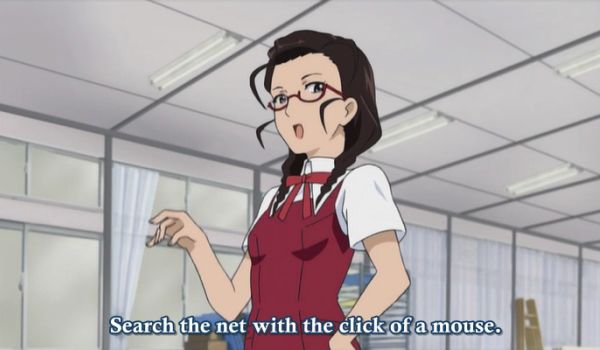
Search the net with the click of a mouse! It is almost too easy…

So there has been some worry about how the web influences our thinking. Not just the content of our thoughts – actually, with Google at hand, we probably think a little more factually where we used to be guesstimating – but the WAY we think.  Studies show that people don’t read more than a few paragraphs. For instance, statistically you probably don’t read this entry to the end, at least if I provide a link somewhere before that.

In the past, people read books, so the theory goes. Books are deeeep. They let you immerse yourself in the narrative, build a grand cathedral of interrelated facts (or fiction, as the case may be), with many relationships knit together, thorough analysis and a span of time.  What is not to love? But now, people click the first link they see, and if they see a block of text filling the whole screen, they press backspace.

The idea is that people are starting to do this in the rest of their life too.  Certainly newspaper and magazines are starting to include highlights and fact boxes for those who can’t take the time to read the whole article. Who is to say that we are not adopting the same attitude in human relationships.

Don’t worry about that last part, say I.  Most people were always going on tangents anyway. Besides, the few who could follow a long narrative during a conversation, were the ones who followed their own, regardless of what everyone else was talking about.

And seriously, which came first, the hyperlink or the the remote TV control?  Even though many TV channels already look like someone is clicking frenetically on the remote, with random changes of angles, colors, faces and scenes, people STILL click the remote anyway. Because they can.

The books, I give you the point.  But take a trip to the nearest book kiosk and look at what kind of books they sell, and which of these again people actually buy.  Murder mysteries and Harlequin romance. And even then, people read them on the plane, subway, doctor’s waiting room or wherever they don’t have anything else to do and people would look strangely at them if they touched themselves.

There may be some who used to read War and Peace and now are unable to read more than a couple paragraphs.  That is worrying. (They should also see a doctor and get tested if they are 40 or above, Alzheimer’s is a terrible and creeping illness.) As for my humble self, people I have met on the net – like Carl McColman, Robert W Godwin, Ryuho Okawa – have made me not only return to books, but start to build a library of timeless wisdom instead of the hundreds of fantasy and sci-fi books I used to have.

You have to take responsibility for your actions.  But at least now you have more chances to learn things from cultures far from your own, geographically or in thoughtspace. If that is what you want. Or you could read numerous explanations of why George Bush is the Antichrist and will return to imperil us all once again.  It is up to you, really. You could even log off and read a good book.

But if you just did that, you would miss out on your reward! A link! Click it click it click it! The Last Psychiatrist – whose irony, wit and clarity of thought surpass even my own! (You know how hard that can be… but then again, you are not reading the rest of the entry after the link, so I can write whatever I want here.)

Online libraries revisited

It will take its sweet time to restock my bookshelves after getting rid of the worthless stuff. But should I really fill them again? What is the chance that my heirs will want to read “The Challenge of Enlightenment”, “Meditations on the Tarot” or “One Cosmos under God”? Chances are they go on the fire or a landfill eventually.

This entry first appeared in my LiveJournal.

I have to say this Questia thing is somewhat impressive. If they had offered an Android client rather than just iPhone, I would probably subscribe. While it seems to be geared mostly at students and young researchers, there seems to be a lot of good stuff in there.

Of course, what I really hope for is that Google gets permission to do something similar. Millions of books, for free, on every imaginable device. It just might spell the end of the bookstore as we knew it. As it is, I use Google Books along with Amazon.com to scope out books before acquiring them (or not, usually).

But so far, there does not seem to be a “killer app”. You’d think governments at least would want to give their citizens an online Great Library, so as to surge far ahead of all other countries in the world and launch the next Renaissance. But perhaps an enlightened public is the greatest fear of a politician. In any case, leaving it to the market is even better. Imagine the world under Swedish hegemony.

There is also the Baen Free Library, but that is somewhat limited (to a subset of Baen books, naturally) and rather non-academic in nature, to say the least.

Project Gutenberg seems to still be geared toward download rather than online reading. It is one of the oldest attempts at creating a Great Library online. Constrained by its volunteer-based approach.

There is also something called “The Free Library” which has somehow been hiding from me until now. It is ugly as all ugly,with an undocumented and self-defeating interface, but it may still be worth much more than you pay for it, considering that it is free.

Anyone have any others?

Flattery, lol

Why am I not excited? Read on to find out!

You may not be aware how awesome I am, but the comments I receive show it. Here are some of the most recent:

“an outstanding blog if i ever seen one. If you are the type to update your website daily, then you have gained one daily reader in me today. Please keep up the powerul work.”

“Thanks for the interesting content!!!”

“Incredible post. You really understand what you are writing about here. Im so happy I was able to locate this site. I look to see more great writing from you. Keep up the excellent work.”

“I just wanted to comment and say that I really enjoyed reading your blog post here. It was very informative and I also digg the way you write! Keep it up and I’ll be back to read more in the future”

“Wonderful to read!”

Weren’t those all nice comments? And weren’t they all completely free of references to what I actually wrote? And weren’t they all from people whose contact info is some shoddy commercial website? ^_^  Yes they were!

Humans are so weak to flattery, it is hilarious. Well, it is all fun and games until someone loses an eye, as they say. Or their mind.  Or their virginity.  Or an awful lot of money, I guess, especially if you lose more than you have. Ancient Scriptures compare flattery with a hunter setting a trap, and that is certainly apt.

As you become able to connect to higher realities – through religion, philosophy, science, great literature – you can afford to think more objectively about yourself. Well, it is unlikely that we will do so 100%, but we can certainly move in that direction. And as we do, we gain resistance to flattery. This is an immensely useful power to have in real life.