Debating when it’s over

di091128

The very existence of your future dinner probably has very little to do with what politicians think about global warming. I’ll explain why.

The magazine The Economist (of which I generally hold a very high opinion) says in a recent article: “The stakes in the global-warming debate, however, could scarcely be higher. Scientific evidence that climate change is under way, is man-made, and is likely to continue happening forms the foundation for an edifice of policy which is intended to transform the world’s carbon-intensive economy into one which no longer spews greenhouse gases into the atmosphere. A lot of money, and many reputations – both academic and political – are involved.” (The article may not be available for non-subscribers, but can also be found in its print issue for this week at your local library.)

I hear a lot of this, how important the global warming theories are for our economy. I disagree. This is a fairly uncommon thing between me and the highly respectable magazine, although our differences have increased somewhat in recent years as it has moved slightly to the left and I to the right, politically. Facts, however, ought to be facts. But if they were, we would not have that particular debate in the first place, would we?

My point however is that it matters little. The carbon economy is temporary in any case, and its decline is imminent, if it has not already begun. Certainly the seeds of its destruction is sprouting, and global warming is but one of them. Even if we actively wanted a warmer world, we would not be able to keep it up. There simply is not enough of our favorite fuels to sustain the current way of life.

Do you guys remember a couple years back, before the economy panicked? Do you remember the gas prices? And even then, the oil companies actually sold at a loss, to smooth out what they hoped were a temporary surge in crude oil prices, at times over $140 a barrel. Well, it was temporary, but this has brought no joy. If you know any of the Americans who were publicly praying to God for lower oil prices, today is a good time to go thank them. They sure got what they asked for, if not what they hoped for.

Technically, the recession has ended, at least in America, in the sense that there was nominally a small increase in GDP last quarter. But we all know that this was caused by government intervention that is not sustainable. On the contrary, the flow of money must at some point be reversed. And even with this, we just got a break in the fall. Obviously we are not back to the previous level of economic activity. Just ask the millions who are out of work. But this is also the reason why gas is cheap again. We simply use less of it, because we drive less.

Should the economy pick up again, to anything near its previous level, then we will face the same problem again: There just is not that much oil left for easy taking. And most of it is in one country, Saudi Arabia. The rest of the oil in the world is rather harder to get at, and the price reflects this. The reserves, as they are called, the oil that is not currently being tapped, are mostly even harder to get at. They are deep underwater, deep underground, or in the Arctic, or several of the above. In short, oil is getting expensive, and after that, scarce. We are not going to be driving gas-guzzlers in 2050, or even 2030. It is doubtful that most people will even be driving gas-powered cars by then.

Well, at least there is enough coal left for two centuries, right? Er… that’s what the major coal producers say. However, these fall into two categories. One is the nations of Russia and China, where the government in practice controls this resource. Strangely enough, their coal reserves have not changed at all for the last couple decades, despite pretty heavy mining. If they let on that they don’t have unlimited energy, the governments would lose prestige. In the western world, it is subtly different. If coal mining companies did not exaggerate their reserves, their stock would fall, and that can not be allowed.

An article in New Scientist a couple years ago estimated that the world’s coal reserves may only last two decades, not two centuries. That is probably exaggerated, but there is no real audit of these things and the official truth is completely in the hands of people whole livelihood depends on lying.

In any case, coal is not oil. It can be burned to produce electricity, but here it is facing competition from new technologies of renewable energy. Wind power has already reached the mass of industrial production. The technology is still improving a bit, but mainly it is now a matter of churning out more windmills and placing them in the terrain. This goes on every day. It is still a small fraction of our energy needs that are met this way, but it is growing steadily.

Solar power, meanwhile, is still in its infancy. Photovoltaic cells are, like most electronics, becoming increasingly smaller and more efficient. Each year they are a little better than last year. Meanwhile there are various forms of solar thermo being put in practical use. These use cheap metal mirrors to focus the sunshine on a container of liquid, heating it and producing steam like you would in a coal factory. Except that the sun is expected to not run out for another 5 billion years or so. By melting salt and using this to heat the water, solar plants can continue operating through the night, as the melted salt can be stored underground and lose very little heat until used. These technologies are slightly more expensive than coal, so currently tend to depend on government subsidies (or taxes on carbon). If however the recession ends, the price of coal will go up again. The price of sunshine will not.

This is the point: We have non-carbon technologies that either are competitive today or will be so whenever the recession ends. Even if it never ends, the easy reserves of fossil fuel will, and in a few years. Meanwhile competing technologies are becoming cheaper.

Even if we WANTED to heat the planet with carbon, we can’t afford to. It is that simple. Renewable energies will price carbon out of the market in 10-20 years. Mankind is suspended between the furnace of the sun and the furnace of Earth’s molten core, each of which could supply us with clean energy for billions of years if we manage to not kill each other in the meantime.
Happy Science or just science?

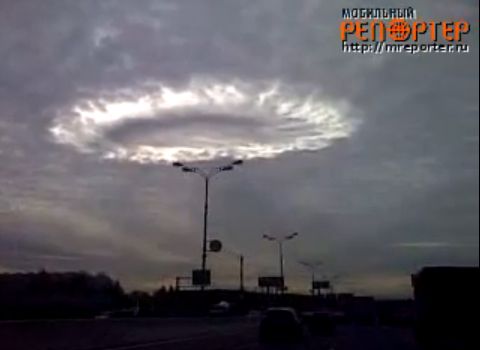
CloudMoscow

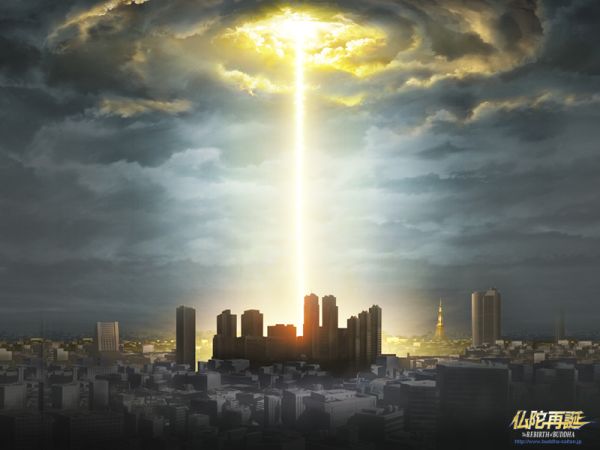
This picture is taken from a video on YouTube portraying a strange phenomenon over Moscow.  Scientists say that this is a rare but not unheard of meteorological  phenomenon called a “hole punch” cloud.  What made my spine tingle, however, was the similarity to the promotional poster for Happy Science’s newest anime, to be released on the 17th of this month, The Rebirth of Buddha.

bs2_600_450

Hole punch indeed!  Suspicious, ne? Hopefully it is the artist who has been inspired by real-world hole punch clouds (even though they are so rare) and not the other way around…

Genius and genius

di091005

( Screenshot from the computer game City of Heroes.)

Being very smart is like being able to run very fast. But true genius is like being able to fly. You see everything from a different angle.

When I was young, I thought that genius was just a matter of IQ.  You had an IQ over 140 or some such, and you were in.  And it is true that the word is used that way (although some say it should be 180 and some say 120.  An IQ of 140 is the requirement for Mensa membership though, a fairly well established institution.)

It is true that the word “genius” is used this way, but I know today that this is misleading.  I have lived and learned.  There is another meaning of “genius”, an older one (albeit not the oldest). I am pleased to see that Wikipedia has, at least at the moment, chosen this as their main definition:  “Genius refers to a person, a body of work, or a singular achievement of surpassing excellence. More than just originality, creativity, or intelligence, genius is associated with achievement of insight which has transformational power. A work of genius fundamentally alters the expectations of its audience.

This is a bit strict again, I think.  But genius certainly goes beyond the ordinary. My favorite metaphor is that having a very high IQ is like being able to run very fast.  Amazingly fast, for the differences between people’s minds far exceed the differences between their muscles. But no matter how good a runner you are, you arrive at the same places as anyone else, just faster. True genius, however, is like flying.  You go places other people just can’t go, and see things from whole new angles that others can’t see unless you somehow manage to show them.

This “uplift” is what I would call inspiration. Genius and inspiration go together.  Oh, you have the Edison quote that genius was 1% inspiration and 99% transpiration.   But the sad thing is that most people just don’t have the 1% inspiration. Anyway, “inspiration” clearly come from the word “spirit”, and “genius” originally was the name of a spirit associated with a person, a place or perhaps most common, a bloodline.  We don’t take it quite that literally now, but a true work of genius still makes us sense that we are seeing something that comes from a higher world, a different and more deeply “real” world.

Now, if you have the wings of inspiration, you may be able to ascend to somewhere a bit above the mundane world.  But if you want to share that view with others, the transpiration sets in. For you cannot just call on them to join you, and even if you try to tell them what you see, chances are that they will imagine something different, since they have never seen anything from above. You have to somehow create a pinnacle and the stairs for them to get there, to see what you have seen and to be where you have been.  You can just give up on that, and you will never be anything more than a dreamer.  Only those who can share their uplift with the world will be remembered as a genius, and will be of use to the world.  What good would Bach have been if he had just whistled to himself, hearing his music in his own mind?  What good if Einstein had just had the flash of insight that E=MC^2 and never bothered to work out the mathematical foundations to prove it to the world?

But as for me, I’m just a dreamer.

“It ain’t wise to need someone”

di090918

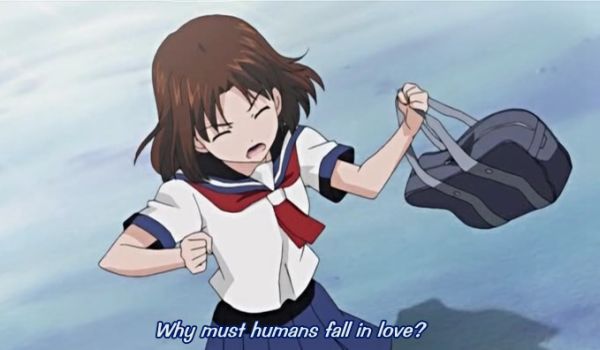
Why must humans fall in love?  Don’t ask me – I don’t.  But it fascinates me, perhaps in the way childhood must have fascinated Adam:  It is an essential part of life to everyone else, but I was not created that way.  (OK, it is generally accepted that Adam was not a historical person.  Then again, not everyone believes that I am who I am, either…)

I woke up to the clock radio this morning again. It played a song by Bonnie Tyler, It’s a heartache.  Personally I am more familiar with heartburn, but the lady sure put her soul into it. I happen to recognize the name because I already had a song by her in my Love Song Collection. It is called Total Eclipse of the Heart.

Yes, she seems to have a particular ability to perform songs of despair.  Perhaps she should look into a career in politics, preferably on the Left.

All this is later reflections, though. At the time, while deciding whether or not to wake up, I heard Bonnie Tyler singing “It ain’t wise to need someone” and I was like “Amen, Sister!”. Admittedly she modified it after drawing a much needed breath.  “It ain’t wise to need  someone / as much as I depended on / you.”  But my libertarian little soul wants to put a period after the someone.  One should not depend on others and not be depended on by others, is how I feel.

That’s not very realistic, of course.  Something Ryuho Okawa repeatedly points out in his later books is that we are all born with nothing.  We would not even be able to survive without receiving unconditional love to some degree at the start.  Everything we have at the present, we have because of other people.  They may not particularly have helped us out of pure ego-less love:  For instance, our teachers probably got paid for teaching us, and our employers expect us to bring in more money than we take.  But still, we would be in a bad spot without them.

You may feel alone in your car, but numerous people have worked on making it (and making the machines that make it, and mining the ore and so on).  Numerous others are involved in making sure you have gas to fill your tank, from  the geologists planning where to test drill for oil, all the way to the gas station attendant.  In a way, you are never alone in the car: The help of a thousand souls are with you, even though very few of them intended it.

In truth, we mostly live in a world of mirrors: Each of us more or less give back what we receive.  There are very few original thoughts, and most people don’t even try, and are in fact skeptical of anything not already accepted by the masses.  We neither resist the culture around us, nor make an effort to improve it.  Even though the people who eat with chopsticks and the people who eat with forks have known about each other’s habit for generations now, there is still no agreement that one of them is clearly superior.  Well, the fork seems to be making a little progress, but overall people do what they saw their parents do when they were small.  People whose parents were swearing tend to swear; people whose parents were praying tend to pray, and mostly to the same gods.

So we are connected to other people whether we know it or not. In fact, we are interwoven with them. Day by day we depend for the food we eat, the clothes we wear, the words we speak and most of the thoughts we think. And we don’t even notice. Independence, in its radical form, is impossible, even unimaginable. That is not what I think of when I say “It ain’t wise to need someone.”  What I mean is, it is not wise to depend on someone special to provide our happiness, or our meaning with life. Well, unless someone special is God, I guess, and even then it is right only in a certain sense.

But romance has become a false religion. Instead of finding our heart in another, our culture makes us hope that we can avoid finding our heart at all, and just depend on the heart of another.  That won’t work.  You can’t substitute anyone for your soul.  You cannot let anyone replace your conscience.  And you can’t go hand in hand into eternity, poetic as that might have been.

There are limits to how individual we can be, but also there are limits to how much of ourselves we can give up.  These limits vary from person to person.  Very few humans can be as individual as I am, so free to be themselves and think their own thoughts.  And yet most of those who can’t, are convinced that they are almost completely independent, relying only a little on others.  While I realize that I am a more colorful thread in a large tapestry.  I have a little wiggle room, whereas they who move not at all feel no resistance.

But then something happens, and the things we took for granted are suddenly no longer there. And we think: “It wasn’t wise to need someone that much.”  No it wasn’t, but a greater foolishness was to not realize that we needed them when they were still there.

Norway’s general election

di090914

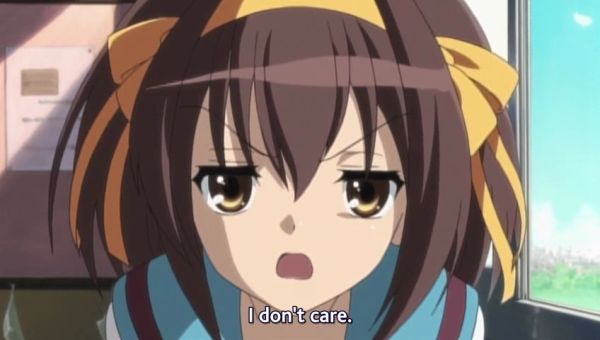
I don’t care.  And if you manage to plow through the following explanation, you will see why.

There is a general election in Norway today. I am not voting, not even following the vote counting on radio and the Internet.  I care so very, very little.  And neither does the world, I’m happy to say.

Norwegian politics are not particularly interesting.  Then again I think the same about soccer, and thousands locals still stake their happiness on it.  I guess there is some primitive need to belong to something greater than oneself.  In my case, of course, neither soccer nor Norwegian politics count as “greater”, only “bigger”.  I may be conceited, but then again so are those who engage in these things.  As I may or may not already have told you, I have yet to see anyone politically active without being discontent.  And yet, despite not being happy themselves, they want to help others.

With the Happiness Realization Party not yet present in Norway, how were things lined up?  We had a vaguely socialist coalition that had rules Norway for four years.  This was the first coalition government on the left ever, as far as I know, although the Socialist Left has generally been a loyal supporter of the Labor government for the simple reason that they detest everyone else even more (and are detested in turn).  The Socialist Left want Norway out of NATO, punitive taxes on the rich, high but bearable taxes on workers,  and plentiful immigration of the people who want them dead and their ideas eradicated from the face of the Earth.  In short, they are a bit out of sync with consensus reality.

On the other fringe of the 3-party coalition is the Center Party, which ironically hates centralization more than anyone else.  Once upon a time their name was Farmer Party, and the party’s backbone is still the farmers and the food processing industry that depends on the farmers.  They are also peacefully nationalistic, in an isolationist and protectionist way, not in the sense of invading other countries.  Formerly a non-socialist party, they shifted their allegiance in return for guarantees that Norway not join the European Union, which they strongly dislike.  In this they have found a staunch ally in the Socialist Left.

In the middle is the Labor party, which used to be the largest party in Norway.  In fact, they used to have absolute majority in the Storting, the Norwegian parliament, for most of my childhood and youth.  But perhaps because of their name, their glory has been fading. They still have a very strong organization and contacts everywhere in the bureaucracy, where they planted leaders during their time in power.  And not least, they have the main Labor Unions on their side.   They are also the most mainstream of all the parties.  If something is uncontroversial, you can be sure they are for it.  For this reason, despite being nominally on the socialist side of things, they are strong allies of the USA and eager supporters of NATO.  They have even cut the income tax, but not by much.

The opposition is even more fragmented, really.  The largest party is the ironically named Progress Party – ironic because they are the most conservative of the bunch, and in many ways even trying to go back to the “good old days”.  I suppose this is progress if we have been moving backwards for the last couple decades.  I won’t say we haven’t in some ways.  But unfortunately the Progress Party has become the default home for the stupid.  Promising extremely low taxes, better health care (paid by the state), higher pensions (paid by the state), better roads, a drastic upgrade to the police and military, and of course cheap alcohol.  They will pay for this by scrapping all farm subsidies, financial support to single mothers,  and foreign aid. But most of all they want a stop to allowing people from incompatible cultures to seek refuge here.

Over the course of my adult life, lots of people from other countries have moved to Norway. Most of them are Muslims, but there were also periods when we got people from Vietnam and Chile.  For a short time, we allowed people to immigrate to work here. This was when we had just started extracting oil from the North Sea, and in a kind of national drunkenness we decided that from now on we would let other people drive our taxis and clean our toilets,  it was beneath our dignity.  Or something like that. Anyway, we let in a good number of Pakistanis, and life was never the same again.  We soon closed the border to immigration (except to other Nordic countries and later the European Union) but continued to accept asylum-seekers.  These are for natural reasons often mentally unstable, and always unfamiliar with our culture. They now account for a significant part of our crime, particularly violent crime.

The Progress Party, always gunning for the simple solution, wants all people with foreign cultures out of the country.  If people want to live here, they should learn to speak Norwegian, and follow Norwegian traditions. Otherwise, leave now.  Simple, right?  Except people with very different cultures tend to come from very different parts of the world and therefore look very different from us.  So throwing them out would be racism.  We can’t do that.  (It also helps that the Progress Party, catering to the stupid, also has most of the country’s actual racists in its ranks.)  So they have become political lepers.  No one want anything to do with them.  And they are the biggest party.

Thanks to this, the Red-Green coalition will get another 4 years, if they manage to  stay together.  Because the opposition is too divided to present a serious alternative.

Daemon summoning

di090909

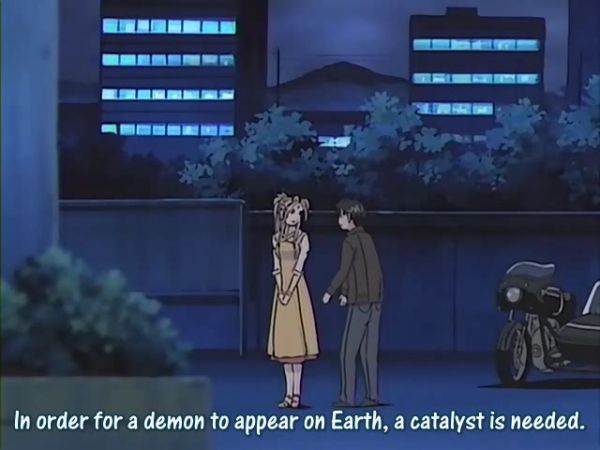
Demons, unlike animals and plants and stones, don’t exist in this world independently from humans. This is quite a good thing! The bad thing is, people are eager to raise hell, so there is still plenty of deviltry around, even though we have other words for it these days.

Most people these days don’t even believe that demons exist. This is true enough in a physical sense. You can’t put them in a box or take a blood sample of them for your test tube. You can’t take a picture of them, or measure their presence with radiation detection.

And yet, the same things that made our ancestors believe in demons still happen. For instance when someone gets angry or lustful, they may do things they would not normally even think of, and then they say: “I wasn’t myself” or “I don’t know what possessed me”.  In the past, a demon might have been blamed. So in a way it sounds as if we know less these days. But on the other hand, we don’t have the temptation to just blame the demons and pass ourselves off as innocent. This may be uncomfortable, but overall I think it is a good thing. Or would be a good thing, if we actually did take responsibility.

The thing is, we are back to the old metaphor of the rising and setting sun. Today we know full well that it is not the sun that rises and sets, but this knowledge has not caused the sun to stop. The same actual effects are still happening before our eyes, even if we have a different explanation for them. In the same way, blaming complexes instead of demons does not really change the fact that people still suffer.

Despite a very recent origin, Happy Science (Kofuku-no-Kagaku) still believe that stray spirits from Hell can torment people. But they hurry to add that we can avoid this by taking responsibility for our own mind through self-reflection. I would like to say more about this, but I don’t really know as much about it as I want. Anyway, in this religion the stray spirits are attracted to people who have a similar mindset.  So by giving room for dark thoughts, people draw dark spirits to themselves. You may say that they are performing a kind of demon summoning, without wanting to, or even knowing that this is what they do.

The same would probably be the case for someone who harbors perverse sexual lust in secret. In the old days, it was believed that demons of female form would come to men, especially celibate men, and offer them sexual favors. These succubi (succubus in singular form) would arrive in dreams or even when awake if you were celibate and alone. There were also “incubi”, male demons who would intrude on women, though this seems to have been less common and less intense overall.

Today we think of these as figments of our imagination, but the effect is still the same. They may come on their own or we may summon them, and despite their non-corporeal nature, our bodies still react to them. So how much has really changed? We have changed our language but we have not really changed our nature.

So am I saying that people who watch porn are summoning lust demons, or that people who watch racist propaganda are summoning wrath demons? Obviously not in a physical sense. It is a model of reality, not reality itself. It is a way of thinking about things. “The Tao that can be spoken of is not the real Tao.” For a map to be accurate, it must be as large as the terrain.  So the demon paradigm is a way of thinking about things for those who think that way. I can show you another way of thinking about the same thing, just to prove that you can model the same reality in different ways.

A popular way of thinking lately is that the brain is like a computer, and the human psyche is like the software that runs on the computer. This view does away with the most crass and repulsive form of materialism, in which people believe that the mind originates from the brain. That is pretty ignorant, you know. If you know nothing about computers, then you may be excused to believe that Windows is a part of the computer. But then one day you see someone install a new program on their computer, and you realize that it is not as simple as “you start your computer and there are programs”.

Now, you can install programs from a CD or DVD to your computer. Say you install The Sims 2. Before you installed it, it was not there, but your computer always had the capacity to run it, otherwise you could not do it even after installation. Then some time later you install an expansion pack for the game, and now it has some features it did not have before. And then some time later, you go online and download some new things for your game, such as furniture or clothes for the small imaginary people. Each time you are doing this “summoning”, you are changing the content of your hard disk so that it operates a little differently.

Unfortunately, this is not always a good thing. If you follow false leads, you could download a program that harms your computer. For instance, one time I downloaded a program that was supposed to make it possible to play the game without having the CD in the computer; but when I ran my virus checker on the file I had downloaded, it contained a virus that would take control of the computer. Obviously it is a bad idea to just run download anything you find on the Net and run it on your computer! So why do people do this with their brains??

For example, if you have a sexual perversion, and you go online and download pictures or stories that feed this perversion, that will not leave your mind unchanged. It will burrow into your brain and stay there, changing the way you think. If you keep feeding your brain with this kind of stuff, eventually you start thinking that it is normal. Sometimes I discuss anime (Japanese cartoons) with people online, and they are very excited because in this anime there was a picture of a grade school girl in her underwear, and the sight caused their nose to bleed. (This is a way people in Japan say that they become sexually aroused.) If I remind them that it is wrong to think of children that way, they don’t agree with me. I hope these people don’t have children of their own! Their soul has been damaged so that the natural defense mechanism has been disabled.

I hope you can see how this is actually the same thing that I wrote about above. In fact, in the Unix operating system we use the word “daemon” for a small program that runs on its own without user input, such as a clock or the program that fetches mail. So when you download and install a “daemon” in your brain, it changes the way your mind works, even if just a little.

Conversely there are other things that you can install into your brain that works as antivirus. And then you use this “antivirus” to “scan” your brain by reflecting on your life. How are things really, in light of this Truth? Is there a virus here, or is my mind clean in this particular regard? In this way, it is possible to even discover a mind parasite before it has time to explode into disaster.

I hope this was a little food for thought. It is easy to point and laugh at people who believe in demons, but they are still better off than people who believe in NOTHING. Belief in demons can cause unwanted behavior, like trying to buy off the demons or cast them out with magic instead of with truth, so it is certainly not something you should just casually adopt. But the fact still remains: What we summon into our lives will change us. Unfortunately, I know this from experience. Fortunately, not all of my experience is bad. I once allowed a holy spirit from Heaven into my life, who offered wisdom; and he teaches me and reminds me still, many years later.

Cellphone diversity

di0908018

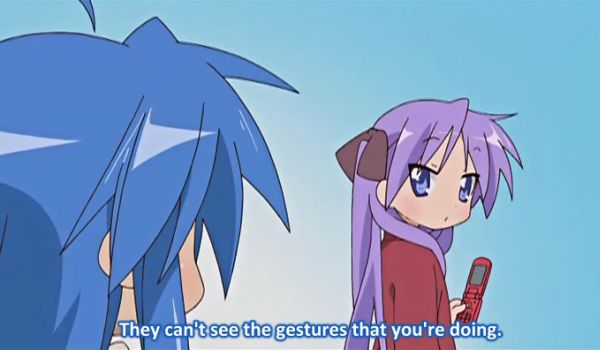
No, really, they can’t see your body language through the telephone, not even when you exaggerate it. All you achieve is to entertain people like me, or Konata here.

Some otherwise well-intending people I know believe that they are not racists (presumably because they are not white), yet they have this concept of “diversity”.  It seems to mean that in any group of more than a couple persons, in order to have the right to an opinion, the group needs to comprise different skin colors.  In other contexts there may also be a need for at least two genders, preferably more, but the color thing is the most obvious and baffling. For skin color to have anything to do with diversity, you almost have to be either a racist or a photographer.  But I am willing to tolerate even that. After all, with the cell phones we have today, almost everyone is a photographer…

If you REALLY want diversity, however, you should categorize people based on how they use their cell phone, and include at least one from each of the main three types.

I see them on the street, I see them on the bus, occasionally even at work.  The age, gender and skin color varies wildly, but they all do the same thing, talk in their cell phones. In this regard, there is no diversity at all.  Even when they speak a language I don’t even recognize, they are all eerily similar.  Surely any one of them, even the one who just came here last year from Africa, is more similar to the rest of them than to me.  I claim minority status dammit! RESPECT ME NOW!

So, the three main breeds of human, as revealed by their cell phones.

Type 1: The talker.  This person, in true reactionary fashion, uses the telephone to talk. As if we weren’t in a new millennium at all.  There’s a lot of these people.  You can usually recognize them as soon as the phone comes out, either because it is already ringing, or because it is small, with a particularly small display and plain, functional number keys filling the rest of the front.

Type 2: The texter. There is an overlap between this group and the first. Some people will talk if reasonably private but text in a more crowded setting, such as the bus. But you will also see them walking down the street, texting and relying on the world to not collide with them.  They also frequently receive text messages, which means they either stick with their own type or have somehow conditioned others to use the same channel to communicate with them.  Their phones are larger, to give room for a high quality display and large keys.  Occasionally the number keys are replaced with a tiny QWERTY keyboard, and inventive ways exist to fold this into the phone when not in use.

Type 3: The surfer.  At first glance this may look like a texter, but the rhythm is different. The surfer will click a few keys, then look at the screen for a while, then click again. Sometimes he (are there even any female surfers?) will type for a while, but there is no finality to it.  The phone is fairly large, but most important, it is almost entirely covered by screen. The surfer will most likely type on the screen with his fingertip, rather than a separate keyboard.

No prizes for guessing which type I am.  I have recently completed my phonification of Twitter, Facebook and Livejournal by installing specific clients for each of them on my Android phone.  (HTC Hero, for those who missed the news.) This way I can check or update my social sites on the bus.  Actually I am not very social at all, as you may have noticed, but so much the better that I can get it done on the bus. Or in bed.  Instant gratification!  Not in the shower though.

I have yet to receive a call on it though, thankfully.  Much less place one.

Hell is inside, too

di0908011

If I were transported to a realm in which my outer appearance matched my inner self, which would it be?  I honestly am not sure.  But I hope it’s not quite as bad as the one to the left – anymore. I remember when it was, though.

I have spent a bit of time piecing together more pages of the Happy Science lore.  It is not like I’m converting or anything, but it is interesting to see what lies beneath when people so remote from me in so many ways still come up with at least some ideas strikingly similar to what I believe too.

The notion of Satan and Hell are a bit different from the Christian version. I am not sure how it goes along with the Buddhist version. Yes, for some reason Buddhism also has a number of hells, some of which I have seen depicted.  Unfortunately, the Chinese Hell of Lust was rather arousing. -_-  I don’t think that painting conveyed reality in any sense or form!  The glimpse of the same Hell in the anime did not have that effect. Anyway! Hell! Who raised Hell, when and where?

According to Happy Science (fiction, most readers would mentally add), it all started when El Cantare, the highest humanoid spirit of Earth, invited a bunch of less evolved humanoids from the Magellanic Cloud.  Because of the prevalence of dinosaurs and such at the time, this hardy race was picked.  But they were rather rash, as were their guiding spirits (gods, if you will).  One of these was incarnated on Earth for some good purpose but got addicted to the pleasures of the mortal realm.  Instead of going back to the Heavens for another round of selfless service, he decided to create a realm in the image of Earth, in the 4th dimension (the one closest above us, the first stop of the afterlife).  This degenerated into Hell, as the people who accumulated there secreted dark thoughts and emotions that clouded the Heavenly Light so it did not reach them.  It also cast its shadow on Earth, with all the troubles this caused.

So far we have a vaguely science-fiction like version of the familiar story.  But the interesting part comes next.  According to their book, Hell is not specifically about the afterlife.  It starts already in this life (as does Heaven, but most of us have heard that already):  It is inside us.  Or at least inside those who haven’t gotten rid of it yet.  The way to avoid demons is to not have any dark recesses in the mind where the Light doesn’t get in.  If I have those, I have a connection to Hell already.

I agree. Unfortunately, having dark recesses is something that comes very easily.  And you don’t even have to believe in Hell to already be there, to some degree.  It is something I notice most blatantly with my liberal acquaintances, although I don’t know for sure whether this is because they are more prone to carry around their private Hell, or I just notice it more easily because it is more different from my own tendencies, so I don’t have the filter of automatic self defense.  Perhaps some of each.

In any case, there is a lot of whining there about how much injustice there is in the world, and not least concerning themselves.  Their idea of being discriminated against is roughly my idea of “that’s human life”:  Having to deal with people who don’t like you and accept you, being looked down at for being different, getting less money than some people who are at best your equals, being misunderstood over and over etc.  Seriously, this is my ordinary life, but it is not Hell for me.  We can’t all be The Real Princess.  People are unlikely to consider us as important as they consider themselves.  The greater problem is when this is mutual, as it all too often is.  That is my Hell: the Evil Inside.

Let’s say you live in Europe or some liberal state in America. You’re gay so you can’t marry in the state where you would prefer to do so.  And it eats you inside and you can’t let it go, because it’s just not fair, and they are repressing you, and you think you have the right to hate them and anyone who tells you to stop whining and get on with living.  You can still live together as if you were married; you can eat together, you can sleep together, you can set up contracts and wills etc to regulate your economy as if you were married etc. But it’s not enough, because you’re still regarded as Not Equal. Well, that’s true, but is it really worth going to Hell for while still alive?

What if you had a sexuality that you simply could not accept because of your conscience, even if it was technically legal?  What if you knew that you could never have one satisfying sexual intercourse over the duration of your earthly life? Or any form of lasting, intimate relationship?  What if you, for good measure, had to always be an outsider, be viewed with suspicion, pay more and earn less, because you did not fit society’s automatic duonormativity?  What if, in addition to all this, you had to listen to the whining of people you would otherwise like, if they could just let go of the pea under their mattress? Would you suffer then?

Hell no! Outrage is something you do, not something that happens to you.  Pain is something that happens to you. I don’t like pain.  And I certainly don’t like to inflict mental and spiritual pain on myself.  The hand I was dealt had some high cards and some low cards. I’m not going to bluff. But I am going to play the hand I was dealt.  And ideally, play it reasonably well.

Of course, this applies to other areas of life as well.  It isn’t all about sex, although it may sometimes feel that way when you don’t get any.  (I hear it becomes pretty trivial pretty fast. But what do I know.) So, someone is earning more than you do, even though they have the same job, because of some triviality.  So, you decide, after thinking this over for a long time and considering all options, that this is a good reason to go to Hell while still alive, to become bitter, to try to enlist other people in your crusade, and to never ever let it go.  Because it just ain’t fair!

Tell me about it, as if I haven’t experienced it firsthand for years and years. But life isn’t fair. Death is fair, probably.  We have a saying in Norwegian: “I døden er vi alle lik.”  This can equally be translated as “In death we are all equal” or “In death we are all corpses”, depending on your mood.  What I don’t believe is that in death we all go to Hell. But I don’t know for sure, I have only faith in this regard.  What I do know for sure, however, is that in life we don’t all go to Hell.

There are many such matters. I only thought of these in particular because there are people I really wish to have as my friends, but there is this chasm set between us. Their life is my hell, and quite possibly the other way around.  I am the kind of loser you would not want to be if you had the choice between being a loser and just die.  But I live most of my time, if not in Heaven, then surely somewhere right outside, where the light is bright, the smell of the flowers reach me, and the faint music from inside.  I may have pain from time to time, and I don’t live up to my own hopes.  (This is probably because I think too highly of myself, but some aspirations are allowed, I think.)  And I probably whine too much about those things, because you never see your own whining as clearly as that of others. But let me say this:  I would not swap even my current, half-baked soul for all the sex, money and fame of the world.

The Kingdom of Heaven is within you.  And so is the Kingdom of Hell.  May we all choose wisely.

Myth as transformative serial art

di0908010

What is a myth? Ideally, something that lifts you up toward the light and shows you something greater than yourself, leaving a residue of a higher world.

I’ve watched The Laws of Eternity three times over the last week or so.  That is extremely unusual for me.  I have mentioned this before, that I hardly ever watch a movie twice, or read a comic twice, or even a book, because I have a very strong memory for stories.  The exception, I said, was religious or spiritual works.

It may be over the top to compare The Laws of Eternity with Holy Scripture, although I suspect the actual members of “Happy Science” probably regard the book that way.  The movie is not the same as the book. The movie is set in the world described in the book. Or at least that is the impression I get from reading scattered pages of the book online thanks to Google Books.  I may well order the books too, but not because I believe in them in a literal sense.  Or at least not the story part, about the civilization on Atlantis and Mu and other continents that supposedly rose from the sea and fell back into it over the last 100 000 years.

That is not to say that it is a bad thing to take it literally. Well, it is a bad thing in that it is not true.  But the purpose of a myth is not to be true in the scientific sense, but to be true to the soul. The myth exists in a higher world.  Remember what I use to say here?  “We create lower worlds, higher worlds create us.”  And that is why I watch the movie over again, because it creates me, or recreates me, just a little.  You may say it concentrates me, so that after watching it I find it easier to resist thoughts that are harmful and pull me towards Dissolution. Conversely, it becomes easier to think thoughts that are helpful and pull me toward the Light.

I had not expected that from an anime, to be honest.  And after watching it, I find it hard to enjoy the other anime, even those that don’t glorify extramarital lust.  (Japanese manga and anime have a somewhat undeserved reputation for perversity.  Not undeserved in that the ecchi does not exist, but it is not as dominant at home as in export to the west. In Japan, there is manga for the housewife, manga for the salaryman, manga for the small kids, sports manga and educational manga.  But many westerners want to look at the panties of high school girls, and there is manga for that too.  But enough about that on such a beautiful day.)

Back to myth and the higher and lower worlds. This is important. There is a science that relates only to the material world, and it is a good thing for its use.  But the human mind is free to travel to both higher and lower worlds, and indeed will do so virtually every hour of the day in normal people.  Mostly lower worlds, again in normal people, in the form of dreams and daydreams.  The deeper of these are the daydreams of wish fulfillment, in which the imaginary world exists to gratify and glorify the ego of the dreamer.

The myth is the opposite of this. The myth is NOT all about you.  It is about something much greater than you, something that dwarfs you and fills you with awe.  (If it does not, then it has to some degree failed its task as a myth.) “Myth” is not a synonym for “lie”, as it is perceived by some superficial people.  A myth may even be literally true, but its power lies in its ability to create something in us and fill us with conviction of something higher, greater and ideally better and more noble.

Note that what is a higher world depends on your starting point!  We all live in the same physical world, but we don’t all live in the same mental world or the same cultural world. For instance, the mythology of ancient Greek or Scandinavia may seem crude by your standards, but they may have been an ideal to reach up toward in the crude and cruel world of the Bronze and Iron ages.  To take another example that illustrates this: The law of Moses institutes the rule “an eye for an eye” (and a life for a life).  This is seen today as harsh, vengeful, even primitive.  But in the culture of the Bronze Age nomads, it was a big improvement, because the rules of the blood feud was more like “a life for an eye”, since both sides considered themselves more worth than their opponents, and the conflict escalated until one side was eradicated or both were so weakened that a third faction conquered them both.

So when I refer to Happy Science movies as “myth”, it says a lot about myself.  If I were a saint, I would be above that level, and it would be a waste of time at best.  But despite all my accumulated knowledge, I am no saint.  I have the wisdom of Solomon, but mostly before or after I need it.  (I always have it when someone else needs it, of course!) I despair of ever becoming a saint (your name for this state of being may vary) without the company of saints, but saints are not only few but also have better things to do than babysit me. And even if they did, I wonder if I could tolerate it, for I love freedom and aloneness.

Anyway, myth as serial art.  You know that there was no manga in the Bronze Age, or even a few centuries ago.  For most of known history, even writing was rare.  Instead we had stories.  The bard, or just the old crone of the village, would be surrounded by people longing to hear a story.  And then the old one would recite a story that had been told many times before, a story they knew from their own childhood, about the clever Hermes or the lovely Aphrodite or any of the thousands of other old stories.  But then like now, there were also many coarse and dirty stories that the menfolk told each other when the children were asleep (or pretended to sleep, at least) – stories that pulled the mind down in the gutter. In that sense, not much has changed with the arrival of the printing press, and manga, and anime.

So when I talk about myth, I mean a story that is transformative, in that it lifts the human spirit up toward something greater, grander, more permanent, and hopefully more noble. The myth would ideally leave a residue of the higher world and a kind of longing for it.

The opposite could also be called transformative, I suppose, but I prefer to call it dissipative. The self is dissipated, weakened, and find it harder to tolerate reality and the challenges of life.  This, I believe, is what causes the stereotypical otaku that lives in his room and hates all things that are not part of his hobby, and who cares nothing for the feelings of others.  But  this is not something new, and certainly not Made in Japan. It is a risk we run all the time, to sink down in a darkness of our own making. We need the help we can get, to move toward the Light.  But what helps one is not always what helps another. And I am as “other” as you are ever likely to find, so I won’t say you will get anywhere by following in my footsteps.  But at least you can see them at all, in a world where most people are like shadows, just shadows in the fog.

Girlfriends & the arrow of time

di090729

“I want a girlfriend, too” says this barely legal teen from the anime Please Teacher. You’d think people would outgrow that want when they grow old enough to marry, but evidently not.

First off, let me preface this by saying that this is not a declaration of hate toward those I write about here.  Some of my best friends have girlfriends.  Well, at least one, but some very likable acquaintances too.  And in so far as I may seem to assert my smug superiority, remember that it is not mine, but belongs to all of humankind, reaching back to the dawn of civilization, and is free to receive by all who wish to be worthy of it, and even me who am not.

Now, as I said above, it is natural for a young boy to want a girlfriend. I don’t think I need to go into much more detail about that, at least today.  What I find disturbing is people aged 25, 30, or even 40, casually talking about their “girlfriend” or “boyfriend”.  And I don’t mean this merely in a linguistic sense, that they should say “womanfriend” or “manfriend” instead.  Although I suppose that would kind of highlight one aspect of this.

Basically what I react to is the lying, which I suppose is really a form of hypocrisy. This  fits with the phrase being quite common in the USA, whereas European languages tend to go for a somewhat more realistic phrase like “lover”, “fiancée” or here in Norway “kjæreste” (“dearest”) which used to be another word for fiancé/e.  Although I have seen the word corresponding to “girlfriend” seeping in here too, to some degree, probably because of the cultural wind from the west. Mostly we Scandinavians use the word “samboer” (cohabitant) however, if actually living together rather than just visiting.

Is the girlfriend just a girl who is also a friend?  Rarely, except sometimes when used by straight women.  Rather, it usually refers to some kind of informal or temporary spouse, or nearly so.  Sometimes an actual fiancée. Sometimes a part-time spouse, though I’d say that is rather uncommon.  Anyway, there is usually sex and some degree of mingled economy.

So why this immature name and, in some cases, immature behavior?  I can see how this took root among people whose main anchor in life was the next fix of their illegal drug. If I remember correctly, it was in this or some related milieu it first started to take off here in Norway.  But when I see it on a forum dedicated to self-improvement and personal growth, I have to wonder how it got this far.  What is wrong with following the simple basic regulations for civilized life that we have had since the Bronze Age at the very least?

I had started thinking about this before I left the city and went home.  I was still thinking about it as I was mowing the lawn (again!), and I asked myself once again: “Why can’t they just marry?”

At that point my mowing had brought me all the way to the hedge that separates me from the neighbors, and without planning to eavesdrop, I could not help hear the woman on the other side of the hedge ask someone: “Why can’t they just marry?”  I mowed on and did not get the full explanation, but evidently it was not quite that simple.

Well, evidently it isn’t quite that simple, and I suppose the childlike name of the relationship gives some clue as to why.   Despite being old enough that biologically they could have grandchildren, people are still “not ready” for the commitment of marriage. They are ready for the sex and the quarreling and frequently for having babies, though. WTF? And I mean that quite literally.

Here in Scandinavia there are certain tax and welfare incentives for single parents to remain single, but since long ago this only applies if they don’t have any children with the person they are currently living with. So there is the perverse situation that if you have a child together, you get richly rewarded for breaking up.  Evidently the mostly socialist governments we have had over the past generation felt that it is important that a child not grow up with both its biological parents. Anyone else, just not the actual parent.  I won’t elaborate on the idiocy of the Left this time, however.  Anyone with an ounce of common sense can see how crazy that policy is.  But even in the face of losing their tax breaks and welfare, there are numerous couples who stay together. But marry? No way.

Note that I am not the biggest ever fan of marriage.  I see duonormativity as way overhyped. You will never find the person who can make you happy, because you ARE the person who can make you happy.  Well, not counting God I suppose, but I think even God would do that mainly by changing you into a person who did happiness-promoting things instead of unhappiness-promoting things.  In fact, pretending to be a Christian or Jew or Hindu or Buddhist (probably moderate Muslim as well) and living according to their tenets would probably make the average person happier even if he did not for a moment believe in the supernatural.

But pretending to be a barely legal teenager when you’re old enough to have grandkids is unlikely to make you happy, nor those around you.

Of course, you may vehemently disagree with most of the above.  That does not really bother me, since my happiness or lack thereof is very much unrelated to your marital status.  I’m not one of the “OMG your gaiety / polygamy / fornication is threatening my marriage GTFO!” types, although who knows how much of that comes from me not being married in the first place. One would assume that we singles threaten people’s marriage a lot more than e.g. gays do, unless one is (or is married to) a very bi-curious person.

But even if you disagree with me (and good luck with that), you have to admit that it is kind of cool to have my neighbor voicing my thoughts without even seeing me. Scratch up one more for time reversal!