
Quivering at work

di090330

Kyaaa! Endlessly happy endorphins and hormones course through their minds and bodies, causing them to quiver with pleasure!  And today it was my turn…

“Within 8 minutes you will quiver with pleasure ” says the website.  It sounds like something you would confine to the bedroom, doesn’t it?  Not that I know anything about those realistically vibrating rings or whatever my fellow singles collect.  No. But it is amazing what the mind can do with a little technical assistance pulsing at the right frequency. Or so we have learned from the website. In fact, the bedroom is one recommended location.  I tried that last night before going to sleep, but no quivering ensued. Perhaps because my ultra wide frequency headphones are really big, heavy and lumpy to wear in bed.

LifeFlow did make me quiver with pleasure at work today, though. Although I am not sure how much came from the isochronic tones and how much came from reading the outrageous deadpan parody of Bill Harris at their forum.

You can say what you will about Bill Harris, and a lot of people do just that, since he is rich and famous and they are not.  But one thing he does right is to pile on with information.  Actually the scientific content is pretty low – it is popular science at its most popular – but there is some science, some common sense and a lot of anecdotal evidence.  The sum total of this makes for a fairly specific impressions.  Well,  LifeFlow subtly copies the same recipe. They use their own words, no cut and paste, but they retain and use the same key concepts and in roughly the same order. If you have read Centerpointe stuff, it is very obvious.  Hilariously so, at times, although I am not sure if that was intended.  That makes it even funnier.

(The two competitors use the same basic technology, but only at the very core.  Both of them use binaural beats, which I have written about for a month now.  LifeFlow also uses monaural beats (where interference between two tones takes place in the air rather than the head) and isochronic tones (where a carrier tone is cut on and off, and the frequency at which it goes on and off is the target frequency).  Actually, the human ear cannot hear frequencies lower than 20 Hz at best, which is higher than those used to assist meditation.  Your body can FEEL the beat however if it is loud enough, but there is doubt about whether this causes brainwaves to follow the frequency. Isochronic tones however should work, in much the same way that pulses of light do.  They can also be used without headphones, but you still need the headphones for the binaural part.)

Where Centerpointe advertises “The lazy man’s way to meditate”, LifeFlow sells “the laziest, most enjoyable way to meditate ever”.  Centerpointe: “Did you know that people who meditate everyday are many times happier than those who don’t? They’re also healthier, and live longer.”  LifeFlow: “Did you know that people who meditate daily are much happier, healthier and live longer than those who don’t?” And so on, and on, for pages.  Everything Bill says, down to the dubious theory about reorganizing the brain on a higher level and the sage advice to not resist the change, Michael says too, in slightly different words.

So at work today I fired up the free demo MP3 which I had downloaded from their site.  While MP3 is a “lossy” compression, the LifeFlow Project Meditation still thinks it should have enough effect to impress the listener.  The sound was pretty soft, so I  turned it up quite a bit.  The result was an amazing feeling of suddenly being in a sunlit forest glade.  Birds were twittering, a small brook was gurgling happily in the background, and there were other vague sounds  like wind.  At this sound level, I could feel the  slight vibration in my body from the deep sounds that we can’t hear.  You may know this as “infrasound”.  In any case, it was as close  to being outdoors as you can be while in an office.

I enjoyed my improved work environment.  When the 14 minute demo stopped, I  just played it over. And over. At the fourth playing through (I think), I took a break from work and looked at their website, where I found the stuff above, where they were aping the Holosync Solution, down to the money back guarantedd (although there is only half as much money involved here) and the offer of personal follow-up and even a set of CDs on how to meditate. Each of these things and many others were lifted straight from Centerpointe’s Holosync pages, but casually written in other words.  At that point, I started to quiver with pleasure – or at least mirth – as endlessly happy endorphins and hormones coursed through my mind and body. As we say here in Norway, “a good laughter prolongs life”.

I had to turn off the sound and take a walk, but it took more than half an hour before the endlessly happy endorphins drained  enough that I could concentrate on work for more than a few seconds at a time.  I’ll definitely be more careful in the future, if any.  But whether the isochronic sounds could cause that kind of high without the hilarious and possibly unintentional parody, I don’t know.  If I find out, I will try to report again.

Unfortunately, the frequency used here (alpha) does not substitute for sleep, so I really really could need a bed now.

Awareness revisited

di090329

You won’t understand yourself in just 15 years – and probably not even 33, barring divine incarnation. But over the years, we catch the occasional glimpse of ourselves, and of the world, without the heavy curtains of habit, prejudice, custom and common assumptions.

(I wrote this post earlier this month but can’t see I have posted it before.  I probably felt that I was not worthy to write about such things.  I still am not, but we must say all the words that should be spoken, before they are lost forever.)

I know I wrote about awareness last month, but I think it is worth visiting again. I remember how little I understood – and how much I misunderstood – about it myself for most of my adult life.

Take the connection between awareness and intelligence, for instance. There is clearly a connection. People who are more intelligent tend to be aware of more things at the same time. (A positive correlation, as my high school teacher would call it.) This is most noticeable when people are severely lacking in the top domain, so to speak. They can be blissfully unaware of the effect they have on others, or of the consequences for themselves of what they do. There are also other small effects, like bumping into people and objects because they are looking another way or thinking of something else.

But then again you have the distracted professor stereotype. It is not all fiction, either. I have seen it firsthand. And to some degree I have been that way myself. Not quite the type who puts jam in the tea, and I have mostly had excellent situational awareness, but nobody would call me practical. Let us agree that I have a very low dust awareness, to put it that way. And my social skills were abysmal for most of my life. Then they improved. (And then I stopped being social at all, but that’s a slightly different matter.)

Experience plays a role in displayed awareness: When we have done something often enough, we no longer need to think consciously about it, and can move our awareness to other areas. It will look as if we are more aware, but in this case that is not necessarily true. It can be, however, if we use our newfound freedom from details to expand our view and take in a wider perspective. We can get an overview that integrates different things we were aware of separately, but were not aware of their connections.

But often experience causes us to become less aware, creatures of habit. There is actually a default network in the brain, a connected circuit of parts, and it works diligently to keep our awareness down, or so it seems. Our lives get automated, and when we have free time, this “default network” will immediately present us with some mind task that can distract us: Memories, plans, daydreams and what-if scenarios. That way we don’t need to be present in the moment and notice the world or, even worse, our own awareness.

(A small voice in my head says that I may be over-biologizing here. If this default network was The Enemy, any number of people would become Enlightened by falling and hitting their head. More likely this is a necessary part of the brain that just happens to pick up the slack when we don’t use the slack for other purposes.)

This is peculiar, indeed: There seems to be a process that slowly increases through life, removing our awareness, making us function more and more automatically. This is widely regarded as the reason why life seems to speed up as we grow older. Where once a summer vacation was interminably long, now entire generations swirl before our eyes and are gone, and then it is over, and where did the years go?

But even for us who have vowed to not kill time, for it is our life – even for us, the same mechanism is lurking within. To expand awareness is to swim against the current of time itself. The strange part is that it is such a simple, easy, even pleasant thing to do, and yet we don’t. We shrink back.

I still think one of the best descriptions of this conundrum is the Norwegian song “Floden” (The River) by Bjørn Eidsvåg, which I referred to on November 24th, 2006. (Is it really that long ago? Where did the years go?) Having still not heard an official English translation (please comment or mail me if you know one) I shall simply repeat my own near-literal and none too lyrical translation from back then.

Each time I dare to bathe in you, I become whole and clean;
and I feel a healing shiver go through marrow and bone.
I wonder now, why don’t I bathe more in you?
Why, why, when I feel the good you do to me?
It can almost seem like I try to avoid you
and am horribly afraid of the grace and joy you give me…
Peculiar, peculiar!

Yes, each time we reach into higher awareness, we feel almost instinctively that it is a good thing, we realize that this is how life was meant to be lived, we feel it rebalance our body and soul. And yet at some point we shrink back, driven by a fear we cannot explain. I believe this is a guard that is set around us to keep us from going insane. Think of consensus reality as an island we all live on. If you go off the deep end, you leave behind everyone and everything you have in this life, and you better have a really good reason for that!

So what I try to do is extend consensus reality a little bit at a time, here on the shallow end. To become a little bit more aware of what I do, what I say, what I feel, what I think. A little bit more aware of my motivations, of my mortality, and of the fact that not everything is about me. More about the things that are not about me in the future, if any.

For now, let me assure you that Ken Wilber and his book-writing friends are adding their voice to the unlikely choir of Jesus, Bill Harris, the Buddha and me, urging you all to watch and wake. (Although doing so might deprive both Centerpointe Research Institute and even the Integral Institute of some customers, I think. Eventually. I suppose theoretically some readers may even outgrow the Chaos Node. Nah…)

Creepy sleepy 2

di090325

How could I possibly get any sleep when there are nameless horrors in my basement and faces of people who aren’t there?  (Apart from that, however, I’m fine.)

Well, at least I had one night of long restful sleep. Then last night the creepy returned, although different and less dangerous.

I had been in bed for about half an hour, but slept only a few minutes (unlike usual, it took me some time to fall asleep, I felt restless, perhaps because I had not exercised). I had a vivid dream, but this time in my dream at least I was not in my bed. Instead, I was in the hallway, a few steps away. I had opened the door down to the basement, which is currently not in use. The light was on down there, and there was some kind of activity. I called out, but there was no answer. I was filled with dread and slammed the door shut and locked it. Then I woke up in my bed.

The sheer ordinariness actually makes it worse, that it happens at the same place and time where I really am. It was as if I had just actually experienced it. I could not sleep again, also because my body was even more restless. I got up and turned on lights in each room – but the door to the basement I did not open. Even thinking the word “basement” made the hair on my body stand on end.

Having checked the rooms, I started exercising. And gradually the realization came to me. Let’s look at some amazing foreshadowing, here:
But perhaps you should wait a little longer before you set off to reclaim the parts of yourself that you have thrown down the stairs to the basement and locked the door after. Because there may just be a reason why one would go to such an extreme step with a part of oneself.
Shadow work is not a hobby, to be undertaken for the excitement of it. At the very least pick your shadows carefully, because you really don’t want them to take over your house and throw you down the stairs to the basement, then lock the door.

-Me, in the entry “Shadow work“, twelve days ago.

For most of my adult life, until a couple years ago, I did not have a basement. In fact, I used to live in a basement of sorts. So the phrase was purely metaphorical to me. Here in this house there actually is a basement – and for good measure, one that is mostly off-limits to me. (The landlord stores stuff there and even used to stay there for some days now and then.) It is the perfect embodiment of the subconscious, and it is right here a few steps from my bed!

For good measure, notice the irony of the phrase “a hobby, to be undertaken for the excitement of it”. What is this brainwave hacking, which I was already embroiled in when I wrote that earlier entry? A hobby, undertaken for the excitement of it. While a lot of people come to Holosync out of a desperate need to change their lives (or at least that is Harris’ impression), I am not one of them. Like my knowledge sims who roll the want to be hit by lightning, I am playing with things that are a few sizes too big for me, because of my curiosity.

And who is the part of me that was thrown down in the cellar? Well, I have a suspicion about that too, based on something else that happened while exercising. When I sit on the bike, my face is high enough to reflect in the glass mosaic window. Not as advanced as a church window, it consists of squares of different hues or different refraction, making it hard to see clearly through. The distorted face in the window took me back to the many years when I was scared of windows and mirrors in the dark, because seeing my face there reminded me of a childhood memory: Seeing the face of my autistic uncle in a windows when I was little.

My uncle was considered severely retarded (autism was not a diagnoses at the time) and was locked in a room upstairs. Not the basement, but the parallel is still kind of obvious. As a child, I was manically eager to show off how smart I was, and I have later thought this may have been because I feared being locked away and not counted as part of the family if I was too stupid. Like my uncle. We did not visit him, did not even talk about him (although my brothers scared me with him when I was too small to think, and I was scarred for life.) I at least did not even think about him, except when I happened to see his face in the window, the face of someone who wasn’t there, like a ghost only more physical. When that happened, I was filled with a nameless dread – the same dread that I felt this night.
Did Holosync indeed stir up this nest of hornets? I don’t know. It could be the ILP itself, or the time might just be right for it to surface. But messing with your deep brainwaves does seem like a prime suspect.

In any case, it took me a long time to quiet down. I did not get to sleep before the daylight was shining brightly through the window, so I only got like one hour or so of sleep. That can’t possibly be good, although I managed to function through the workday with only a minimal nap, a minute or two I’d say. Perhaps the stomach pain (in the ulcer spot) is also a price for the sleepless night.

I hope this does not become a hobby. But that said, perhaps it is about time the light of awareness starts shining into my basement. Carefully, very carefully.

My unusual brain

di090324

Well, I may be human but I wouldn’t say I’m ordinary…

I was slightly surprised that binaural brainwave entrainment seemed to work on me at all, even if just a tiny little bit. After all, my brain has been unusual as long as I can remember. Most notably, typical “right brain” talents are pretty much missing: The ability to draw, to keep a rhythm, to recognize faces. They are just not there. The rest of the brain can take up the slack to some degree: I will recognize faces eventually after seeing them often, just as I will recognize any other object that I’m around for a long time. But I’m just happy if I can remember my colleagues that I see every day, while others show up after twenty or thirty years and recognize you on the street. And so on.

(Oh, and I can’t sing with other people either. (I can sing alone.) And probably not make love, although I did not try that for years and fail to improve, as with singing. Judging from song and dance, I probably would have continued to fail though, so it was just as well.)

I also strongly favor my right hand. It is not that my left hand is hanging limply by my side. It assists well enough, and I can even touch-type. But it is always the right I rely on, whether for writing or throwing darts or eating. And there are many other indicators of handedness, like what eye you use to aim with a rifle or which way you cross your arms and legs. I did a test of those in one of Desmond Morris’ books once and got a staggering 10 out of 10 right hand (left brain). This is highly unusual. Put that together with the sheer absence of typical right-brain talents, and one could be forgiven for thinking I had been dropped on my head when I was a baby.

On the other side (literally), the typical left-brain talents are highly developed, more so than in the average person. I have a very large vocabulary, for instance. Bear in mind that English is my third language (after the two Norwegian languages) and that I have never visited an English-speaking country. I did learn English in high school, but most of what I know I have picked up later by just reading. On the other hand, I struggle with the Japanese Kanji (characters that symbolize a word or concept) since these rely on visual recognition of a complex pattern, a right-brain skill.

Another anomaly occurs when I go to sleep at night. According to the textbooks, humans first drift through chaotic dreams that seem to consist of thoughts and floating images, not lifelike or intense. There are two stadiums of this, evidently, though I know not the difference between them, and then you have a period of deep dreamless sleep. After that, you go through the same two levels on your way up again, and then have a time of vivid, lifelike and intense dreams (REM sleep) before you go down again. Each cycle lasts about 90 minutes. But I start dreaming the lifelike (only more intense than my daily life) dreams within minutes (possibly moments) after I go to sleep. I have woken up after less than five minutes from these dreams when they were scary enough to wake me.

And it does not end there. My almost autistic lack of social needs, for instance. When I am off from work, I can easily go a day or two literally without seeing another human. (Not even on TV – I don’t have a TV.) During November (which I take off from work whenever possible to take part in National Novel Writing Month) I can literally go a month without talking to anyone except to say “thank you” to the lady in the supermarket when she gives me back my change. In all fairness, I get the occasional e-mail, but my impression is that this kind of life would drive most human to despair. Me, I thoroughly enjoy it. I don’t miss the sight and sound and smell of humans (or cats or dogs).

Of course, part of this is the continuing Presence that I attribute to God or Jesus or the Holy Spirit, or some combination thereof, but I cannot really prove that even to myself. It just seems to fit the description, if you know what I mean. While I’d love for this to be a purely spiritual thing, I suspect that people come with different ability to perceive such a Presence. Certainly there are many, many Christians who are more pious than me (it really doesn’t take all that much) and who don’t sense it in the same way I do. And there seems to be at least some Hindus who have very similar experience, despite worshiping at different deity. So there may be a kind of “sense organ” for this, the infamous “God organ in the brain”. I would not mind if so. After all, the fact that we have a visual cortex has never been a convincing proof that the visible world is all in our mind…

There are probably other differences as well, that I just can’t remember off the top of my head. In truth it is hard to distribute human traits among body, mind and spirit. For me no less since I grew up with my biological parents (and even two grandparents) so “nature and nurture” were often aligned. But perhaps I have given you a glimpse of some differences that may go pretty deep.

Even with that though, I would still say I am “kind of” human. Of course, the proof of belonging to the same species is being able to interbreed, and so far there has been none of that! Still, I think we are similar enough that most any human could become as happy as I am. Come as you are and become like me! Tempting, is it not?

(“Come as you are and become like us” is a fairly well known phrase in Norway, depicting churches that appear inclusive and newbie-friendly in theory but who expect everyone to think and act the same once they are members.)

Holosync, a realistic view

di090320

So, will it magically fill you with overflowing happiness as soon as you press the PLAY button?

Centerpointe Research Institute, which created and sells the Holosync solution, uses exaggerated claims and unrealistic expectations to sell their product. This is not necessarily as evil as it sounds. I may post another entry on why. Let us just assume for now that for the intended target group, there may be a strong placebo effect in addition to the actual physiological effect.

I don’t expect that target group to read this blog, although you never know in this age of Google. But I will angle this at the more rational reader, who does not expect miracles. How much CAN we expect from HoloSync, then? And why?

I have used the product in some form or another for over a month now. But in the beginning I had only MP3 copies, which are less effective since MP3 is a “lossy” format, it has less detail than the audio format used on CDs, so some of the very precise sound pulses will get lost. You may still get an idea of how it works, but don’t be smart and save the money by downloading MP3 files instead of buying.

Centerpointe rushed their demo CD to me (they rush almost everything, it seems) and so I started to use that. They admit on the CD that it is not “industrial strength” – in fact, Harris uses that exact phrase – but again it gives an impression. I used this day after day until the actual product arrived on March 9, then switched over. Since then I have used the Dive, which moves gradually through alpha, theta and delta waves over the course of 30 minutes. It is not yet time to use the next track, Immersion, that is designed to keep one in delta (deep sleep like) for another 30 minutes. I have however used the Dive an extra time in the morning the last few days to compensate for lack of sleep.

So, does it compensate for lack of sleep? Not really, or not completely. Specifically, dream sleep is much more than theta waves, although they may be responsible for some of the effects of REM sleep (theta seems to be the natural rhythm of the hippocampus, the “index” of our long-term memory). I have only the briefest of dream-like flashes when using artificial theta. It is an entirely different experience, despite the theta waves. This should surprise no one. We are basically hacking the brain here. The binaural beat creates a standing wave, and it is synchronized in both hemispheres, but that does not mean it completely fills those hemispheres. It can be suppressed easily by opening my eyes and looking around, or just moving in my chair, or even by thoughts and feelings. During sleep, there is a mechanism that switches out such distractions, giving the REM sleep full reign of the brain. Well, almost. There is always some kind of gatekeeper that will try to rouse us in case of danger, but it takes very little mental space.

I am sure I can become better at accommodating the altered states, with practice. There are also differences among people in how they use their brain. But we are definitely hacking here. We are introducing a particular pattern of brainwaves that merely emulates those that arise naturally. Some differences from the real thing should be expected. Instead it is reasonable to compare it to simply going about life without the brain hacking. And compared to that, there is clearly a difference.

Getting up in the morning is noticeably easier when I know I can slip into my chair and do a Holosync Dive. The Dive goes slowly through the whole range of frequencies from beta to alpha to theta to delta, and seems to clear out the fog that tends to prevail when I normally wake up. (I believe it is alpha, it certainly feels like alpha. When I wake up, I have this relaxed awareness without volition, much like when meditating. I am aware that I have to get up and do the various things needed before going to work, but I don’t really feel that it concerns me. Well, the Dive clears out that.)

Another use is to reduce the pain and excess mucus production from my sinuses after work. These things tend to grow worse over the course of the workday, but half an hour of Dive when I get home makes me feel a lot better. Of course so does a long nap, but it is hard to time a nap well. It is hard to make it long enough to have biological effects and not go into full sleep mode.

***

Another side of the coin (or is it a die? It seems to have too many sides for a coin) is the actual feeling or experience. Harris frequently talks about how most people find the Holosync sessions pleasurable, a pleasant buzz, feel good, look forward to them etc. I can’t say I’ve noticed any of that. There are points during the Dive when the sound effects make me dizzy for a moment. I guess people may like that. I don’t take pleasure from alcohol either – it has no effects on me until they point where I start to get a headache and queasiness / diarrhea. So this may well say more about me than Holosync. And Harris does mention that some people don’t feel anything special, and a few even feel bad. (In the last case, they should talk to the hotline about it.)

In any case, Harris makes it clear that he sees the experience as the least important part. Whether you enjoy it, hate it or don’t care, the effects on the brain will continue to accumulate in any case. Your stress threshold will rise, you will be able to think with both sides of the brain instead of one at a time, and (especially) your awareness will expand so you not only notice the situation around you but also your own inner reactions, and this is the most important part, because if you can change them, you can change everything in your life eventually.

So if you are addicted to the Holosync experience, you should still not exceed 1 hour a day. (You can use the extra CDs that induce alpha and theta waves, but no excess delta please.) If it has no effect, just keep your eyes closed and think of whatever you want. And if it is unpleasant, just observe it in a detached manner, knowing that it is your own brain that conjures up the unpleasantness to resist change. Try to keep it up, and call or write their helpline if you find it too hard.

This seems like excellent advise. The esoteric traditions of the great world religions agree to not be distracted by great white lights and magical powers, but just keep breathing (or praying).

So yeah, I suppose it could happen that you would find Holosync intensely pleasurable, but I would not bet on it. Nor would I bet on it suddenly changing you into some kind of superhuman. But anyone who takes the time to set aside an hour a day to become a better person is sure to reap some reward from it, and if you can do it while cheating a little on sleep and slightly improving your health, so much the better.

HoloSync vs. sleep

di090317

There are several reasons for lack of sleep… although in my case, our supergroup’s weekly gaming night isn’t until Wednesday. And even then I’ve usually had to skip it. Perhaps HoloSync can fix that too?

There is still some vegetation in my sinuses, although it mostly only blossoms up over the workday. Perhaps my workplace is cursed, there certainly are plenty of people who have felt the reason to curse us. Or perhaps work just sucks. There was some poll here in Norway a few years ago among the people on disability pension, and the vast majority of them reported good or very good health. This upset some people, who thought these folks were just relaxing with a drinking straw in our tax money, and not even sick at all. But the thing is, they were almost certainly ill, and many of them gravely ill, back when they had to work. Conversely, if we had the year off, we would be practically bursting with vitality. Work sucks. Even the Bible says so. But it has to be done. Even if that means my sinuses run full of stuff you don’t discuss during meals.

So on the night to yesterday, I went to sleep at a decent time, but told myself that if I woke up early, I would just get up and do a Dive (the entry-level HoloSync session) instead of trying to sleep more and get my bronchia full of goo. This also came to pass, although I should probably not have gotten up after only four and a half hours of sleep. In retrospect. Hindsight. 20/20 and all that.

The reason why I got up was actually also that I had just finished a rather dramatic dream, by my standards. It was certainly more exciting to me than I am able to describe it, but every bit as exhausting. I will write it later in the entry if it looks too short.

Anyway, I did the extra sync (I also do one after I come home, sometimes right after and sometimes later in the evening, but well before bedtime so I don’t go to bed too rested). I fell asleep, as usual, but I guess it helped. I did not fall asleep at work, or at least not for long. (I have written repeatedly about the value of naps at work. I don’t have as many of them as I used to, but often a short one, which restores my energy greatly in only a few minutes. Naps are good. People should do those instead of smoking and drinking coffee, and the world would be a better place.)

Fast forward to this morning. I had gone to bed too late, for reasons that fall outside this entry. So I only had 5:30 hours to sleep, while the optimum for me is 6:30 to 7, depending on my energy level. I decided against adding an extra hour to the timer, knowing that this will likely incur a cost when I try to get back. My body does not “go back” when it comes to wake-up time. Add that to the intestinal routines of my morning (again outside the scope of this entry) and I would soon end up at work after lunch. So once again I put my trust in HoloSync.

You may already know that yogis, gurus and Zen monks get by on much less sleep than most people. Because they meditate hours a day, and have done so for decades, something has changed inside them so that some of the meditation time counts as sleep time. Should I explain the biology of that? Normal sleep consists of several phases, which follow each other in a 90-minute cycle. The two supposedly essential phases are delta (deep dreamless sleep) and REM (vivid dream), but there is also time spent in vague, non-vivid dream sleep. People who wake from that “filler” sleep often believe that they have been thinking rather than dreaming, more so the older they are. (This type of sleep becomes more and more lifelike over time, in other words. It also makes up more of the total sleep time.) It is also worth noting that in the beginning of the night, delta sleep makes up more of the 90 minutes, while toward the morning REM takes up more time and delta sleep dwindles.

People who meditate very deeply enter into brain/mind states that are similar to some of the sleep states, but with the difference that they are passively aware during them, conscious instead of unconscious. In extreme cases they are also passively aware (“witnessing”) during actual sleep. I don’t know if there is any benefit to that except that it is cool. But making do with less sleep certainly sounds like a benefit to me!

Now HoloSync (and its competitors in the binaural technology) induce these altered brain waves through technology. The Dive starts with alpha waves, which are common in deep relaxation and just before falling asleep. It then moves on to theta waves, which plays some role during REM and possible also during filler sleep (I need to check that again) and which is slower than alpha. Finally it moves down into delta waves for the last part of the 30 minutes it lasts.

There is a second track on the CD, which you can set to play right after the Dive once you have gotten used to it, and it keeps you in delta for another half hour. That is substantially longer than you normally stay in deep sleep in one go, unless you are badly exhausted. I only use the Dive yet, however.

This time I stayed awake during most of the Dive, and minimally aware even during the last part. Although I lost volition fairly early, so that I could not have looked at my watch even if I wanted to (which I might be tempted to, since I did not have much more than the half hour before I had to go to work). I was surprised at staying aware so much for so long, since during all my earlier listens I have fallen asleep fairly quickly. (It still has some effect as long as your headphones stay on though, so no big loss.) This time I even had a very brief lucid dream scene, nothing interesting really (I was running toward our mailboxes and saw them coming closer and closer) but it was kind of cool to watch this and know that it came from my brain entering theta waves. (I can not normally visualize, the way most humans can, when awake. It just does not work.)

I was a bit tired at work, but I am pretty sure it helped at least somewhat. Normally I would have needed a 7 hour sleep at least since I was already in sleep debt from the previous day.

I think only the last 10 minutes or so of the Dive is actual delta, and perhaps 10 minutes theta, so it hardly makes up for a whole lost sleep cycle. But it does seem to mitigate lack of sleep somewhat. If I ever move on to add the 30 minutes of delta in Immersion, I ought to report any changes in my sleep habits here.

It strikes me that there are two groups of people who could benefit from this side effect. The most obvious is those who suffer from insomnia. If you don’t fall asleep when listening to the HoloSync tracks, that is considered a Good Thing. It is more effective if you are conscious at the time and can listen to it. If you fall asleep after all, well, sleep is what you don’t get enough of, right?

The other group is those who suffer from alpha intrusion in their delta sleep. There is a meme going around in the Chronic Fatigue Syndrome camp that this alpha intrusion is found in most people with the illness, and I have seen some who think it may be a cause of the chronic fatigue itself. Delta sleep is important for regenerating the body. There needs to be more study of whether delta without sleep has all the same benefits, but the few tests that have been done show hormone levels changing as if the test persons got lots of delta sleep. So theoretically binaural beat technology might restore function to ME/CFS patients, although they might need to use it for a couple hours a day for the rest of their lives. Also, they would lose their disability pensions, but if they are anything like me, they would probably rather work than be sick. Even though work sucks, being sick sucks more.

OK, this got pretty long. The dream was about getting off the train by mistake and chasing it. Not very exciting, I’m afraid. Then again it wasn’t a lucid dream at all. Lucid people rarely get off the train hours before their station. Although I am sure it happens and is more interesting to hear about than my dreams.

Change, awareness, colors!

di090316

Or, as I call it, experienced reality vs measurable reality.

I am still riding the wave of vaguely New-Age self-improvement stuff. Today I think I’ll just round up some odds and ends. There is no end to the oddities in this world and especially the New Age world.

For instance, I found this blog by a guy who had bought HoloSync and decided to journal his journey of self-improvement. “Changing myself” is its name, and it consists of 7 entries an February and March 2007. Then it suddenly ends, contrary to the stated plans of the author. What happened? Did HoloSync wake the demons in the dark corner of his heart and they made him end his life in a gruesome way? Did he leave everything to join a cult? Did his premonitions about a car crash finally come true? Or did he just get bored of writing a blog, like almost everyone else? In any case, we will never know the truth about HoloSync, or at least not from him.

Speaking of HoloSync, their constantly active founder and director Bill Harris is constantly trying to make the world a better place and sell HoloSync at the same time. For instance in “The Blog That Ate Mind Chatter”, he has an entry named “It’s all about awareness…”, a statement that sounds pretty close to what I’ve been talking about lately. Of course it leads to a glowing recommendation of his own product, but then again would he bother selling it if he did not believe in it? Well, perhaps if he was some kind of snake oil salesman. There is anyway a lot in this article that will be of interest even if you don’t hack your brainwaves. His revelation is eerily similar to the one I received around the age of 15 while reading a small tract by the Norwegian mystic Elias Aslaksen. At that time I suddenly realized that what happened to me was less important than my own reaction to it. And that’s the message Harris brings here too, except his is more about feeling good than doing good. There is a “hidden step” between what happens to us and how we feel. That step is our own inner constructs.

Harris also explains by example of small children how awareness grows from almost nothing in the beginning of our life and becomes stronger and stronger, giving us more and more choice. He claims that this process can continue as long as we live. Is this so, or does the increase in awareness simply follow from the maturing nervous system? Seriously, there is a great difference in the brain of a newborn baby and an older child. Not only in size, but in how connected the different parts are. In adults, new connections don’t happen automatically. I am not even sure (as Harris seems to be) that new connections will happen automatically if you listen to binaural beats every day. At some point, I think the connections that take place in “software” become more important than those that happen in “hardware”. You can’t listen yourself to Enlightenment.

The disciples of Ken Wilber agree. (Wilber himself has only overseen the writing of Integral Life Practice, not actually written any of the chapters. Still, I think we can say it is written in his spirit, more or less.) On the topic of “mind machines” and such, ILP only mentions these technological solutions briefly and in the same breath as mind-altering drugs. These are fine to use if you can do so legally and harmlessly, but they must be used in addition to and not instead of a traditional practice such as meditation.

Of course, ILP has its own weirdness. I’ve made my way through the various thoughts about physical training and nutrition, and come to the part where the Subtle Body is described in more detail. Chakras and meridians and auras oh my! I know this may be unfair coming from someone who lets an invisible friend tell him when the pasta is cooked, but I keep translating “subtle body” as “fantasy body”. Chakras and auras are great for ninja anime, but I would not entrust my health to them. That is not to put down the exercises that are supposed to strengthen the Subtle Body, such as yoga or Tai Chi. I am sure both the breathing, the postures and the focused intentions are good for the health. I just think they work by a slightly different mechanism than the ancient traditions believe.

For instance, I recently read of a study showing that patients with headache responded equally well to acupuncture that was genuine but had nothing to do with headache. Now, I am sure there are numerous studies that show the exact opposite. Why? Because unlike drugs, you cannot easily do “double-blind” tests with acupuncture. You have to either use an acupuncturist or a traditional doctor, for the simple reason that stabbing people wildly with needles is dangerous, illegal and unethical. And despite their best intentions, the acupuncturists and the doctors would send unconscious messages to the patients through their posture, their tone of voice, their expression of confidence (or not) and any number of other subtle clues. Subtle bodies indeed! So depending on who did the study, the outcome would confirm what they already knew to be true.

All this underscores the difference between measurable reality and experienced reality. Science is traditionally all about measurable reality, but if you want a truly encompassing system of knowledge (as the Integral movement strives for), you have to make room for experience. We do this in daily life: As I seem to say every few days, we still speak and act as if the sun really rises in the morning, even though we know it is the earth that rotates. To take another example that you may not know so well, the colors “brown” and “orange” are actually the same, except for context. If you get to look at any one of them through a cylinder that shows only the painted area and nothing else, brown looks like orange. Seriously, I have tried (with the roll in the center of household paper towels). And in Japan, green and blue are the same color. People can tell the difference when seeing them side by side, of course, but not from memory. This is not a biological difference but a linguistic one, but it affects memory in most people.

Well, that should be enough for one day! And in any case, the day is over.

Bringing awareness into everything

di090314

Open your mind… and look inside.

I have continued reading Integral Life Practice, which I guess is a small form of integral life practice on its own.

I mean, there is reading and there is reading and there is reading. On one end of the spectrum there is escapism reading, the “trashy novel” and such, which lets the reader enjoy a freedom from the normal restraints, and escape into what I call “lower worlds” where you feel powerful and your surroundings easily conform to your fantasies. On the other extreme is the contemplative reading of Holy Scripture, in which your purpose is to ascend to a “higher world” which is greater than you and commands your awe and obedience. And of course in between these you have the purely informative non-fiction, which sets out to inform us about the “real world” in which our bodies already live.

Integral Life Practice does not qualify as Holy Scripture – Ken Wilber’s AQAL is a philosophical system rather than a religion – but neither is the book purely informative. It seeks to inspire the reader to grow toward his highest potential. As such, it transports the mind to a slightly higher reality which you then have to move your real life into by living a disciplined life to some extent. The discipline in this case is the Integral Life Practice from which the book has taken its name.

I have now come to the Mind module, the second of the four main modules. A central tenet of ILP is that you have to practice something from each of the four modules every day, even if it is just a tiny 1-minute exercise. The Mind module centers on the AQAL system itself. It sees reality as consisting of four quadrants. Things can be either internal (to the mind) or external (physical). They can also be either individual or collective, or should we say singular and plural. But all these things are explained lucidly by Wilber himself for free on the Net. Likewise the concept of lines, in this case lines of development. For instance you can be highly developed along the cognitive line (you’re smart!) but poorly along the moral line (you’re a scoundrel). Likewise you can be spiritually advanced but neglect your body. And so on – there are a number of lines, mostly taken from decades of science done by others.

Now the idea is that you can use the “practices” to shore up the lines that are lagging disastrously, especially if they are main lines. (Your musical skills may or may not have a bearing on your life, although they could certainly enrich it if you have the opportunity. Your interpersonal development is pretty much essential, unless you are a hermit in this life and aiming for Nirvana – extinction – in the next.) Besides getting out of trouble with your weak spots, you can also identify your special talents and develop these for the good of the world. Evidently mediocrity does not command much sympathy in the AQAL camp – there is little mention of the lines where you have just trudged along passably.

The authors make special note of the fact that several spiritual teachers of great repute have had their life and teaching marred by sexual misbehavior. This is not a purely American thing, I remember the elders in the Christian Church pointing out the same trend among the more airy wing of the Pentecostal movement. This is what happens when one thinks spiritual growth can run ahead without Shadow Work. The Church was big on Shadow Work, at least in its early years. The thing is, if you have this kind of weak spots, they can totally ruin all the good you thought you could do.

The purpose of the Mind module is basically to make the reader aware of all the different facets of daily life: The quadrants, the lines, the levels and the types. By bringing awareness into everything, we get new choices. We don’t need to react automatically, as we often do. Merely knowing that things have different sides, and that people are different in so many ways, can be helpful. But awareness is something more than just bookish knowledge. It requires us to be present and witness the things we are aware of. This is where the practices – exercises, if you will – come in. And that is why we should think of AQAL every day.

I think this is a most excellent idea, to shine awareness into every corner of our daily life. Whether this really is the ultimate Theory of Everything, and whether it does a better job than certain other life practices, is open to debate. But given the human tendency to shrink back from awareness and into an automated life, I can only cheer on this attempt to go in the opposite direction.

Shadow work

di090313

You don’t need to know what a Kokuchi is – the link to darkness is true for even the most trivial of “possessions”.  Whenever we have to say “I don’t know what possessed me”, the shadow was there.

Let’s continue looking at my latest purchase, the book Integral Life Practice which I wrote about yesterday. The first of the four essential modules is the Shadow Module. I think this is an unfortunate placement, albeit understandable.  The authors have reason to be excited that they have included this module at all.  If you think “shadow work” is an alien phrase in mainstream literature, imagine the New Age movement where people start their day with positive affirmations of the type “I am God. I attract health, wealth and happiness.  I deserve to be happy.  I manifest everything I want by the power of my mind.

Long time readers will be familiar with my studies of automisanthropology, the science of why I, of all people, am up to no good. I have been at this since my youth, and consider it a major reason why I am generally happy in my near-hermit life. Living closely with oneself without having done shadow work is likely to be uncomfortable if not outright dangerous. So yeah, shadow work for the win!

However! In the book, this is the first of the four basic modules. And while the authors sensibly mention that a good therapist is the common way to go about it, they don’t let this stop them for long. After all, you may not be able to or willing to see a mental health practitioner. So they quickly move on to their quick, bare-bones gold star method for assimilating your shadow, the 3-2-1 method.  This name comes from the starting point of thinking of the shadow in the third person, as something remote and external; then talking to it in the second person, as a “you”, and finally assimilating it into the first person, I.

This probably works, with some practice. And the book is all about practice – it’s actually in its name. But perhaps you should wait a little longer before you set off to reclaim the parts of yourself that you have thrown down the stairs to the basement and locked the door after. Because there may just be a reason why one would go to such an extreme step with a part of oneself.

Shadow work is not a hobby, to be undertaken for the excitement of it. At the very least pick your shadows carefully, because you really don’t want them to take over your house and throw you down the stairs to the basement, then lock the door.

The authors have been practicing various self-strengthening techniques for many years. In order for you too to be able to face your own shadow, you should first make sure your body, mind and spirit are not a total wreck. If you worship a god, be sure to enlist its help too. I agree that shadow work should be done concurrently with the other three, but I would like to put it at number 4 rather than number 1. It should be approached with great caution, after careful preparation.  But approached it must be, eventually.

Overall, we aim to gradually increase awareness in our lives.  Awareness is the silver bullet, the panacea, the skeleton key, the cheat code to the game of life. (OK, actually it is more like the “sudo” command in Linux, in that you have to use it over and over, not once and for all. But you get the point.)  As we gradually raise our awareness in all parts of our lives, we cannot avoid becoming aware of our projections and our repressed parts. In which case we have to either take a good hard look at them, or give up this whole awareness thing and shrink back to a more constrained state of mind with fewer choices and more slavery.

As I said on September 16, 2001: If you want to see the rainbow, you have to face your own shadow.  I mean that literally:  This is the way light works in the natural world. But it also has some deeper meaning. The rainbow, in the ancient Hebrew myth of Noah’s Flood, was God’s promise that he would never utterly destroy the world.  But if we want that hope, we have to face our shadow.

More about the book later, Light willing.

Integral Life Practice – first look

di090312 Proof that I have at least unpacked it!

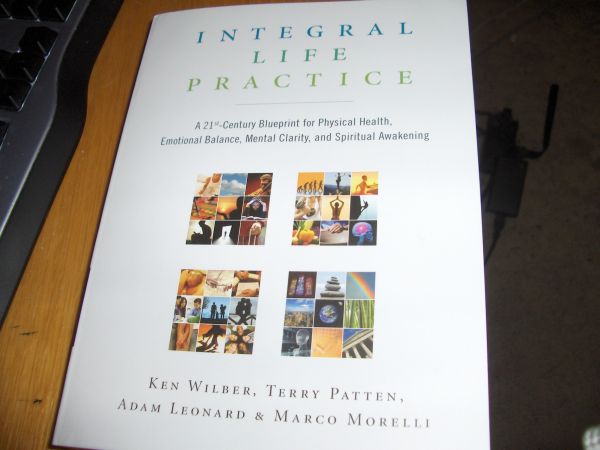
So I have cracked open the book I got in the mail the other day. I have even read the first chapters. Obviously I can’t give anything like a sensible review until I have either read it through or thrown it in the recycling bin. Even then, I shall have to be cautious, for this is a book that could save or damn the world.

The concept of integral life practices looks very much like what I in my near future fiction called “the Innerways”. This is not surprising, since when I made that concept, I already had a cursory knowledge of Ken Wilber’s theories, and had taken an interest in them since they resonated with my own writing about what I call “the Next Big Thing”, the necessary shift in human consciousness to enable our new role as stewards of the planet rather than simply one of its millions of species. The way from our current halfway apelike state to that frightening responsibility goes through the Innerways, the practices that prepare each of us to reach our highest aspiration. The book Integral Life Practice is an attempt at just that, guiding individuals onto the beginning of those paths.

For those who haven’t read or don’t remember my series of essays in 2005 (starting June 18), let me briefly state my own position. This is one of the most important things I have written about. In fact, it is one of the few important things I have ever written. So bear with me for a paragraph.

Our ancestors until around 60 000 years ago did not have culture as we know it. Well, recent findings show outbreaks of it here and there in Africa, but scattered and temporary. Mostly they lived like their ancestors a million years earlier, despite having the same body and brain as us. At some point there was an explosion of creativity, traditionally associated with the invention of abstract language, although we don’t really know that. There has been a lot of upgrades since then, but none nearly as fundamental. There is a gaping abyss between any healthy human today, even the naked Stone Age hunters of the jungle, and our ancestors who knew nothing of inspiration or aspiration. A similar leap, I believe, is about to happen again. The Ice Age mind will give way to something so much greater that it is hard to believe we are the same species. Either that, or we’ll all die terribly along with most of the planet’s higher life.

The Innerways – or integral life practices – are the perfectly natural, non-magical things we can do while we are ordinary humans, but which will at the same time move us toward the next stage. It may be that we who live today will never be part of the next phase – actually, I am pretty sure of this – but we have to move in that direction, so that the next generation can stand on our shoulders and reach for the stars. We may not become more than human, but we have an obligation to become more human than we were.

The genius insight of Integral Life Practice is to serve a “balanced diet” of such practices, which can mutually strengthen each other. This is not a new concept – “a healthy soul in a healthy body” is an ideal that has lasted for millennia. But it is extended to four core areas: Body, mind, spirit and shadow. (Shadow here refers to the subconscious, not to demon worship or some such.) I know many people today think that spirit may be an epiphenomenon, kind of like the sun seems to rise and set while in reality it is the earth that rotates. But even if you don’t believe the sun rises, you would still be a fool to think the night will last forever. In the same way, spirit is an experienced reality, and you ignore it at your own cost. Spirit – in the form of aspiration and inspiration, at the very least – has been with us since we became human.

This was pretty random, as can be expected of a chaotic mind in a sick body after a brief look at the beginning of a new book. I am not going to recommend it just yet, but I sincerely hope to complete it and test its basic ideas – to the extent that I have not accidentally tested them already. The terrain seems strangely familiar.

Oh, and one more thing: The book is a very accessible read for something so groundbreaking.

PS: I found that the book was also recommended by Bill Harris, of HoloSync fame. It is a small world Integral movement after all!