My Gmail was hacked!

Just thought you might want to know. Sometime during the day, someone took over my gmail account. It had a password made of 8 random letters and numbers. Admittedly this is a bit few, but normally brute hacking won’t work against someone like gmail since they won’t allow a re-attempt speed that can only be achieved by a robot.

I installed a Google News applet for my android phone today. I wonder if that may have been a malicious program – android does not control their free applet all that strictly, so that is a possibility. I may have given it my google account password indeed, which would be an insane thing for me to do given that it only delivers public news. I will have to reinstall it (once I get control of my android account) to see whether it really does ask for the password. Since it has a pretty Google logo, I may have fed it by habit. Worth checking.

I have filed a request for getting back control of gmail, which is luckily frozen. It has probably only been used to send a few thousand spam mail, in which case all my address book contacts will have gotten one.  I am not sure how much difference that makes: Since my gmail name is in hundreds of places anyway, a lot of forged mail with me seemingly as sender is already being belched out on the Net. I know this because I get several of these daily in my own spam box. Hopefully people will realize at a glance, as usual, that no that’s not him.

If a more creative organization had gotten hold of it, they could probably use it more efficiently. But it is already frozen, which means they probably jumped to the spam pump immediately. So there should be relatively little damage. I’ve changed a few other passwords, including to my old account at chaosnode.net.  The handle is the same, after all, and if you have known me for a long time, you probably have it on file already.

I provided Google with some pretty unique information (the complete url of the invitation mail I got when I first got gmail), so I expect to get it back within 24 hours.

A huge disappointment is that despite some 10 attempts, I never got the text message with a verification code, which could have unlocked the account automatically without fuss. Why?  Perhaps my text messaging in Android does not work when my google account is locked? That would be pretty idiotic, but you never know.

Well, that was fast! Control of Gmail is back in my grubby hands, with a new password that makes more sense to me and still no sense even to my best friends. I have also set different passwords on Facebook and Chaosnode.

The spam sent from my account was pitiful, with only random letters in the subject header. I can only assume that they are paid per mail, and their contract with the Mafia never said anything about the mail actually being read by anyone.

Special thanks to Fujitsu-Siemens, who made a PC so durable (despite numerous problems) that I could recover my correspondence from many years ago by simply firing up Opera and scrolling through the mail. Whew.

Also four thumbs up to Google for handling this quickly and professionally. It seems most of the mails were rejected before even getting to my contacts, as gmail detected a sudden change in behavior when the robot took over. Now the only thing that did not work as expected was the text message with the recovery code. It has still not arrived, so I think we can tentatively say that it does not work … either generally, or in Norway, or with Telenor Mobil, or with Android phones, or some combination.

It is quite disturbing how much e-mail really matters these days. I get my bills to that address, even.  I’d like to check out that applet and see if it really does ask for my Google password. But not today, just in case it has found some other way to steal it.  I have deleted it for now.  Your curiosity may vary.

Webthink vs bookthink

Search the net with the click of a mouse! It is almost too easy…

So there has been some worry about how the web influences our thinking. Not just the content of our thoughts – actually, with Google at hand, we probably think a little more factually where we used to be guesstimating – but the WAY we think.  Studies show that people don’t read more than a few paragraphs. For instance, statistically you probably don’t read this entry to the end, at least if I provide a link somewhere before that.

In the past, people read books, so the theory goes. Books are deeeep. They let you immerse yourself in the narrative, build a grand cathedral of interrelated facts (or fiction, as the case may be), with many relationships knit together, thorough analysis and a span of time.  What is not to love? But now, people click the first link they see, and if they see a block of text filling the whole screen, they press backspace.

The idea is that people are starting to do this in the rest of their life too.  Certainly newspaper and magazines are starting to include highlights and fact boxes for those who can’t take the time to read the whole article. Who is to say that we are not adopting the same attitude in human relationships.

Don’t worry about that last part, say I.  Most people were always going on tangents anyway. Besides, the few who could follow a long narrative during a conversation, were the ones who followed their own, regardless of what everyone else was talking about.

And seriously, which came first, the hyperlink or the the remote TV control?  Even though many TV channels already look like someone is clicking frenetically on the remote, with random changes of angles, colors, faces and scenes, people STILL click the remote anyway. Because they can.

The books, I give you the point.  But take a trip to the nearest book kiosk and look at what kind of books they sell, and which of these again people actually buy.  Murder mysteries and Harlequin romance. And even then, people read them on the plane, subway, doctor’s waiting room or wherever they don’t have anything else to do and people would look strangely at them if they touched themselves.

There may be some who used to read War and Peace and now are unable to read more than a couple paragraphs.  That is worrying. (They should also see a doctor and get tested if they are 40 or above, Alzheimer’s is a terrible and creeping illness.) As for my humble self, people I have met on the net – like Carl McColman, Robert W Godwin, Ryuho Okawa – have made me not only return to books, but start to build a library of timeless wisdom instead of the hundreds of fantasy and sci-fi books I used to have.

You have to take responsibility for your actions.  But at least now you have more chances to learn things from cultures far from your own, geographically or in thoughtspace. If that is what you want. Or you could read numerous explanations of why George Bush is the Antichrist and will return to imperil us all once again.  It is up to you, really. You could even log off and read a good book.

But if you just did that, you would miss out on your reward! A link! Click it click it click it! The Last Psychiatrist – whose irony, wit and clarity of thought surpass even my own! (You know how hard that can be… but then again, you are not reading the rest of the entry after the link, so I can write whatever I want here.)

Unimaginably much information

You may well stare: The rise and fall of entire civilizations could be contained within that computer!

“There was 5 exabytes of information created between the dawn of civilization through 2003,” says Google CEO Eric Schmidt, “but that much information is now created every 2 days, and the pace is increasing.”

Few people in the world are better placed to feel the pulse of information flow than Schmidt, so I’ll take him on face value regarding the facts.  When he uses the expression “dawn of civilization”, it means he is not just talking about the Internet.  From clay tablets to newspapers and advertising fliers, everything is in there. Presumably also music cassettes, CD’s, movie reels and DVDs as well. Exabytes are unbelievably large: One quintillion bytes, or about 50 000 years of DVD-quality video.

Most of the new information is probably irrelevant or erroneous. For instance, over 90% of e-mail traffic is spam. (Microsoft says 97%, most other sources are lower though.) But Google is pretty good at filtering those:  Looking over the spam folder, which contains 30 days of spam, I found only one legitimate message, and it was a rather unimportant one, from a mailing list I’m on.  Likewise, I have had one spam-mail delivered in my inbox over the last month. Not perfect, but nearly so.

Twitter is a good example of the next level of “random” data: Even after you have subtracted the spammers, the relevance of what is left varies, to say the least. On my Twitter feed I get words of wisdom that will be valid and valuable as long as humans are humans. I also get product launches, and friends griping about their computer games and telling me what they have for dinner. Twitter is badly in need of tagging, but does not have it.

Modern blogs, on the other hand, have tagging.  However, it is often only available for those who write the blog, and their concepts may be different from yours.  Most notably, one person’s religion is another person’s superstition. In America in particular, one person’s political view is another person’s clinical insanity.

Even without using tags, though, Eric Schmidt boasts: “Show us 14 photos of yourself and we can identify who you are.” That is an average, obviously. But more and more of the online content is photographs or even movies. Schmidt’s comment also puts Google Street View is a slightly different light…

Much of the new content is neither text nor pictures nor sound, but abstract data like information from cash registers, car counting devices etc. These seem utterly impersonal at the moment, but it may not always remain so. As the net of data grows ever finer, it becomes possible to track the individual whether he wants it or not. In fact, I would say that trying to retain anonymity in this age is like walking into a bank wearing a mask and gloves.  You will stand out as a shadow on the data:  This customer always pays with cash, does not wear a connected mobile phone, avoids buildings with video surveillance… there may already be government agencies looking out for such a pattern.

Now – what will YOU do with the world’s information when Google puts it in your hand and says “Here, take this!”?

***

(I picked up the quote from an article on ReadWriteWeb: Google CEO Schmidt: “People aren’t ready for the technology revolution”. They have some interesting information on that site, by the way. You may want to bookmark it for a rainy day.)

Big Facebook sees you

di0908017

“Similar interests create friends, and aspirations gather those with the same mindset.” As does Facebook, evidently, or at least it frantically tries.

So I did not spend the whole weekend meditating on my worthlessness and lack of loving my fellow humans.  I also went and got a Facebook accound.  Theoretically there may be a connection, but knowing me, my FB probably won’t be much of an Outreach of Love.

What I did notice, however, was that while I was still registering, the web site presented me with several people it thought might be my friends.  In the case of some of them, they were. These were people from a mailing list where I have been a regular for years.  It is not publicly stored though, to the best of my knowledge.  It is fairly easy to gain access and most of the subscribers are lurkers, but it is still fairly limited.  It’s not the Micropenis Support Group Mailing List (my apologies to all who just googled for that) but it is still a place I don’t expect my employer to ever look.

At a later stage in establishing the account, I got a new batch of potential friends. Again there was one or two that seemed familiar.  Given the millions and millions of people already using Facebook, it can’t be an accident.  What, then?  I wondered.

Ironically the most likely answer came from one of my now Facebook friends. She proposed that these were people who had me in their email contact list.  For toward the end of the registration process, the website asked politely for my gmail password.  (I suppose if you had Hotmail, it would ask for the Hotmail passwords, etc.) How stupid do they think I am?  I would not give my gmail password to my second best friend. And to my best friend only if I suspected that the end of my life was drawing near.  Actually it always is, but I have not given her my password yet. So, forget it FB.  But perhaps some other people did, and FB duly put their contacts in their database for later.

Another possibility is that these are people who specifically queried FB with my email address to see if I was a user.  I know we discussed social network sites on the mailing list.  So they may have been curious to see whether I really didn’t use it.  Well, now I do. People can change. A little.

Quick! To the GOOGLEPHONE!

di090802

I suppose for one day I can write about something that is NOT a pain in the @$$.  My new mobile phone (or cell, as I believe Americans still call them?) definitely qualifies. At least unless you try to type Scandinavian or other accented characters, which was a slightly nightmarish experience, albeit in the Kafka style rather than Dante and the burning sensation.  Luckily, I have very little to say that I don’t say in English.  When you are as weird as me, using a language with billions of readers is your best bet of being read at all!

To be honest, I was considering an Apple iPhone 3GS. They are cute, they are easy to use, and there is a lot of software available for them. Also, your girl next door knows them inside and out if you should get stuck (or just want an excuse to talk to the girl next door, for the male reader. Or writer.)  It so happens that the newest model was set to be released in Norway this past Friday.

On the other hand, I don’t really like Apple.  I have used their iTunes and found it clumsy, swollen and overbearing compared to Amarok for Linux, which I grew used to over the last year. I am also not happy with Apple several times a week trying to make me click “OK” on installing more of their software which I have never asked for, not to mention that they have actually installed a couple smaller programs without asking.  (Mobileme and Bonjour. Well, they may possibly have been mentioned, either by name or some generic description, deep in the legalese of the iTunes user agreement. I know I have never asked for them nor explicitly allowed them to install.)  This, and the frequent updates that all need to restart the computer, earns Apple a vote of Not Very Much Confidence from me. I know it is popular among girls however.  I guess we just value different things.

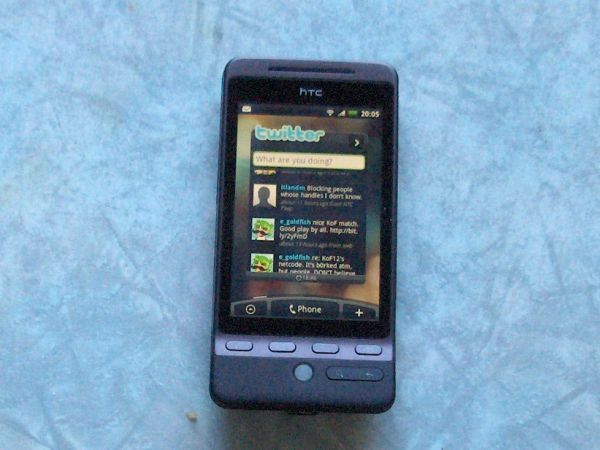
Even so, it was a near miss.  There just did not seem to be other phones that were close to my concept of the Datapad.  Regular readers may remember that I have written about this repeatedly in the past, most detailed in the entry Datapad 2010, written in the year 2000. It is an almost frighteningly prescient description of the iPhone. Or, as it happens, the HTC Hero, the newest and most powerful flagship of HTC’s series powered by the Android operating system made by Google and the open source community.

Like its smaller predecessor HTC Magic (Google Ion in the States), this gadget comes with some Google functionality built in by default. If you have a Google account, as I have, you can get your Gmail right to the phone, and check your Google calendar everywhere. You can read your favorite news sources through Google News.  And of course you can always search for whatever phrase you need the final word on.

But not content with Google, the phone also comes with one-touch access to Twitter, Facebook, MySpace as well as Ebay and Amazon.com, not to forget Wikipedia.  I’m actually on Twitter, although it is mostly a symbolic presence, telling whether or not I am at work and such. (I block any followers whose handles I don’t recognize, btw.)  Facebook?  Don’t you need an invitation for that?  I am not sure what I would do with it even if I had it.  I use LiveJournal, which I had to add manually, but it was not a pain in the posterior to do so, once I had typed a couple hundred characters altogether so had an idea of how to hit the on-screen keyboard correctly.

How many ways does it connect to the Internet?  Not quite enough. I want it to also access the Internet through a PC when connected by USB cable to synchronize.  It does not. Boo! You may think you don’t need to when you actually have a computer right there accessing the Internet. But the thing is, I would want to quickly refresh Twitter, mail, calendar etc before unplugging and moving away from the computer.  I can’t see any way to do that.

On the other hand, it does connect to wireless networks that are either open or to which you have a WEP key. And it does connect through the various mobile-phone networks normally available.  I am switching to a mobile broadband plan for it.  It is actually probably more expensive than just paying for actual use for me, since I have wireless at home, but having a fixed predictable expense is still a way to make life less complicated.  I have had enough of the time of surprising phone bills. Sometimes surprising me with hundreds of dollars back before the age of broadband.  Simplicity over thrift, at least on a small scale.

While you can’t use your computer to give your phone Internet access (as far as I can see), you CAN use your phone to give Internet access to your computer.  If the speed is good, I may well do this and do away with the wireless broadband modem on the laptop.

Of course it comes with a built-in GPS receiver so you can find out exactly where you are, should you get lost.  (Just combine it with Google Maps, which covers most of the civilized world and probably then some.) This may serve me well if I am healthy enough to take that trip to Oslo in 10 days.  Though I am not sure about that right now, and what with the swine flu… but that’s not today’s topic. GPS requires free sky and takes a toll on the battery, but it is there when you need it. And when you need GPS, you REALLY need it.  It may come down to either that or asking someone for directions, and a man can’t do that.  It hurts us in the man-thing. Anyway, even without using the Global Positioning System, you can get your bearings using data from the mobile network base stations.  It also gives you the local weather forecast.

There is the usual multi-mega-pixel camera which you don’t need and which should probably have been illegal (in Japan mobile phones are required to make a loud sound when taking pictures. I will leave the reason for this to your imagination.)

Oh, and you can probably use it to talk with, too.  I haven’t tried. Who in their right mind would TALK to their telephone? Perhaps one day when it can automatically transcribe it and post it to Twitter.

Oh, and about that iPhone 3GS? It was sold out the first day.  I strongly suspect this was arranged by only supplying a moderate quantity, so they could get the “SOLD OUT WITHIN HOURS” headlines. Free marketing, and not even obviously from them!  Anyway, by the merest of coincidence the HTC Hero came into the shop the very same day!  Providence, surely? In any case, the Datapad 2010 has arrived, a year early.  See you on the bitstream!

Thunder and router

di090707

Old router brought back after years in a dusty plastic bag.

Last night as I was about to go to bed, very sleepy, I thought I heard far-off thunder.  I turned off all the computers and the network (router and ADSL modem) and disconnected them from the mains.  I did not however unplug the phone cables.  Perhaps I should have, but probably it would have made no difference.

When I woke up, it had rained but was already clearing up.  The air stayed cooler both indoors and outdoors for all of the day.  But I could not connect to the Internet.  I decided to give it time and went to work. It has happened before during thunderstorm season that the ISP’s node has been out of commission for a few hours.  But when I returned, I still could not get online.

Still, there was something strange going on.  My Winamp Remote icon in the Windows tray showed that I was connected, although I had been unable to connect to it from work.  (I often play music at work from my hard disk at home, now that I have transferred all my CDs to hard disk.) When I tried to load a page, it started, seemed to load a tiny bit of it, but then gave up.  And when I ran network diagnosis on the Vista machine, it said I was connected to the Internet after I fiddled a bit with the cables.  (I am not sure that was actually necessary.)  I even got City of Heroes running on that machine. It took some tries to get connected, but once it hooked up, the speed was just fine.  Still, I could not load web pages on any of my computers, nor connect the LiveJournal client or Opera Unite.  Something was amiss.

I unplugged the WAN cable from the home network router and plugged it straight in my main PC.  It warned me that there might be limited or no connection, but moments later I could connect to everything at the speed I have purchased and then some. Of course the other machines were now disconnected from the Net.  The main problem with this was that I could not dualbox in City of Heroes.

Lately, after  days of a strict Sims 3 gaming diet, I have returned to City of Heroes. My imaginary girlfriend, who for good measure roleplays my imaginary wife in that particular game, has several characters around level 30 on Virtue, the unofficial official roleplaying server.  (There are no official roleplaying servers, but the players have decided on this one for roleplaying.) Anyway, level 30 is a good time to start on the zone Brickstown, which has a nice mix of smaller and larger groups of villains shortly after you leave the train station. Well, the short of it is that my imaginary female companion has mostly support characters, defenders and controllers, which are not all that good at playing alone.  Sometimes she gets a spot on some random team, but if not I will log on one of my official characters and help her out. I have a number of tankers and scrappers on Virtue, which go well with her defenders and controllers respectively.  (By “her” I am referring to an imaginary player, but the dynamic would be the same with real players.)

Because of all this I really wanted to have at least two computers online, but I could only get one to work.  On the other hand, when the router was connected, I could call up shared files on another local computer in the blink of an eye.  Clearly both the router and the ADSL modem worked, but somehow it seemed that they hated each other’s guts.  I could even connect to the modem through the router from my PC, so clearly the connection was there. But the router did not want to route data to and from the Internet.

I am not sure the thunder was part of this at all, truth to tell. The surge would have needed to go through the modem without hurting it, then hitting the router, yet doing so little damage that it could do anything else than load web pages.  Suspicious.  If we exclude malicious intent, the most likely cause is probably overheating.  The Jensen router is very compact and gets hot even in winter. In summer it is disturbingly hot to the touch and could really have needed some cooling.  It may be too late now, however.

Around bedtime I decided to fetch the old router, which I had stopped using sometime before I moved here.  The problem was that its wireless network was very weak and had a ridiculously small radius, something like the size of my previous living room.  I did not get a good connection from my bedroom. There may have been other issues too, but if so I have forgotten them.  One nice thing about it is, it is much less hot.  I unplugged the old and plugged everything into the even older, which had spent the last several years in a dusty plastic bag in my cupboard. It did not work.  I was not too surprised.  I had a new ISP since then, probably two.  I found the user manual (which was on a CD) and managed to log into the router. Here I changed the setup from PPPOE to Dynamic something, and within a minute the computers were connected!  Good as new!

Happy ending, except that I was now extremely sleepy again and also felt a little sick. I went to bed, the computers happily chatting with the Internet.

To be continued?

Jammie Thomas pays my music

di090619

In the trash they go. There will be no new ones.

Jammie Thomas, one of the most ordinary people in the western world, was just fined nearly 2 million dollars for having made 24 songs available for upload on the file sharing service Kazaa. (The songs became available for upload because she downloaded them – this is the nature of most file sharing systems.)

I get the impression that the court’s decision did not spark much controversy in the USA, and this seems reasonable:  Americans are used to farcical trials, where the best paid lawyers win more or less by default; so much more when the opponent does not belong to the ruling ethnicity. For us Europeans it seems strange, but once you get to know a number of Americans, you realize how little faith they have in the judicial system.  And if neither the particular crime nor punishment has any direct consequence for you, you just ignore it.  Mind your own small business.

The reaction here in Scandinavia is very different.  A wave of hate  and contempt is sweeping Norway (the homeland of “So sue me” DVD-Jon) and neighboring Sweden (harbor of The Pirate Bay). Particularly the younger generation vow to never buy a CD again. I am not sure they will stick to that always, but probably as long as they can effortlessly download the songs from file sharing sites.  Certainly whatever sting their conscience may have offered them before is now gone, nay reversed:  A deep sense of righteous glee filling them each time they get to stick it to the fascist recording industry and the corrupt governments that allow it to run rampant over the back of the poor.

My reactions are more mixed. I developed a pretty large software package for certain businesses a couple decades ago, and I remember the murderous rage I felt at the thought of people stealing it.  I would not particularly mind seeing them in debt for the rest of their life – actually how I felt at the time was that they were not really human and their lives worthless.  Of course, this is true most of the time for most of us, but I was still projecting much of that then, thus the intensity of feeling.  Objects and random strangers cannot incite such intense emotions, they always need to have an anchor inside us.

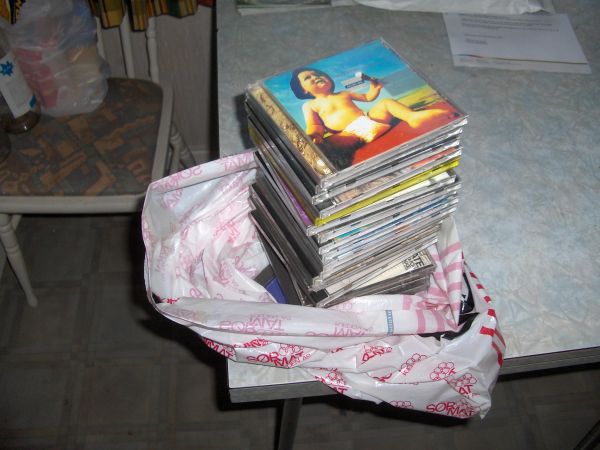
For the young and angry virtual mob, the anchor is no doubt the reasonable fear because they too have been sharing songs online, and probably more than 24 of them at that. The thought that their entire lives could be ruined any random day and that there is nothing they can do about it would be pretty upsetting.  (This does not in any way change the fact that this was a gross miscarriage of justice and should never have happened.) Personally I have bought and paid for my hundreds of CDs, which I am throwing away, except for the Japanese ones.  I am even more motivated to get rid of them now.  I do not really want to have physical objects in my house associated with the cRIminal Association of America and its lickspit running dogs here in Norway.

Actually downloading music used to be legal here in Norway, until the current mainly Social Democrat government changed it. Their minister of culture is still supporting the record label industry, whereas the state’s less political privacy watchdog is pulling in the opposite direction.  This is no great wonder, for the Social Democrat leadership is strongly in favor of the European Union, from which we got the current law.  This again makes sense since the EU is dominated by Social Democrats. As such it has an extensive bureaucracy with many leading positions that may be available to former politicians who have been good at wagging their tail, and with no more need for elections to maintain your status.

When I was young – in the 1970es – we had cassette recorders, which people used to play music casettes they had bought, but probably more often songs they had recorded from the radio or copied from one another.  This had been going on since the days of the spool tape recorder, about half a century ago.  Kids these days have probably not seen those contraptions, but I have one stashed away in a closet here, as well as a couple tapes with songs copied form Light knows where.  (Although by far most of my tapes are recordings of meetings at conferences in the Christian Church, popularly known as Smith’s Friends. I am keeping these for as long as the tapes may still last, or I do, lest they be lost forever.)

OK, that’s a pretty roundabout entry.  But I am currently working on getting Opera Unite running stably on my machine, so I can stream all those thousands of songs I have bought and paid to friend and family.  (Who else but friends and family would wade through a blog like this?)

I will come back to the actual address of my music streaming server if I get it to work stably. So far it stops working on my home machine with Windows, my old Linux machine is too weak to pull it, and the new Linux machine is only active a few hours a day.  But my intention is good, at least.  ^_^

Opera unite!

di090616

This description (from the anime Hatsukoi Limited, btw) probably describes the average user of this new piece of free software. Ironically, it is called “Opera unite”.

On February 16, 2001, I wrote an essay about PC-to-PC networking and the future of the Internet. And then I did not upload it, because I decided to write about an anime instead and how it reflected my own life. So there is no way for me to actually document my prediction of the present event.

On February 10, 2003, I once again took a drive-by stab at the topic, mentioning that I would have liked to host the Chaos Node directly from my local harddisk, if standardized technology existed. It didn’t, so I didn’t. I still don’t, but the possibility suddenly jumped miles closer. Thanks to Opera, the Norwegian web browser which tends to come up with the good ideas first, then have them copied by IE and lately Firefox. This one is highly unlikely to be copied by Microsoft, however.

Opera just built a server into the browser. It is not quite grandmother-friendly yet, as there come up some lines that look like Javascript code when you set it up. But it is still astonishingly simple, and should only take a few minutes to get running for the parent generation. From then on, changing the setup can be done in seconds.

There is already built-in code for letting other people play your MP3 files, if you so decide. Or look at your pictures, but only those pictures you want to share. You can even share entire folders to the point where people can download anything they want from them. Obviously this should not be of a too private nature. Well, unless it is password protected. Any of this can be password protected, although each application can only have one password. (So you can not share your baby pictures with grandma and your porn work related documents with someone from work at the same time. You would have to run multiple instances of the same program, and I don’t see that supported.)

The big deal however is that programmers can add their own small programs. If I don’t like that the music players only handles MP3 files, I may make my own that plays AAC, the format used by iTunes. Of course, that requires me to actually program, which I stopped doing years ago. Whatever I think of, someone else is bound to do it, and thanks to Google I should be able to find them when they do so.

The folks at Opera Software are very excited about the new invention. They feel they have finally fulfilled the promise of the Internet. I agree. But I don’t think it will spread enough to really change the world as long as only Opera supports it. (You don’t need Opera to view such a site, only to make it available. So I can share my MP3 files via Opera, and you can play them in Firefox or Internet Exploder.)

The real revolution, I think, will be for illegal file sharing. The “sites” created this way are temporary, ephemeral , transient and don’t last long. There is no backup of them on any corporate server which can be subpoenaed by the Rabid Illiterate American Association or likeminded people. Operaunite.com only connects the giver and the taker, they don’t host the files. Your local harddisk hosts the files. And unlike a torrent tracker, Operaunite.com does not give any hint as to what is stored, or has been stored in the past.

The downside of this is that you can’t find these places on Google or The Pirate Bay or any of the other public resources. You get to know of them by e-mail, IM, certain chat rooms, friends-locked blog entries, someone else’s Opera Unite page, or other underground channels.

If the content is harmless and can stand the light of day, however, there is no reason why you can’t spread it more widely. But even then, you may not want to. Because most likely there will only be a few people in the world interested in your baby pictures and Abba collection, and you may just as well tell them directly.

If this really had come in 2003, there would have been a big unmet demand. But by now we have cloud computing. Pictures can be shared for free on Flickr and Photobucket. Music can be shared for free on Imeem and probably some other sites. Sendfile lets you send any large file privately, such as for instance a movie. There really is no reason to have your computer serving files directly unless you are a fanatic individualist (this program is made in Norway, remember, the only country where the distance between neighbors is measured in stone throws) or really, really don’t want anyone spying on what you’re doing.

Or, of course, you could be like me and do it simply because you can.  Join the revolution!