The Elder Scrolls and technology

Screenshot from the game Skyrim, showing a bright aurora at night.

The Elder Scrolls V: Skyrim impresses with new visual effects, such as the norther lights. Luckily it does not have the actual long winter nights of its real-world counterpart, although you may need the Nordic winter cold to keep your computer from overheating if it is too old.

This is about computer games, so not particularly important. Since I am still fairly new to The Elder Scrolls V: Skyrim, I tend to compare it to earlier games in the same series, especially its predecessor Oblivion.

I actually think the difference from Oblivion (spring 2006) to Skyrim ( fall 2011) is not all that big. They both run on the Xbox 360 and PS3 gaming platforms, as well as Windows-based computers. Bethesda Softworks argue that they know the console platforms better now, so are able to wring more power out of the same hardware. That seems to be true, to some extent. But the Windows version also does allows computers with the newest video cards to show off their capabilities.

I find it thought-provoking that the basic gaming platform has not changed in five and a half year. That was certainly not true a decade ago. The change from Daggerfall (one of the last games made for MS-DOS, in 1996) to its sequel Morrowind (Windows and Xbox, 2002) was dramatic. Not only were the graphics superior by leaps and bounds, but the AI was radically improved. The changes from Morrowind to Oblivion and on to Skyrim have been subtle in comparison.

It may be true that the capabilities of our computers double every year and a half, but there is little sign of this in the games. Except for the more detailed graphics, especially in the rendered landscapes, both of the latest games could have been made with the technology of 2002. Developers have certainly learned from the earlier games and improved on them, but they hardly rely on technological progress to any great extent. In so far as they do, it has more to do with cheap storage: Skyrim is filled with recorded voice dialog throughout, which would have been considered a luxury with the hard drives of a decade ago, but is barely noticeable on today’s much larger hard disks.

The artificial intelligence is more advanced now, it seems, and it is possible that this would have taxed the computers of 2002 beyond what they could handle. Certainly the game world seems more alive and natural now. But it is a gradual improvement. And the change from Oblivion to Skyrim is quite incremental, more a matter of design than raw power. Which makes sense since we are still stuck with Xbox 360 in 2011. Who would have thought it?

Another data point to my theory that the personal computer has reached the end of the line. Gradually from around 2005, the “battle front” has moved from personal computers to portable devices. The progress there is still pretty fast. But there really is no strong demand for more powerful personal computers or game consoles. They are already doing what we want. And what we want right now is to play Skyrim. ^_^

Hello Skyrim!

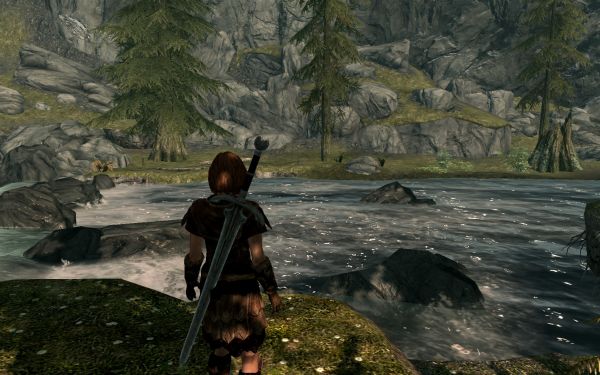
Screenshot game Skyrim, featuring river and woman.

Not unlike home.

The Elder Scrolls V: SKYRIM already appears in my doomed third attempt at a novel this month. There, the main character is on his way to buy the game, and in his excitement he collides with a car on 11/11/11 at 11:11:11. He then wakes up in Daggerfall, 500 years after the Elders Scrolls games, in a female Breton body.

I seem to have escaped with my life so far, but naturally I pressed “Enter” on 11/11/11 at 11:11:11, as is good and proper, to enter the kingdom of Skyrim.

Skyrim, land of the Nords, is the northernmost province of the continent of Tamriel, where the Elder Scrolls games take place. From the very start of the series, the place has been pattern on Norway, although the names of people and places are more like a mixture of Danish and Old Norse, with English and Old English. It is amusing for a Norwegian to find a lake named Geir (a common Norwegian male name), and the game starts in a small town named Helgen (which could mean “saint”, “the weekend” or even “the guy called Helge”, although the latter is a West Norwegian usage mainly.)

The locals are blond, strong, tolerant of cold, and the men are usually bearded. The architecture is inspired by the Viking age, complete with stylish dragon heads. (The place reminds me quite a bit of the Viking part of the multiplayer game Dark Age of Camelot. It helps that the size of the game is also similar. It is truly huge for a single-player game.

As for the dragon decorations, they are somewhat ironic in this game, for it has dragons, and they are not friendly. Well, one of them is responsible for the main character’s escape inches from the headman’s axe, but that is somewhat of a coincidence. Or is it? In any case, the dragons are supposed to be the main enemy faction of the game. I, however, have only played the game for one short day (and I even managed to get a walk in), so my character is still level 3 and still gets scratched up good by the local bandits near the starting area. No dragons for a while, I hope. The things are HUGE. Big as houses.

Skyrim continues the Elder Scrolls tradition of letting the player do whatever he or she wants. There is a helpful character giving advise and fighting for you during the first quarter of an hour or so, perhaps a little more, which serves as a tutorial to the game. They have changed the controls a little again, so a tutorial is appreciated. After that, however, it is up to you. There is a main quest and the reviews says it is the best of its sort in the series, but there are a lot of other things to do. It is a bit like a Sims game with fighting, I guess. You can collect stuff and craft weapons and armor or potions or magical equipment, and sell them for profit. You can buy a house and furnish it. You can even marry, although I haven’t heard anything about babies.

The game is supposed to be theoretically endless, as the game engine creates new minor quests based on your experience so far. Of course, the same was the case for Daggerfall, but I still stopped playing it after a bit more than 5 years. I expect it to take substantially less time with this game, since real life has been upgraded since then…

I can’t really call this a review, as even many of the first impressions are not my own. It is more like explaining where the day went.  But I would not be surprised if I end up doing what I did with Oblivion, traipse around the landscape and take photo-like screenshot.

Giving away clothes

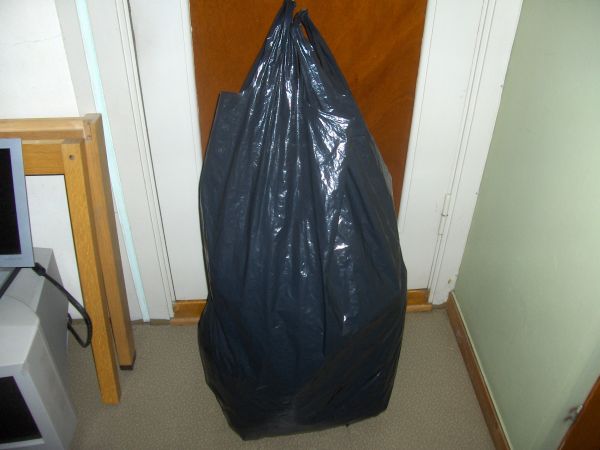
Plastig bag filled with clothes

Filled with clothes. No, I am not moving again quite yet.

A newly established charity is collecting clothes for Russia and Poland. I wish them the best of luck: Russia actively tries to stop people from trucking stuff like that into the country, as it is bad for the local economy. And Poland… well, its standard of living is lower than ours, but I sincerely doubt there are more people needing clothes than the local Catholic charities can keep up with.

That said, I eagerly grab an excuse to get rid of some of my immense hoard of clothes. I packed this bag full, so full in fact that I have to be careful when dragging it; and yet if someone else had packed that bag and told me to look in my wardrobes, I would not have been able to tell what was gone. I am not even sure I would have been able to tell whether or not anything was gone at all! They still look and feel pretty much full.

To be honest, I wonder whether the charity will even come to pick up the clothes, or whether it is just a publicity stunt.

And even if they do pick it up, I wonder whether it will ever reach the supposedly poor in Eastern Europe, or whether it will be quietly burned when the challenge of transportation and distribution dawns on the organization. Or when it is stopped in customs.

But it is worth a try, simply because I will have that much less if I move again, which probably won’t be years off. If I live, I don’t see myself here in a year. You can rent fairly large houses not far from here for the rent I pay here. Although fairly large houses are likely to go to families, for obvious reasons.  I have to scale down so I can rent something cheaper. Well, I don’t “have to” as in otherwise hunger, but “have to” as in I could spend that money more wisely, if at all. Having to rent an extra room to store the excessive amount of clothes is not wisdom, I think.

Even so, I am not packing up everything except what I need for a month. No. First of all because I don’t really expect this to work. But also because, well, it’s clothes and I can use them. If I live another 40 years, like my grandpa did, I can wear out most of them. And that’s better than them being burned near the border. Probably. I am not quite sure. So I am hedging. Giving away the stuff I am pretty sure I will never wear, and that is too good to throw away.

Well, that I think is too good to throw away. The poor Russians or Poles may well think differently. I am honestly not sure which has the highest standard for what to wear, they or I. Just because you’re poor does not mean you don’t have pride. I, on the other hand, am single and celibate. What use do I have for pride?

Humans as sims

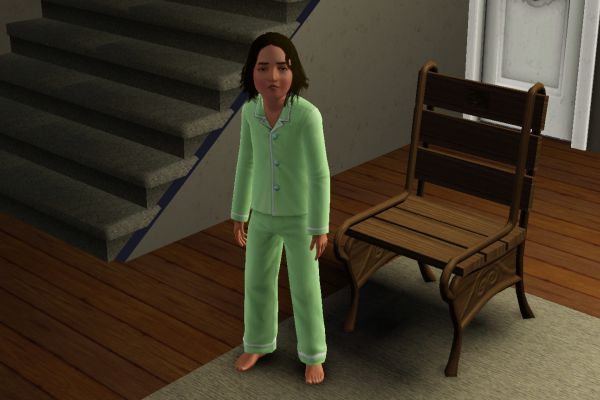
Grumpy child from Sims 3

Here to talk smack about us sims again? We’re just as good as other people, you know!

By now, a few expansions and patches into Sims 3, the little computer people are disturbingly lifelike in their behavior. Or rather, and this is my point, humans are disturbingly sims-like in their behavior.

I hold the view that ordinary humans are barely conscious most of the time. Instead, their behavior (including their thoughts) can largely be described by two “engines” that work together: HABIT  and IMPULSE.

The skeleton of a normal human life is the habit engine. It is itself not conscious: We don’t give any thought to whether we are going to get up in the morning – well, most of us don’t – or whether we are going to get dressed before going to work. We have large, overarching habits that gives us a structure for the day, and which again triggers smaller routines of habit to accomplish subgoals like buttoning shirts or tying shoelaces. In other words, we have a habit of stringing together habits in a certain sequence. This fills a good part of our day. As we get older, habits tend to grow stronger and fill ever more of the time.

The other engine is what I call the impulse engine. For fellow programmers, you may have thought of it as triggering an exception. One reason for such an impulse could be that a need has reached a trigger level: Hunger, thirst, excretion, attention. Usually a trigger event occurs well before critical levels are reached, although some needs have shorter fuses than others, so to speak. But in many (most?) cases the basic needs are already taken care of by our habits.

But the impulse engine is not triggered just by internal needs. It is also triggered by external objects. Seeing a bowl of snacks can trigger snacking, although I am not sure where the border goes to habit in that case. Seeing a sexy woman can definitely cause a trigger event in a man. Seeing a baby can trigger most women and many fathers, although most childless men consider babies part of the furniture unless the thing screams or stinks. And of course the whole business of advertising is based on triggering impulses. Of course, if you do that often enough and in the right context, it can eventually lead to a habit.

Both the habit and impulse engine are reasonably well modeled in The Sims 3. The little electronic people have a disturbingly human-like electronic mind. What they don’t have is a human soul (in the classical sense) or human spirit. This has to be provided by the player.

“Great souls have wills; feeble ones have only wishes” says a famous Chinese proverb. In that light, sims are exceedingly feeble: Without the support of their player, they will achieve their goals purely by accident, and higher goals (like reaching the top of a career or maximizing several skills) not at all. They will however be able to stay alive, employed and reasonably satisfied about their needs, and even reproduce and raise (usually crazy, neurotic, grumpy or hot-headed) children.  From what I hear, they are not very different from Texans.

The purpose of religious ritual, like keeping the Sabbath or saying grace, is to interrupt the automatic working of the twin engines of habit and impulse, and give the soul a bit of “space” in which it has the chance to wake up for a moment and become aware. It tries, like this blog, to make people suddenly sit up and think: “I am right here, right now. This is it. I am alive!”

I may not have mentioned it on this blog, but I have noticed that the median weight of Norwegians has increased steadily after saying grace went completely out of fashion here during my childhood and youth. Of course, there are numerous other factors like the size of dinner plates and the widespread use of cars. But still… if you woke up each time you sat down to eat, and became acutely aware of who you were and what you were doing, would it change nothing?

Sims never say grace. But even if they did, it would just be another habit.

Neo-Tamriel worldbuilding

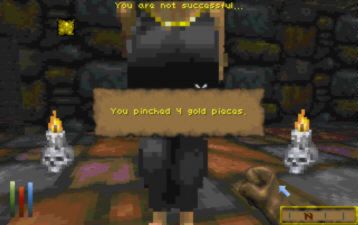
Pinching from behind in Daggerfall

Little known fact: In the RPG Daggerfall, you got rewarded for sneaking up on people from behind. In this case the reward is minimal, but then again it’s not exactly a small target.

I’ve temporarily stopped writing on my second attempt at a NaNoWriMo novel. Temporarily, I say! At least I say that for now. It just isn’t as engaging as I’d like. Well, actually I like making all those parallel earths and tell how history unfolded differently on each of them. There are thousands and thousands of parallel earths in that story, although it looks like all of the novel will take place on it. Still, there are people from many others, and the Sixthers have smuggled in books from even others, so there is that.

On the other hand, there is no risk of sex, ever. I mean, ever and ever. The people who are restored to life are immune. They can hug and cuddle but they simply have no sex drive anymore. Also, they don’t die, at least not permanently. Now as my old literature teacher in high school told us, all true poetry is about love and death. And let me add, when the love is platonic and the death is temporary, it does affect the tension level in your writing. Yeah, verily.

Still, I expect to return and write more about the innumerable alternate histories. Someday.

***

In the meanwhile, I have started a story about a guy who is biking to town to buy Skyrim, the fifth Elder Scrolls game, on 11/11/11. (That’s when it comes out in real life! Wheeee!) On his way he crashes into a car and strikes his head. Perhaps fatally, perhaps not, the story so far is very vague in that regard. He begins to have a near-death experience, then suddenly he is sucked away and wakes up in a temple in Daggerfall. Except it all looks lifelike, instead of the low-resolution game graphics. And the sounds and smells are also completely realistic. Furthermore, several hundred years have passed in Tamriel, and magic has risen to a level where it is barely distinguishable from technology. A modern, magical world.

This is something I wrote about in my MoM2000 NaNovel, which erased itself and its backups (except a few hundred words) from my hard disk and made me lose NaNoWriMo that year. Good work! Anyway, that was based on the magical strategy game Master of Magic, and the functional tech level was up to year 2000, only with magic instead of technology.

The Younger Scrolls I: Aleena is based on the series of RPGs called The Elder Scrolls,  of which the first was called Arena. Daggerfall was the second and my all-time favorite, although it was particularly hard on my wrists and so I had to give it up. They are all hards on the wrist, but that one was exceptional. I blame it on having to hold down the right mouse button every time you perform a sword stroke (or warhammer or whatever).

In The Younger Scrolls, magic has become more of a commodity so society has a standard of living similar to Earth in the 20th century. I have not yet learned exactly what the differences are, there certainly are differences.  It is not like every piece of technology in our world has an exact magical equivalent. On the other hand, they have summoning and teleportation – the ability to move people or objects from one place to another in the blink of an eye – although it requires rather a fair bit of magic power and skill.

The name Aleena refers to the name of the main character. The 18 year old boy is called Alvin, but when he wakes up in Tamriel he has the body of a 19 year old girl called Aleena.  She is a Breton – a pale, fair-haired, pudgy race of humans with innate magical resistance and more talent for magic than most humans, although less than elves. They are the most common race in Daggerfall, and judging from my memories (and some screenshots) from the game, the women in Daggerfall had particularly well developed hips and backsides. I used to sneak up on them in the game but the game mechanics had no visuals for pinching them, only a text message. Well, I was younger back then. I believe I got the game in 1994.

Tamriel 500 years after Daggerfall has a higher standard of living and a larger population. Crime, then rampant, is greatly reduced. Farms have replaced much of the wilderness. Still, there is lots of adventure to be had. Racial tensions are high and many-sides (there are numerous humanoid races in Tamriel). And that’s just the civilized ones. Not all wild humanoid races have been fully assimilated. The nymphs have integrated quite well in society, while the centaurs are still rather hostile to outsiders and the goblins, harpies and spriggans are still a barbarian menace, although only on the fringes of civilization. Worse are the werecreatures and the various daedra (corporeal demons) summoned by mad mages alive, dead or undead. Still, as long as you stay clear of the really bad patches on the borders of civilization, New Daggerfall is probably safer than Florida. OK, that was faint praise, I guess.

Will the virgin Alvin have more luck as a lesbian? Will he / she become a famous hero now that he can no longer spend all his days playing The Elder Scrolls and eating chips? Who knows – I have just recently started. 3002 words today.  At this rate, the only way I can reach 50 000 is by writing a novel about some guy writing novels and getting bored after the first chapters so he starts on a new novel. ^_*


The inner world

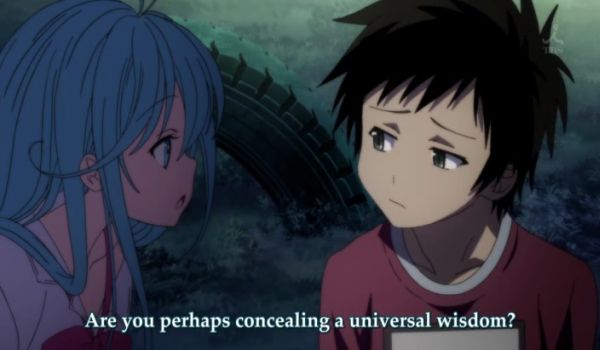
Concealing a universal wisdom

Are you perhaps concealing a universal wisdom? And if so, how would you know?

Recently I read in a book that is substantially holier than me, about seeking God within. It made a commentary that this was the opposite of introspection. I agree, although there are other opposites of introspection too.

Introspection, as I see it, is looking into your own personality, or “soul with a name”. This is the person we call “I”, and we feel responsible for what this person does and says and, if we are extra serious, even what it thinks. So when we look at the thoughts we have or have had, and how we feel etc, that is introspection. It is looking at our conscious self, although it may have been less conscious than it could have been – that is what we are trying to correct, perhaps.

But the inner world does not only consist of this person, the “I”. There is a lot of activity in there. The subconscious is far larger than the conscious, at least for most of us. Nearly all of us. There may theoretically be some amazing people who are so enlightened and so thoroughly conscious that they occupy their entire brain, but I doubt there is one in each millennium, if there ever were any.

The popular view of the subconscious is roughly identical to Freud’s “Id”: The unfinished basement of our psychological house, where we hide all the things we don’t want to have in the daylight. Mostly sex, if Freud is to be believed, which he certainly shouldn’t be. While Freud was picking apart his patients’ dreams looking for sex symbols (because putting an umbrella in a suitcase is totally a graphic depiction of coitus), C.G. Jung noticed to his surprise that some of the dreams were strikingly similar to well known myths in other cultures, myths that were completely unknown to all but a few researchers in Europe. (This was before the age of the Internet. Today, anyone may have picked up anything. This means we could never have had a discovery like that in our age.)

Sometimes, Jung noticed, people would come across persons in their dreams or daydreams that were far wiser than themselves, although their wisdom was often coached in symbols or poetry that the dreamer had to unpack through a conscious effort. It was, in other words, voluntary (and not easy) to absorb the insights that already existed inside them. It was as if ordinary people had limited themselves to a small part of what they could really have been. Inside them were skills and insights and knowledge that they were not even aware they had.

This, incidentally, is the case also with some patients with “multiple personality syndrome”. In actual life, there is an unknown number of people who have multiple personalities but don’t seek medical treatments, because they get along fine with themselves, and find their multiplicity a strength rather than a weakness. Naturally they soon find out that almost everyone else think it is insane, so they don’t disclose it.

But even among those who do have problems with their multiple personalities (for instance one personality may refuse to share information with the rest, leaving blank spots in their memory, or actively try to hurt their relationships or even their bodies) – even in such cases, it is amazing how much the personalities can vary. They can have completely different skills, and in some cases they even have separate allergies! That sounds like a miracle, or the opposite of a miracle perhaps, whatever that is. But in most cases, the sum of the “alters”  is more than one normal person. In some cases, each personality can be pretty close to normal, and yet they are different, so it really is like there are different people sharing the same brain.

I mention this because you probably think that you are using your brain pretty well, and your subconscious is just a dusty basement with trash you’ve kicked downstairs and shut the door. Chances are there are skills and knowledge and abilities down there which are quite a match for what you have achieved in your waking life, unless you are somewhat of an overachiever. It may even be that some of your energy is spent on denying abilities you actually have: There is at least one documented example of a person who could not draw or paint, but after a brain damage began painting beautiful paintings. Not started learning to paint after the brain damage, but suddenly could do so. They had already had the skill but locked it in the basement. OK, here is an article with a long list of such people and a theory of how.

I know that during my first epoch of deep “emptiness” meditation, in my 20es, I began to be able to think in music. To this day it is pretty common that the “voices in my head” sing songs I have never heard before, either without words or with words in a known or unknown language. I don’t have the skill to write down the music, and I don’t plan to specialize that way, so it disappears after a while. It is no big deal: There will be new music later, probably. So far there has. But I think I would rather be me than to have a stroke or a crushing blow and become able to compose!

But as you can see, the subconscious is not really a corner of your mind. It is like a door that opens to some vastly larger place than your mind. At first it may seem like a mansion, then as a landscape, a planet, finally an expanding universe. There is no reason why the inner world should not be much larger than the visible universe: The possible connections in the human brain exceed the number of molecules in the known universe, or at least so I read when I was young. The thing is, perhaps it is not created by our brain at all? When we look out the window, there is frantic activity in the back of our brain, in the visual cortex. But we don’t usually assume that the brain actually creates the world we see outside our window. Why exactly do we assume that the brain creates all our subconscious content?

Well, what do I know. But it is a topic that would baffle you if you took it seriously. It is a bit like discovering that your wardrobe is a doorway to another world, isn’t it? ^_^ Of course, some of us like it here in the safe zone.
 

That didn’t last long

“You’re a novel writer?” -Not at the current pace, I’m not. But I have some novel ideas, I guess.

In the early afternoon today, I decided to stop writing on my NaNoWriMo story. It was a stupid idea in the first place. I thought it would be funny, and I guess it is mildly entertaining. But the cognitive dissonance is too much for a neurotypical human to read, and if I only want to read it myself, I can just do so in my head. I guess erotic religious sci-fi humor is just spreading it too thin, spanning too wide, stretching it etc.

And so, because I have the wisdom of Solomon, I have decided to instead write ANOTHER story that I probably won’t publish because it will disturb people no end. It is something I first wrote before I even got my first PC – I am pretty sure I wrote it on a programmable calculator! It is a complete reboot, of course, since I don’t have the original and haven’t seen it in a decade or two.

It is about a young man who drowns and wakes up in a new body, in a world vaguely similar to the one he left, but not the same. He is not in Heaven or Hell or the New Earth or the Millennium or anything like that. His mind was copied by “sixthers”, people who live in 6 dimensions instead of 4, and have a technology that is indistinguishable from magic. Or perhaps it is a magic that is indistinguishable from technology, it is hard to say when two thirds of their reality is entirely off-limit to us.

So anyway our universe is just one of innumerable “bubbles” in this greater 6-dimensional space. There are other people (for lack of a better word) living in even more dimensions, but it is very rare for them to interact with the bubbles in a way that can be observed. Anyway, evidently the sixthers pick certain people just as they are dying and scan the software on their brains, backing it up and installing it in a new and slightly improved body. They wisely choose to never put people back on their own earth, because even in a new body they would try to get back to the old life they were attached to. Now, they have no attachments. They run errands for the sixthers, trying to make their new world a better place. Or that’s the theory. It may be that ordinary people might not always agree with the sixthers about what the world should be like.

I’ve established at the end of chapter 1 that there will be no sex, never ever. Their bodies are designed and produced in some other way, and although they look like ordinary humans, they are unable to feel sexual desire in any physical way. So that should please the Republican readers. I’m trying to not overdo the similarity to Christian resurrection, although obviously that’s where the inspiration comes from. But this story’s “resurrection” is not general, and happens before the final judgment, if any. It is more Lazarus style, I guess, if Lazarus also got some minor body upgrades in the process.

I wonder if I come up with a new idea again tomorrow?

Anyway, never more erotic religious humor. Or at least I’ll keep that to myself. The world is not ready. And that may well be a good thing.

NaNoWriMo is coming!!

It’s the season for literature!  Hopefully it won’t leave me quite this red-faced, but it is early to say. Written characters tend to take on a life of their own.

Unless something happens over the next five hours or so, I am about to write 50 000 words of erotic religious sci-fi coming-of-age humor. May the Light have mercy on my soul; I have nothing to say in my defense. It is just… NaNoWriMo. Again.

Martin – Martinus Albertus of Little Chicken Springs – lives near the east coast of Vinland (North America in our timeline). He is a high school boy of the less than very manly sort, and an avid “nimyn” (comic book addict, otaku). One day, stung by the accusation that he knows nothing about art despite his expertise in appreciating comics, he goes to the library to check out ancient art. In an art book he finds a picture of the obscure Renaissance painting The Humiliation of St Chronica, in which a female saint was undressed in public by heretical priests, and he has a sudden conversion experience. Religion is not something he is particularly familiar with, and some pretty weird things happen as he and those around him adjust to his new lifestyle.

Perhaps I should just have written about my Sims after all. Oh well. At least my arm is better.