Writing like a God

The view from right outside my door. It just keeps flowing every day!

Woke up two hours early today thanks to a desperate bumblebee, so here is a morning post!

I recently finished reading Ryuho Okawa’s book The Laws of Courage and I’m dipping my toes in Frithjof Schuon’s Survey of Metaphysics. The latter is much harder to read, as are all his books that I know of. It is extremely dense and precise and uses many long words that are rarely used, including some even I haven’t seen before. His writing is also consistently abstract. Well, I am not really complaining — I know some of my writing may look like that to the random visitor. I’m working on it, though.

Back to the would-be savior from outer space. I often think to myself that Ryuho Okawa truly writes like a god — more exactly Hermes, the god of speed. I mean, writing 500 books in a couple of decades? But that is not enough. In The Laws of Courage, he casually mentions that he reads approximately 1000 books a year.  (That’s why he didn’t find it unreasonable to say that the first step towards becoming an intellectual is to have read 1000 books. A statement I don’t find it hard to agree with, although I have no idea how many I have read. Probably comes well over that number only if we include fantasy and science fiction, or even worse, western books, of which my brother had at least a couple hundred during my puberty. I don’t really think they should count toward becoming an intellectual though. -_-)

My own attempt at fiction writing this month goes forward very slowly. Ironically, I think I could write much, much faster if I were to write books of the Truth, but at this time I am not qualified to do that.  Or at the very least I am not allowed to by the source of that Truth. There is just too much responsibility, and I am not yet a very responsible person.

However, I can certainly relate to the extremely prolific writing of people like Ryuho Okawa or Hans Urs von Balthasar. When you try to render a higher-dimensional object in a lower-dimensional world, like for instance a globe on a piece of paper, it just does not fit. You have to unfold it and portray it from different angles to try to let others reconstruct it in their mind. And even then, it largely requires that the recipient has Been There.  If we were not three-dimensional ourselves, a world map would not give us an approximation (and it is nothing more!) of the globe, but just perpetuate our illusion that it was indeed flat.

Now, spiritual truth (and maths and physics for that matter) is indeed on a higher level than ordinary life, so if we try to explain it in metaphors, allegories and parables, it expands and “splinters” into many details that are actually one on the higher plane where they belong. For this reason, there is “no end to the writing of books” and “even Earth itself could not have room for all the books that would have to be written” to convey even one Heavenly life.

God is by definition unlimited. The whole universe is simply an overflowing of God’s unlimited Being. That follows more or less from the concept of God, so if we are able to imagine the existence of a Supreme Being, this is necessarily one of Its qualities.  If it is all in our imagination, then just to have that concept we must be to some extent divine (in possibility even if not in actuality), and how did we end up like that?  Even if I had been born with the first star of the universe, and had been writing ever since, I would still not have come close to exhaust the imagination and intellection of even one soul.   There are no limits, or at least they exceed this seemingly endless universe.

If Shakespeare was still alive, he would still be writing. If Bach was still alive, he would still be composing. If Buddha was still alive, he would still be teaching.  If Socrates was still alive, he would still be asking. The spirit taps into something beyond the ordinary, and once that channel is cleansed of the things that blocked it, there is no end to it except death.  Beethoven kept writing symphonies even after he went deaf.

In short, our spirit taps into the inexhaustible.  There are levels or grades of doing this, but beyond a certain level, there is no end to it.  It becomes like a wellspring that gushes forth endlessly.

“Nice guys” vs Happy Endings

What must I say to be sincere? The unsolvable question!

I mentioned yesterday that love takes the path that leads to happiness for the other person.  In the case of romance, it is pretty obvious that this also is your own happiness. Or one should at least think that would be pretty obvious.

I mentioned long ago the irony of young men complaining that a nice guy can’t get laid.  How nice are you really if you expect to be rewarded for it? It is for the same reason I don’t go out very actively and preach the Truth that you get deliriously happy by loving knowledge and insight for its own sake. I am glad I am not the only one to notice this, but there is an obvious problem:  If people know this beforehand, they may pursue knowledge simply for the joy that awaits them, and then their motivation is not pure love.  And the relationship between a man and wisdom is very much a love, only not physical.

When I grew up, in Norwegian schools we learned a couple poems to the effect that “the greatest joy you can have is to bring joy to others”.  I wonder if this has not contributed more to the affluence of my country than the oil in the North Sea.  There are plenty of nations with oil resources, and most of them are truly tragic places to live, so that can hardly be it.  However, Norwegians are also the most trustful people in the world.  This has its drawbacks – they have more unprotected sex outside marriage than anybody else, according to statistics compiled by Durex – but it also makes everyday life much smoother. It is only in areas with immigrants that people need to lock their doors, and in the countryside you will still get your wallet back if you remember where you lost it.

The thing is that even a small increase in the people’s care about others will have a great effect on their own happiness.  Self-centered people, which is the ideal in the USA and increasingly here in Norway too, will never be happy.  This almost goes without saying when you have lived a life of personal growth, but it is not really obvious at all until you have tried it.  And if you try it only to increase your own happiness, you have not tried it at all!

This is a difficult situation, is it not? As long as you look for your own happiness, you cannot find it.  But when you love a person or a virtue, you will find that happiness seeks you out. By “love” here I mean in a selfless way, that you experience at least moments where your self becomes transparent and for a little while, silence of the mumbling voice inside you that always says “it is about me, it is all about me”.  You may not think you have such a voice, but then ask yourself:  Why is it all about you?  Who told you that?

Being a parent is a struggle and an unpaid workload that I can not really imagine.  Year after year of work and worry.  And yet, at the end of the day parents rarely curse their fate. Yes, there are times when they will tell you that they would never have had children if they knew how it was.  But it does not last.  Eventually, some kind of satisfaction remains.  I believe this is because of those moments when your self became transparent, and forgetting yourself briefly you could delight in the happiness of another.

If you expect your children to pay you tit for tat, you will definitely die unhappy and unrewarded.  Nobody loves a debt collector.

On the topic of endings, happy or otherwise, I am going to post spoilers for the Happy Ending Oneshot manga, which I came across in my research on happy endings.  In this 41-page comic, Boy has a crush on Girl 1.  He is found out by Girl 2, who promises to keep his secret and teach him the basics of not scaring away girls.  Several times, she saves him from making horrible social blunders.  But in the end while he is telling Girl 1 his feelings, he realizes that she is not the one he loves the most. That is Girl 2, who was only seeking his happiness rather than her own, and so he runs off to seek out her instead.  So cute. ^_^ But it won’t work if you try it, obviously, because selflessness is the one thing you cannot do, until you give it up.

Diving into 2D worlds

“As if I don’t do enough of this in real life! AAAARRGH!”

One thing that has not changed from The Sims 2 to The Sims 3 is that if I play it for too long, I get upset.  There is not discernible reason for this. It is just a slow simmering discontent that gradually grows toward boiling anger. In so far as I can find features in the game to irritate me, they are not in proportion to the feelings, which anyway seem to come from within and grow independent of the actual playstyle.  (Except for making sure to take long breaks regularly.)

It has been this way for me for a long time, although I am not sure how long. I think it has increased gradually over the last few years, I did not notice it before. It is not just these games.  If I immerse myself in one particular 2-dimensional world for long, I will start feeling discontent.

You may remember that I think of the universe as being layered, or rather having a gradient. As you move upward, it becomes harder and more timeless. (For instance the laws of mathematics must necessarily be at least as old as the universe itself, and have not changed at all in these eons.) As we move downward, the world becomes soft and malleable, but also temporary and less real. Think of a daydream, for instance.  You can do pretty much anything you set your mind to in a daydream, but it disappears more easily than fog before the morning sun.

Lower worlds are the worlds we create, higher worlds are the worlds that create us.

When I dive into lower world for a long time, there is a kind of suffering. Even if I have fun and want to play just five minutes more, there is at the same time a growing discontent inside me. I feel that I do not belong here, it is not right. This is not so much a feeling of guilt – I do this on my own time, and there is no one waiting for me – but more a feeling of loss, I guess you could call it. Or perhaps I am just reading that into it because I know it is true. But it is certainly a feeling of being misplaced.

Interestingly, this feeling is not noticeable if I only visit each world briefly. It is as if I need to immerse myself in them for it to happen. I liken this to diving. If you dive into the sea, an element where you don’t belong, it may be pure fun at first, but you cannot breathe there, so you will start to suffer, and this suffering will increase faster and faster until it is unbearable.  My immersion in lower worlds is a much slower process, as it can take an hour or two before it becomes distinctly unpleasant.  But eventually it becomes worse and worse, and I have to get out of there.

You may have seen YouTube clips of young people who go berserk in front of their computer, but this seems to be when they play competitive games, particularly games in which their characters kill each other.  But I feel this mounting frustration even from the very peaceful, cute and charming Sim games, loved by women and children.  Actually it sometimes takes longer when I play City of Heroes, if I team up with other superheroes. Their players are after all people from the third dimension, so there is a kind of influx of reality from there.

There are people who are known as “otaku”, a Japanese word for geeks of 2-dimensional worlds like games, comics and cartoons. In English this is not a very negative word, it just says that they enjoy Japanese serial arts. But in Japan where the concept arose, it means people who have drowned in the lower worlds. They are no longer able to live meaningfully in the 3-dimensional world.  In my paradigm, you may say they have lost so much mental substance, becoming adapted to the softer world of fantasy, so this ordinary world is too hard for them, to sharp, too unyielding, too demanding.

Conversely there are those who have adapted to higher worlds, but these are few and we don’t hear much about them. To them this so-called real world is like a fog and the people in it like shadows, except for their spirit or inner light. All these familiar forms are only temporary, and cannot make the heart content.  For we were made to be adequate to the ultimate reality, the Light, the Alpha and Omega, Infinity and Eternity. The universe itself is not enough to satisfy us.  This is true, but it is not obvious as we start out.  Even now, it is not exactly a problem for me. Living in the ordinary world does not constrain me the way diving into lower worlds does.  But if I live till I am 120, I will likely find this world gradually more constraining.  Right now I feel like I could enjoy it for millennia, but if I keep growing, there may well come a day when I shall rejoice when exiting this world as well.  That is not to say that I’ll never start another game of physical existence – that is something I don’t know right now.  For now, this one is enough for me, and I feel like I have only recently begun to understand it.

Religious and secular meditation

The religiosity of your meditation is not something outsiders can ascertain.

I was already planning to write this entry when I read something eerily related in The Challenge of the Mind by Ryuho Okawa. He says that the purpose of meditation is to contact High Spirits, such as your Guardian Angel. If it was just to sit down and not think, trees and stones would do a much better job of it than us.

That sounds a bit harsh. There are quite a lot of health benefits associated with non-religious meditation: Lower blood pressure, better sleep, better immune functioning, less tendency to smoking and drinking, better memory and a greater or stronger awareness in daily life. I have called it “defragmenting the brain” too, but there is  even more than that. Still, in my experience, there is a clear difference between religious and secular meditation.  I cannot say whether they meet in the end, because I have not come anywhere near the end of any of them, even after many years.

My history with meditation began in my mid teens or so, when I learned it directly from God.(1) I was praying and felt that it was terribly rude to just rattle off my own wish list and then hang up.  God is not a grocer or something. So I respectfully waited after my prayer, in case God had something to say to me as well.  I understand that some people do hear actual voices from Heaven, but I did not.  (Which is good, because I have a more scientific personality and would likely have been scared out of my skin.) Instead, I felt a benevolent Presence.  Kind of, when you pray, you have a distinct impression that there is someone there receiving your prayer.  I suppose some people, perhaps all people sometimes, have to take this on faith.  But I think most of us have had the distinct impression that we have “connection”.  This was like that, only stronger, and it kept growing stronger.  Like there was someone right by me that I could not see, but I could feel the aura of that luminous Presence.

In less religious terms, it was very much like sitting together with a really close friend or family member who you don’t need to engage in conversation. In these cases it is possible to just be together without thinking of what you are going to say next, simply waiting for them to say something or not – it does not really matter.  This was like that, only with awe and majesty thrown in. Kind of like if you could sit silently together with Abraham Lincoln or something. (Requires optional Time Machine.)

From that experience of simply resting silent in the Divine aura, from this grew my religious meditation.  It was an extension of prayer – it was the heart of prayer really.  And it still is to many people, who would regard meditation with deep skepticism.  “Meditation, isn’t that something that heathens do, and those New Age people?  It is probably evil spirits!”  But actually meditation has a long history in Christianity as well, although in the old days it was called contemplation, while meditation was a more active thinking on holy topics. Today these have been transposed, perhaps in the meantime there was a period of confusion where few people thought of such things at all?

It was months later that a more experienced Christian caught me in the act of silent communion and asked me if I was meditating?  So at first opportunity I looked it up.  We did not have the Internet back then, but there was a public library in the town where I went to school.  There I learned about the science of meditation, and I took up that as well. For years I practiced ever deeper meditation, until in my 20es I started having more and more supernatural experiences:  Telepathy, extra-sensory knowledge and the occasional tiny blip of telekinesis.  Scared, I prayed to God to make it stop, and I cut down quite a bit on both the frequency, regularity and depth of my meditation.  The strange experiences pretty much disappeared after that.

I have practiced meditation since then, but irregularly and not so deeply. Religious meditation in particular is something I have done only when drawn to it.

Over the past year and some I have taken up more meditation again, now with the aid of brainwave entrainment.  Using first Centerpointe’s  Holosync and later Project Meditation’s LifeFlow, I have used sound waves to synchronize my brain waves.  LifeFlow in particular has a broad range of different frequencies.  While these tools do not actually cause meditation, they create a state of brain that is well suited for the state of mind that is meditation.  During natural meditation, the brainwaves will smooth out and get slower.  How slow depends on practice and some seemingly random element.  With brainwave entrainment, you can reduce the random element and get there with much less training.  I have not found this useful for the meditation itself, although being able to induce slow-wave instead of REM sleep in the morning has been nifty. Basically, I can’t see that depth (slowness) of brain waves leads to depth of the meditative experience.  Your meditation may vary (and if so, please tell me. Actually, tell me anyway.)

There does not seem to me to be any spiritual benefits to the brainwave entrainment technology at all.  Your spirit may vary.  I find that to me, religious meditation is still a different experience.  Even though LifeFlow 8 induces a “feeling” in the brain that is very similar to deep prayer meditation, it is not it.  It is kind of like visiting the house of a friend and everything is there except your friend.

There are schools of Buddhism that do not relate to a God or spiritual beings, and yet practice meditation religiously. I would think that to them there is no such difference. But I don’t really know.  There is only so much you can experience in one life.  But luckily we have each other to learn from. So perhaps I will know one day, if I find someone who has the relevant experience.

***

“Directly from God”: Well, that was my experience at least.  I have later come to realize that our connection to God may not be quite what it seems:  Each of us seems to have a personal “branch office of God” in our heart, which can differ a bit from that of other people who also believe in God, even those in the same congregation, even those in the same family.  Each of us has a separate “branch office”.  I mean that for instance in each town there used to be a Social Security office, and you could go there for all your ordinary Social Security needs.  It was unlikely that you ever had any other contact with Social Security. To the common man, this office WAS Social Security.  But actually of course Social Security is a much more vast organization, and there are subtle differences in the way you are spoken to in one town and another.  It seems to be the same way with God:  There is much more to God than what any one of us knows, but at the same time God is represented in our hearts with all the Divinity we will ever need.  If our needs for God grows, so does the God within. In this way, we grow toward each other in God, our internal God presence becoming more similar as the Light increases.  If all goes well.

This individual Divine presence is probably what Happy Science calls “High Spirits”, although in Christianity it is customary to only have one, not to chat with a large number of angels, archangels and Saviors.  For us there is only one God, the Father, and one Lord, Jesus  Christ. It certainly simplifies things.  But of course there are actually many entities in Heaven that are far greater and wiser than we are.  We just don’t play supermarket there, as we already have all the Holy Spirit we need, and then some.  To quote a very old Christian from my home village: “We don’t need more spirit, we need to obey the Spirit we already have!”  Which is of course a pretty good way to get “more”. Or that’s what the Presence in my head tells me…

Broad experience

This is the normal human condition and nothing to be surprised by. We don’t understand anything at all when we have never seen it before and barely even heard about it. How could it be otherwise?

My many-named reader has a question to my previous entry. He asks: “How do you tell the difference between seeing another dimension, divine inspiration and a hallucination?” The short answer is, as I warned at the start of the entry, that you need experience. But as I was about to gently rebuke my reader for forgetting the beginning of the entry before getting to the end (for this could in no way be the fault of my communications skills, of course), I realized that there is more than one dimension even to practice. There is length, of course, but also breadth.

For instance, because I have watched hundreds of hours of anime, I can tell Japanese apart from other languages or from simple babbling, even if I only understand a little and cannot use it. Simply the act of observing means that you will be able to tell things apart eventually. But not without practice, and not after five minutes or even an hour or two. Or at least the ability would not stay long after only an hour or two.

But how can I know that Japanese language does in fact exist and is not an elaborate hoax? Perhaps the Japanese actually speak Chinese, but push this delusion of a separate language on foreigners for political reasons or just to laugh at us behind our backs. (Not that they would need something so elaborate for that – I am sure they do that quite a bit anyway, and with good reason.)

If I had seen only one animated movie in Japanese, then this would certainly be a possible scenario, if not plausible. But as it happens, I have watched a broad range of anime from different publishers, and read about even more that others have watched. This is what we may call a broader experience, in contrast to just longer. For instance if I had only seen The Laws of Eternity, even if I saw it every week, it would not be a very broad experience in Japanese culture. It might have left me a better person than if I had seen all those others, most of which are not very edifying, but I would not have much basis for an opinion about Japanese language, much less the rest of their culture.

This is the case with people who restrain their interests to a very narrow range. In the example of spiritual practices, which I wrote about in my previous entry, there are sects who teach that your only spiritual practice needs to be chanting a particular short phrase over and over for the rest of your life, as often as possible. While this certainly has some effect, it is a narrow approach in the sense that we cannot easily know whether the effect comes from the object of their worship, the particular sounds of the chant, or simply the practice of repeating something an extraordinary number of times.

To further complicate things, sects tend to strongly discourage experimenting with variations of the practice, much less experimenting with the practices of other sects. Sure, members of other sects claim to be happy too, but what do they know about true happiness? And besides, the demons may just be deluding them into thinking that they are happy. After all, if you were a professional demon, wouldn’t you be willing to make people happy for a few years if you could get them to Hell afterwards? (This does not apply to our sect, of course, since we know true happiness when we see it. Besides, it is written in our holy Scripture that we are right, and we know our holy Scripture is true because the Scripture says so.)

The behavior of the sect members is actually quite reasonable. Why risk a good thing for something uncertain? Better the god you know than the devil you don’t. Still, it makes for a narrow experience, not too unlike the fan who only watches the same movie over and over again.

On the other hand, the “butterfly”, “supermarket” or “salad bar” approach to spirituality has its own drawbacks. The most obvious is that people tend to pick only the parts they personally like. But if a child starts to eat only the food he likes best, do only the homework he likes and only show up for P.E. classes if they are fun, he is unlikely to be heading for a long and happy life. If he has parents, they will hopefully tell him to change his ways. Likewise if you use this approach in your spiritual life. If you have a spiritual “father”, he is sure to tell you in no uncertain terms to Eat Your Greens.

Each tradition has its own internal structure or consistency. This is certainly not to say that they are all equal, much less identical. What I mean is that the whole is more than the sum of its parts, and if you only keep picking parts, you will not get that “more”, that wholeness or totality. Just saying. I am not really the right person to go all out against this, since I have a double helping of curiosity at the very least.

On the bright side, the great religions have each quite a broad range of spiritual tools. For instance if you are a Christian, there is no need to Hare off to Krishna or canter over to El Cantare just to add the spice of variety to your life. (If you go for other reasons, it is not like I could stop you anyway.) You may never have run into all of these in Sunday School in the Church of Our Saints in Middle Littlewick, but actually there is both prayer, meditation, contemplation, Lectio Divina and even chanting (although mostly in liturgy). And of course if you are part of a congregation, there are probably various rituals also trying to drag Eternity into time (or time into Eternity).

On the other extreme, Buddhism has a heap of different meditation schools, many of which are not quite religious in the western sense of the word, although some are. The contrast between some of the techniques taught is staggering, certainly on the same scale as the difference between some branches of different religions.

This was very long, but the short of it is: There are a number of different spiritual practices, a few of which I am familiar with from experience, and many more from the experience of others. While the effects of them differ to some extent, there are also many striking similarities.

Then there is the whole thing about religious versus secular meditation / observation, but I am working on a different entry about that.

So how can we tell things apart? We cannot without practice. The practice can be long or broad or both. It can also differ in depth, so I guess we have 3 dimensions there as well. If you have mainly one of these dimensions, I suppose it may be hard to perceive the others clearly. If you have none of them, I don’t see why you would even try. Humans need years to even learn to dress themselves. There is no way we can become proficient with the mind without watching it firsthand for some time. But I believe it is worth it, for a mind is a terrible thing to waste.

3 time dimensions of the mind

“That’s where the light gets in…”

OK, this will sound seriously weird, especially if you have no practice with meditation or similar spiritual practices. As usual, lots of reading can substitute for actual practice, with the exception that if you get some small detail wrong, you end up with a completely different world. But that is life, I guess. And practice is hard to come by, as timelessness takes time.

Read on, then, and be amazed. Or suspicious or something. For I will tell you that unlike the world of physics, the world of the mind has not just one but at least 3 time dimensions. Or I suppose you could say that the fourth dimension, time, is the entrance to the next two. In any case, please bear in mind that this is about the human mind and how it relates to its world. It is not a substitute for physics, nor is physics a substitute for it.

OK, time is the fourth dimension. I hope we can agree to that. All creatures unfold in time, but humans may be the only who can wander it more or less at will. So you may not remember what you ate for dinner on May 25, 2000. Or perhaps you do. Most of us don’t even remember what weekday it was. But there are still hundreds, if not thousands, of memories we can revisit. Many of them at will, others by surprise. And probably unlike any other animal, we can make elaborate projections of the future and work toward them. In fact, we seem to do this more or less automatically. (OK, perhaps not the “work toward” part, unless it is something very exciting.) We spend so much time in the past and the future – and in futures that will never be, and even pasts that never were – that there is very little time left for now.

But the tiny little pinhole of Now is actually the key to eternity. This may sound counter-intuitive, but thousands of years of experience bears it out. If we just flicker past the now on our way into some other time, we will ever lack depth. This depth is the fifth dimension. You can envision it as follows: The small point in time that is Now, can be extended from the surface consciousness into the unconscious. This is a mental dimension, of course. But it is none the less real, because for the most part it is your unconscious that makes your big decisions, while you run after it and rationalize them.

We could say that the unconscious consists of the subconscious (shadow) and supraconscious (light). In Freud’s coarse terms, the id and the superego, although his idea of both is appallingly simplistic. There is a whole kingdom within. Actually more like a universe, but we have to start small. If you could remember your dreams, chances are there are more people within you than you will get to know in a lifetime. -Of course, remembering dreams is a mixed pleasure, as I have mentioned elsewhere. In your unconscious you may meet your guardian angel, but you will also meet your “guardian devil”. There are forces on both sides keeping you in balance, as if you were chained to each of them with heavy iron, so that any attempt to move in either direction will be painfully slow.

This is intentional: If we could just change ourselves on a whim, we would likely change into someone popular, or someone who excels at work, or someone who we think would be loved by a special someone. And if it was that simple, just snap your fingers and you have changed, then most of us would throw away our real self on a whim and likely an illusion at that. Therefore we are chained this way, so that we can neither fall too fast nor rise speedily. When someone rattles the chains, the laws of nature (not to say society) perceives it as madness and puts on the brakes. Whether the madness consists in attacking your neighbor with an axe or giving your money to the poor, the response is pretty much the same. And so we are fettered, for our own safety. But in truth it is possible to move, though it takes an inordinate amount of energy, or dedication, or time, or any combination of these.

This was a glimpse into the effects of extending the tiny pinhole of time from the surface consciousness into the fifth dimension of the mental substance. By the simple process of abiding in the Now, observing calmly, you will experience things you could not otherwise see, at least not and retain your sanity. Such as it is.

As you open up to what is outside (or should we say inside) the surface consciousness, your personal bubble of Now will begin to grow. The pinprick hole in the dark bowl over your head will widen. This is another dimension of time. You will now not only notice that there are things moving outside (or inside) the wall. As you continue to observe these things in the Now, the opening will slowly widen. I have referred to this as “spiritual aperture”. In optics, an aperture is a hole or an opening through which light travels. In the more poetic words of Leonard Cohen:
There is a crack, a crack in everything;
that’s how the light gets in.

As your aperture widens, the tiny hole that became a line into the unknown becomes a column. You can now see more than just light and shadow moving. A vista opens unlike anything we have seen in the outer world, and beyond the words of our languages. Poetry, allegory or the ravings of a lunatic are your choices if you try to share what you have “seen”.

Actually I haven’t seen all that much, because I haven’t taken this practice all that seriously for all that long. This may be convenient for you, or I might have just given up on saying anything at all, since it would be beyond your wildest imagination. Unless, of course, you have been there, as a lot of people have throughout history. But not anything even resembling a majority. Probably not even a multitude, however many that is.

Are there more dimensions? We started with the horizontal time dimension through which our minds habitually run back and forth. Through a tiny hole in this, we shot at right angles into the unconscious, or mental substance. Then we widened this aperture, yet another direction. So beyond these, how many more dimensions are there? Light knows. I have just commenced dabbling in this stuff. It seems that even if I get my full 120 years, it will be hard to get beyond dabbling. But if I do, I will tell you… Light willing. Then again I, or even you, could be gone long before that. So this is it for now.

The “subconscious”

Sometimes our hidden side can be dramatically different from what we believe about ourselves.

In order for human life to make sense, we have to acknowledge that we are not alone in our head. We are not made of the same stuff all the way through. There are parts of us that we do not fully know, and that may have plans or wants that run contrary to those we claim as our own.

Until a few generations ago, this other activity in our brain was generally attributed to angels or demons, or the blessings and curses of priests and witches.  Today we use other expressions, and generally view them as all being “in your head”.  Carl Gustav Jung coined the term “complex”, which is used today in a narrower meaning. But originally complexes meant all the stuff in our mind that is more complex than a simple thought or feeling.  Even our internal representation of other people is in the form of a complex. All the characters in our dreams, whether they look like someone we know or not, are our complexes.

I put the word “subconscious” in quotes here, because it is not accurate.  The hidden part of us could be both subconscious and supraconscious (“superego” in the misunderstood word of Freud), but often they are neither higher nor lower than our conscious self, but simply off to the side. Something that is conscious in me could be non-conscious in you, or even the other way around.

What I mean to point out is that you have an inner world, and it is big, and it is populated.  It is not just a sack of forgotten memories. A lot of your thinking and feeling goes on outside the narrow scope of your awareness.

There are from time to time people who tell us that the subconscious is capable of amazing feats, and that it can be harnessed for personal success. This is often tied to the notion that we use only 10% or less of our brain.  That is not actually true.  Now that we are able to see living brains as they work, it is clear that we use a good deal of our brain at any time. However, it is correct that part of that activity is not under the control of our conscious self or ego. For instance, when we say something we know is not true, parts of the brain light up that are not active when we tell the truth as we see it.  This activity is not something we can decide.  It may be an “angelic” part of our subconscious that is active outside our control.  In the same way, a man may be exposed to erotic stimuli and not react to them, but in his brain there is a flurry of activity.  This is a less angelic part of his subconscious at work, again regardless of conscious choice.

I mention this because it is common among ordinary people to believe that they know what is going on in their head. They also believe that most of the activity in there is themselves, although they will sometimes admit that “I don’t know what came over me” or “I don’t know what possessed me”. But then they forget it again, or they come up with some theory that makes what they did seem rational.  “It was his fault”, “it was because she was wearing a miniskirt”, “the road was full of idiots today”, “a snake told me to eat it”.

In reality, a whole lot of the thinking of ordinary people consists of attempts to explain to themselves what they already did or thought or felt. And not only to themselves. When people get together, they also try to pull each other into this kind of thinking, as if the agreement of other people mattered.  (Usually it doesn’t, except in court.)

I want you to realize that the world we perceive is a mixture of the outer world and the inner world.  The inner world reflects the outer world, but with changes made by our subconscious. We selectively forget, and change the color of memories over time, or even make them up. Your relationship with your subconscious matters a lot, because over time it shapes your world. “I think, therefore I am. But I remember, therefore I am me.”

This understanding is a great help toward humility, which is simply a subset of realism. Humility is realism about myself.  So just for that reason, being aware of our “subconscious” is a great help.  But this understanding is also necessary for some more advanced observation, which I hope to come back to at a later time.

More on resistance to change

“If you are going to fight the boss, go after you have leveled enough.” These words, here put in the mouth of Thomas Edison (in background with steam-powered PSP), are probably worth a try. And no, despite featuring Edison, it is actually not made by Happy Science.

When you are 50 years old, writes Ryuho Okawa, the karma of your soul is approximately 80% finished. Or in other words, the person you are going to be in your next life is about 80% decided.

I don’t have any revelation about the “next life” part of this, but it certainly makes sense to me that at as we grow older, we become more set in our ways. You don’t really need to be the Buddha to realize that, although I suppose it helps. Most married women seems to know it as well, at least about their husbands. (Or that was the case in my childhood, when a woman had the same husband for decades. It is probably not as easy to notice if you did not know him when he was young.)

But in addition to the personal inertia of each of us, which usually increases with age, there is also the inertia of society, which has lately lessened. The “consensus reality” is loosening, fragmenting, and expanding. This is a rare opportunity, for good and for bad.

Boris Mouravieff uses the expression “General Law” about the force that keep people mainstream, so to speak. Unfortunately his choice of name for this force did not foresee Google, where any discussion of it is likely to drown in the army of lawyers. It is an interesting concept. It operates on several different levels: The social, where people will obviously treat you differently if you start to become unusual. The personal, where the weight of your own habits and attachments will hold you back if you try to change. And even a seemingly supernatural aspect, in which unlikely events start to line up as you reach the shore of consensus reality and start to dip your toes in the water of the unknown. He insists however that it is simply a law of nature, albeit a very far-reaching one.

I don’t really know more than that. Barely even that, actually. I have so far resisted buying his books, since even the people who praise them readily admit that there seems to be some insanity in them. And those people generally don’t seem too mainstream themselves.

Now as I said before, the times have changed regarding what is mainstream. Society has fractured into subcultures. It is hard to even claim that American liberals and conservatives live in the same world, for instance. To take the perhaps most concrete example, the planet on which the liberals live is heating steadily, and this is a scientific and measurable fact. The planet on which the conservatives live is fairly stable, temperature-wise, but has been cooling for about a decade now, and this is a scientific and measurable fact. Don’t get me started on the worlds in which CIA (with or without alien technology) invented the HIV virus, killed President Kennedy and blew up the World Trade Center.

It is probably next to impossible for a young person today to imagine the social resistance to change in times past, even a couple generations ago. At the time, people would look at you strangely if you did not go to church each Sunday. Now you have to go to the mosque to get that kind of looks and whispering from your neighbors. (In the western world, that is. If you live in a land where the norm is going to the mosque, things are probably quite different.) Another generation or two back, and your career was pretty much decided when you were born, and your marriage not much later. There were only so many farms and fishing boats in your village, after all, and a woman could not survive legally or otherwise without a man to take care of her. Well, unless she was a teacher. A little further back there were no teachers, instead there were witches, and if your pronunciation of the letter R was a little off, you just might end up in hot water, or glowing coals or something. I’d say the peer pressure in today’s high school is not the ultimate pinnacle of its type, bad as it may be.

Today, you are largely free to choose your poison, or your antidote as the case may be. Sure, there may be a price to pay: You may find old friends turning their back on you, and may even miss a promotion at work. But you are unlikely to find yourself homeless unless you are severely out of alignment with the world most of us live in. And you are pretty sure to not get burned on a stake (or get a stake through your heart).

Even then, the personal and subconscious resistance to change remains as strong as ever. And there are a lot of assumptions that are shared by most subcultures, and/or are reinforced daily by advertising and popular entertainment.

This has been a long way of saying it, but: If you think change is easy, you have probably never tried.

I present you the fact that at best 5% of those who go on a diet achieve lasting change in their body mass. (As in, a decade later.) Note that this is 5% of those who actually try, as opposed to 5% of the populace. In other words, if you look at a school class, there is likely to be either one or none who will take charge of their own physical shape beyond what is already natural to them.

Now consider that this example is about something that has obvious health effects and an effort that is lauded by society, encouraged by the medical establishment, and likely to net you personally an economic surplus. Did I mention save your life from a painful early death? And it is still almost impossible to achieve merely by the means of your own willpower and the support of friends, family and your family doctor.

Now, I honestly don’t mean to write about your obesity or lack thereof. My point is simply that even when the odds are stacked grotesquely in favor of changing something glaringly obvious in your life, it is still almost impossible to change. Even before you are 50. What then if you set before you the task to change what is inside, what is invisible to everyone but you and your God (if any). Something that will require sacrifice in this world, will not make you popular, will not make you rich, and will certainly not bring you any hot loving.

I do not mean to discourage those who seek sanctification (or Enlightenment, or whatever you will call it). Well, not any more than my hero Jesus Christ meant to discourage everyone when he said that the path is narrow and there are few who find it. (He did, if translation to several European languages is even vaguely correct, not even talk about whether they actually walked on it, just whether they found it.)

It is not a discouragement. It is merely a fact. Most people will never be able to change even if they want it. Even if they honestly, seriously want it. This is not because it is impossible. It is because people are people. And even if we really, really want to change, there is always something else we want too. Well, that’s my theory at least. Think about it. Isn’t it because there is something else we ALSO want?

In any case, “just do it” won’t do. Inhuman persistence seems to be a minimum requirement. But you’ll never know how hard it is until you try. Until then you can talk with great confidence.

The darker the shadow?

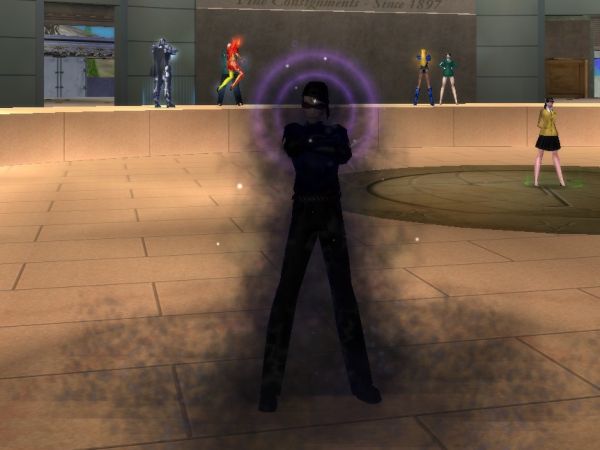
Myrkemann, my dark/dark tanker in City of Heroes. He is here to represent my dark side, although the Norwegian word Myrkemann (or Mørkemann) actually means someone who tries to discourage levity, entertainment and sensual pleasures in society. I am not sure how well that fits with me…

It seems that my recent commenter has returned, and has a reasonable question regarding my entry two days ago, “STILL evil inside“. He asks: “Why would someone like you get these dreams?” which was what I had already tried to say, namely that I am still evil inside after all these years. However, there is a very similar question that may throw more light on the issue, as it were: Why NOW?

I remember a time in my life where these dreams were particularly common and intense. This was in my twenties, and it was a time when I was trying to become a better person, make progress and become holy. I may have a more realistic view now of just what an immense undertaking that is, even with divine intervention on one’s side. But I’ve still been somewhat active lately, reading books of the Truth and thinking about the Truth and to some extent writing about it as well. I have been concerned about blessing others, doing my work with the purpose of giving back love to the world and so on.

There is a saying: “The brighter the light, the darker the shadow.” In natural life this is a bit of an illusion, as the shadow is only darker in contrast. But psychologically, it is quite real. There are forces that are balanced to keep us in our place. This is perfectly natural: At the very least, it generally keeps us from going insane on a whim. Insanity, like sanctification, takes time and immense dedication and energy that already moves in that particular direction. You cannot just sit down and think, “Hey, wouldn’t it be cool to believe that I was from another planet and had awesome powers to help people” and the next day you start claiming to be Kal-El from Krypton. No, a lot of work happens underground before the madness breaks out, and we cannot expect it to go any faster upward than downward.

“Indeed, to the General Law someone who ‘moves’ looks like a fugitive from collective work, and nature takes immediate steps – a whole series of appropriate measures – to make the rebel fall back into line” writes Boris Mouravieff. And not much later, he says: “But here again, he must be particularly vigilant not to spend the reserve as fast as he accumulates it.” Recall Ryuho Okawa’s rule about the iceberg? At least 80% under the surface? I suspect I have fallen foul of this to some degree. And so when the shape of things to come start to rise up above the surface, a corresponding shift in the center of gravity moves below water. “For every action, there is an equal and opposite reaction” as a better man than I said.

This is not something new to me. It happens with alarming regularity. Well, when I make any changes in my life at least. Looking at my bookshelf, there has been some very visible changes: Something like my own weight in fantasy books have been replaced with a modest number of spiritual books. If that were to reflect the status of my heart, things would get hairy indeed. It is not quite that dramatic, but I can see how it would trigger a re-balancing.

I have from the start – or so it seems to me – in this journal striven to draw my own picture in both light and dark colors, because this is the nature of a human and I am still one. I am relentlessly reminded of this whenever I begin to wonder a little, since I seem to have so little in common with each of you. A little here, a little there, but it all adds up. But it may be too little for any one to find much reason to linger. If you come to read about my Sims, chances are you shrink back in horror from both my religious psychology and my nightmares (or especially the nightmares I am in my dreams). Conversely, if you come here for your religious edification, you will no doubt take offense before the week is over. And so on it goes. But at least I try to be “fair and balanced”, as they say in America, about myself.

Not bored to death yet!

Despite my boring pictures, I have not been bored to death yet. Actually, the headline of that article is misleading.
“BORED TO DEATH? IT COULD HAPPEN
The more bored you are, the more likely you are to die early, according to researchers.”
That is what it says, but as we all know, correlation is not causation. Well, actually it usually means there is something causing something, but not necessarily directly.  In this case, boredom and early death both come from a high Optimum Stimulation level.  I know I wrote about this some years ago, but you may have slept through it, so a short summary:

Some people are born with a high Optimum Stimulation Level.  This means they feel best and function best when there is much excitement.  As babies they laugh when they hear sudden loud sounds or see bright flashes of light. As adults they tend to be curious and try new things, take chances, drink, smoke, drive fast without seat belts (sometimes while smoking and drinking, depending on whether they are also stupid, and this trait is not dependent on intelligence so some of them are). They also tend to avoid stable marriages and vote liberal.  And they tend to die early, probably from some other cause than voting liberal.

Conversely, there are people like me.  As babies they cry if there are sudden sounds or lights.  As schoolkids they have their nose in a book.  As adults they tend to follow the laws, avoid dark streets, pray, and vote conservative if at all. They tend to die old and reasonably content with their life.  They also make for lousy novels, and probably so-so blogs as well…

Over the weekend, I have moved all but a few of my DVDs to two external hard disks (in the hope that they won’t both explode at the same time, but I do intend to get a third just in case).  Each of these black boxes take up the space of perhaps 4 DVD boxes, and easily takes a hundred DVDs.  So I should free up another couple shelves.

As a side effect of this, I have watched some of my old favorite anime.  As a result of this again, I have started the groundwork of yet another novel. Hopefully it won’t feature people like me.  And hopefully you aren’t bored to death yet!